‘De-sinicization’ won’t create Australia’s industrial capabilities: Global Times editorial
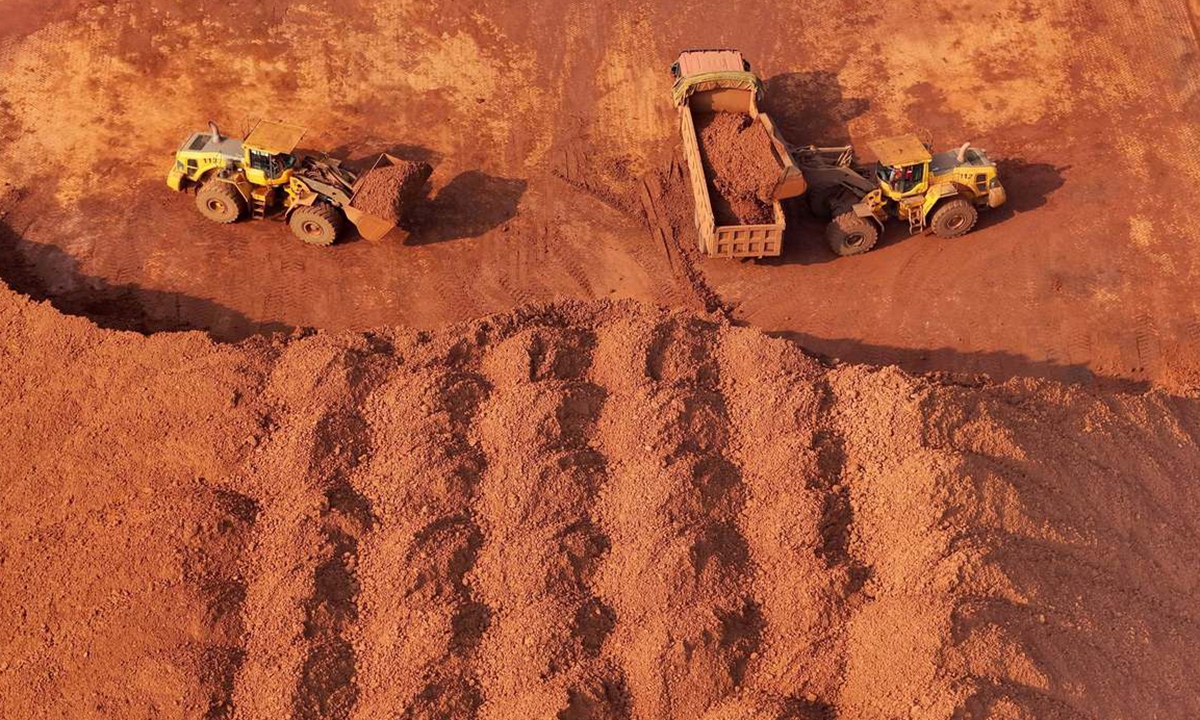
Rare earth resources Photo: VCG
The Australian government recently issued orders to force investors with links to China to sell off their stakes in Northern Minerals, an Australian rare-earths company, sending a clear sign that Canberra is accelerating "de-sinicization" in the critical minerals sector. While politicians continue to hype up "national security" and "critical minerals risks," an article published by Australian news website The Conversation pointedly stated that "blocking Chinese investment won't automatically create Australia's industrial capability." In many ways, this serves as a lesson for the Australian government. What Canberra lacks most today is neither resources nor capital, but rationality in facing reality.
In recent years, Canberra's attitude toward China has reflected a certain contradiction: politically aligning with certain major powers while remaining economically dependent on China; verbally welcoming cooperation while continuously imposing restrictions in practice.
On the one hand, Australia keeps erecting barriers against China in areas such as critical minerals, technological investment, and security issues, while on the other hand, it still expects China to continue buying its iron ore, natural gas, and agricultural products.
The most critical point made by The Conversation article is that it exposes a major illusion within Australian politics: Some Australian politicians genuinely seem to believe that once Chinese capital is pushed out, Australia will somehow automatically create industrial capacity, build rare earths processing chains, and even transform itself into a renewable energy powerhouse. This logic is as ridiculous as a child's fantasy. Industrial systems are not built through slogans, nor can they be created through so-called "political correctness."
Australia's real problem has never been "too much" Chinese investment, but rather its weak manufacturing capabilities and insufficient technological accumulation, while attempting to remain at the high end of the global industrial chain.
A country blessed with abundant natural resources has suddenly realized that the world has changed. China is no longer merely a customer buying ore; it has achieved industrial upgrading, developed systemic advantages in new energy, the digital economy, and advanced manufacturing, and has become a participator in shaping global industrial rules. This has made some Western countries, including Australia, deeply uncomfortable. As China gains advantages in more high-end manufacturing sectors, they have quietly replaced "free market" with "national security" and "open investment" with "de-risking," even though they understand these are merely excuses for protectionism.
In recent years, some Australian politicians seem to have developed a conditioned reflex: Whenever China is involved, suspicion comes first; whenever China invests, restrictions follow; whenever Chinese companies enter key industries, they are immediately labeled a "security risk." Much of this carries the nature of political performance. The problem is that many of Australia's so-called "critical minerals strategies" are themselves built on the Chinese market, Chinese technology, and Chinese industrial supply chains. Without China, many projects might not even make commercial sense.
The reality is stark: Australia has minerals, but not a complete industrial chain; it has resources, but lacks sufficient processing capacity; it has geopolitical ambitions, but lacks the industrial foundation to support them. Yet some politicians in Canberra insist on turning China, the country with the strongest basis for complementary cooperation and mutual benefit, into a "strategic competitor."
For a country whose exports to China consistently account for around one-third of its total exports, "how to deal with China" is an unavoidable question. What is puzzling is that Canberra keeps repeating the same mistakes. Since the beginning of this year, from the controversy over the Darwin Port lease to the Australia-New Zealand Foreign and Defence Ministerial Consultations making unwarranted accusations regarding China's internal affairs, familiar shadows undermining China-Australia mutual trust have once again begun hovering over Canberra.
The argument by former Australian prime minister Paul Keating that the greatest tragedy for a middle power is living within the strategic narrative of great powers is still relevant today.
The act of divesting Chinese capital from Northern Minerals, while ostensibly under the banner of "independent capability," essentially positions Australia as a player that excludes China in the restructuring process of key production and supply chains in the West. This positioning has largely constrained Australia's relationship with China. The cost of serving external forces at the expense of one's own interests inevitably sacrifices strategic autonomy and economic benefits.
Today's world is no longer one where rules are unilaterally set by the West. The Global South is rising, industrial power is shifting eastward, and the international order is being reshaped. Any efforts to suppress China through "small circles" or "decoupling and cutting chains" are self-damaging and destined to be futile. If Australia continues to cling to the old script of "relying on the US for security, relying on China for development, while conveniently containing China," it will ultimately realize that the times have changed, while it remains stuck in the "previous chapter."
RELATED ARTICLES