Australia should effectively safeguard legitimate rights, interests of Chinese citizens in its country: Global Times editorial
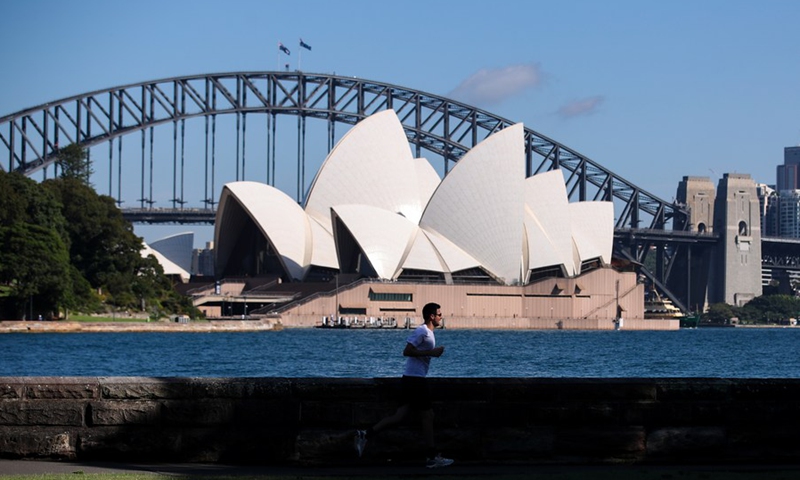
A man runs in a park opposite the Sydney Opera House in Sydney, Australia, on Feb. 26, 2021.(Photo: Xinhua)
Recently, there have been a series of violent incidents targeting Chinese tourists and students in Australia. The latest incident took place on August 6 in a shopping mall in Hobart, Tasmania, where a Chinese student was brutally assaulted by several minors, sustaining serious injuries and being hospitalized. Fortunately, the victim is now out of a life-threatening condition. According to eyewitnesses, the attackers used overtly racist and discriminatory language. The Chinese Consulate-General in Melbourne has urged the Australian side to severely punish the perpetrators and to take concrete measures to safeguard the personal safety of Chinese citizens.If the encounter between one student and a group of "Australian troublemakers" might carry a certain degree of chance, then the fact that several Chinese nationals in Australia have successively suffered attacks in the first half of this year cannot be simply dismissed as a "coincidence."
Just over half a month ago, two Chinese tourists were assaulted by several teenagers in Hobart on the very night they arrived. In May of this year, a Chinese couple in Sydney was surrounded and beaten by several teenagers. In addition, verbal harassment, abuse, and robberies targeting Chinese students and tourists have occurred repeatedly. This raises the question: What kind of social climate emboldens these youths to direct violence at unfamiliar Chinese faces?
The problem clearly cannot be attributed solely to "immature minors." Local scholars and official data indicate that there has been no so-called "surge" in youth crime nationwide in Australia. The recent spate of concentrated assaults against Chinese nationals appears more like a combination of localized "selective targeting" and "copycat violence," compounded by racial hatred. Notably, the violent incidents in Hobart have received virtually no coverage from the national media in Australia, except for one or two local outlets - standing in sharp contrast to their "enthusiasm" for stories about "Chinese spies" or the "China threat." This disparity shows that the repeated assaults on Chinese nationals should not be regarded as isolated public security cases; the reflection must reach into deeper layers of Australia's social and political context.
To some extent, these criminal incidents are the unfortunate consequences of the radicalization of Australia's China policy over the past years. Under previous governments, the so-called "China threat" was baselessly fabricated and endlessly amplified; economic cooperation between China and Australia was maliciously portrayed as "political infiltration," and normal cultural exchanges were smeared as "espionage activities." Some news outlets and think-tanks, driven by ideological bias or political manipulation, churned out negative information about China in bulk, demonizing and stigmatizing the country. When an entire society is long immersed in a "guard against China" narrative, ordinary citizens, especially young people whose minds are still developing, can easily translate this extreme political confrontation into baseless hostility toward individual Chinese people. The appearance of anti-China posters with racist overtones on Australian university campuses a few years ago can hardly be said to be unrelated to the multiple serious incidents happening today.
Over the past two years, China-Australia relations have gradually "halted the decline and stabilized" through high-level engagement and economic and trade recovery. Economically, China is Australia's largest trading partner, with two-way trade in the 2023-24 fiscal year reaching about A$325 billion. Australia's service exports have rebounded significantly with the return of Chinese international students and tourists. During his visit to China last month, Australian Prime Minister Anthony Albanese made it clear that Australia values its relations with China and is willing to strengthen people-to-people exchanges in tourism, education and sports to deepen mutual understanding.
Therefore, whether the individual safety as well as legitimate rights and interests of Chinese citizens in Australia can be effectively safeguarded will serve as a litmus test for assessing the Australian side's sincerity in improving relations with China. This includes not only punishing the perpetrators in accordance with the law and ensuring fairness for the victims, but also fundamentally promoting the establishment of a healthy cognitive environment regarding China.
Creating a safe social environment is crucial for Australia's national image; blindly tolerating the growth of anti-China sentiment ultimately harms Australia's tourism and education sectors. The Australian side must recognize that stabilizing and improving relations with China are systemic undertakings that require both institutional robustness and narrative restraint to work in tandem.
For example, this includes restraining extreme anti-China rhetoric from high-ranking officials and actively clarifying facts in public settings; as well as reinforcing deterrence against criminal behavior at the legislative and law enforcement levels and sending a clear signal of zero tolerance for racism; and distancing from think tanks that "profit from anti-China narratives," among other actions. As long as the deliberately constructed lens that tarnishes China is removed, the development of friendly relations between China and Australia will naturally reveal its true and deserving form.
This also shows that for some people, it seems "easy" to disrupt the interactions between the two countries, while restoring mutual trust may require a considerable amount of time. A series of malicious incidents also reminds us that both countries need to engage in broader and deeper bilateral exchanges to eliminate hostility and enhance mutual trust. China has implemented visa-free measures for Australian citizens visiting for short stays. Hopefully, more Australians, especially the younger generation, will have the opportunity to experience a real, comprehensive, and multifaceted China, as this is the fundamental way to eliminate misunderstandings and promote friendship.
RELATED ARTICLES