BUSINESS / PRESS RELEASE
Land-sea synergy keeps Ningbo’s Maritime Silk Road spirit alive
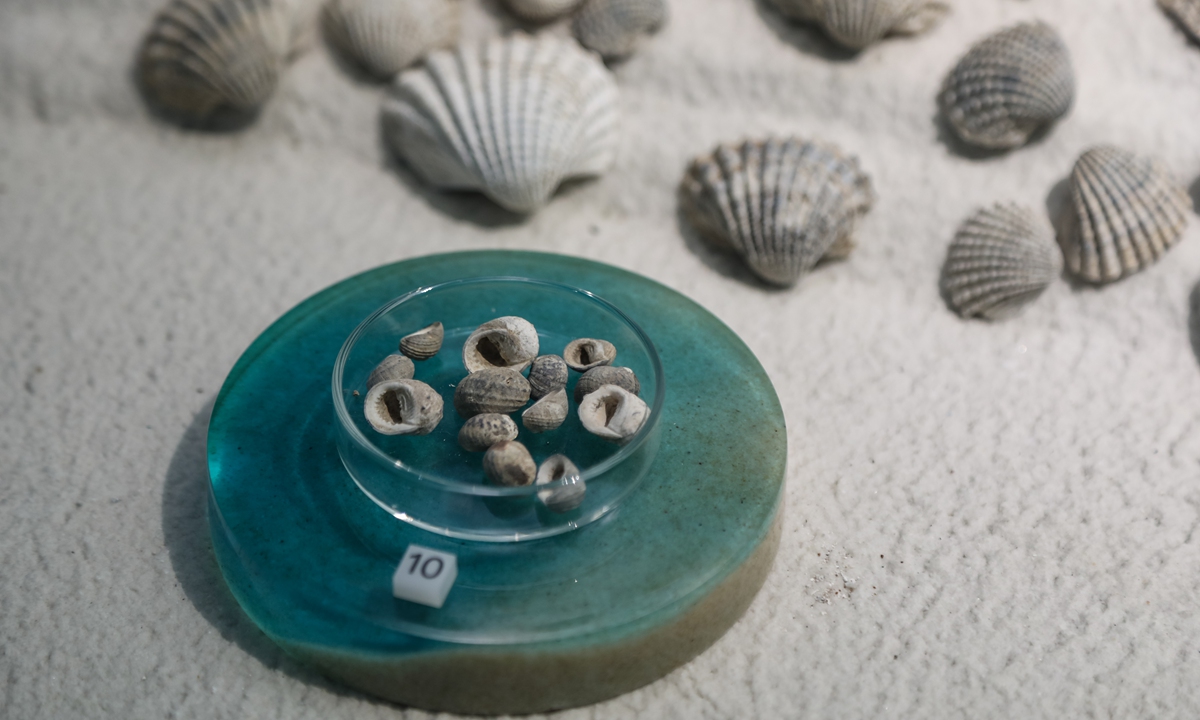
Relics unearthed from the Jingtoushan site in Ningbo, Zhejiang Province Photo: VCG
Located in Ningbo, East China's Zhejiang Province, the local archaeological sites of Jingtoushan and Hemudu are actually of global importance since they are examples for exploring how humans took the first steps to farm the land and draw upon the bounty of the sea. Two quests are bound to the development of human civilization regardless of cultural or geographical differences.Known as the "grandfather" of the Hemudu site, the Jingtoushan site boasts a history of over 8,000 years. Stepping into the site, one will find the ground is covered with the remains of shells and snails. The site in Ningbo is also the deepest buried and earliest shell midden site along China's coastline.
Over the years, archaeologists have uncovered evidence at this site of early humans consuming shellfish, crabs and more, signs that the people of Ningbo were the very "first to eat crabs," a phrase in Chinese that represents someone who has courage and wisdom to venture into the unknown.
Meanwhile, a well-preserved wooden paddle, later confirmed to be the earliest known boat oar in the world used for nearshore navigation, was also discovered at the Jingtoushan site. These remains reveal a local culture that evolved from marine roots, demonstrating the wisdom of maritime adaptation that has long been embedded in this region.
"Even on a global scale, the maritime adaptation and resource use seen at Jingtoushan were exceptional for the Middle Neolithic. These findings and their stories belong not just to China, but to all humankind," said Wang Wei, a distinguished archaeologist.
Yet Ningbo's story of civilization is not defined by the sea alone. Instead, it tells a more nuanced story of a region flourishing by the sea, yet thriving on agriculture. This story can be seen clearly when examining the Hemudu site a bit closer.
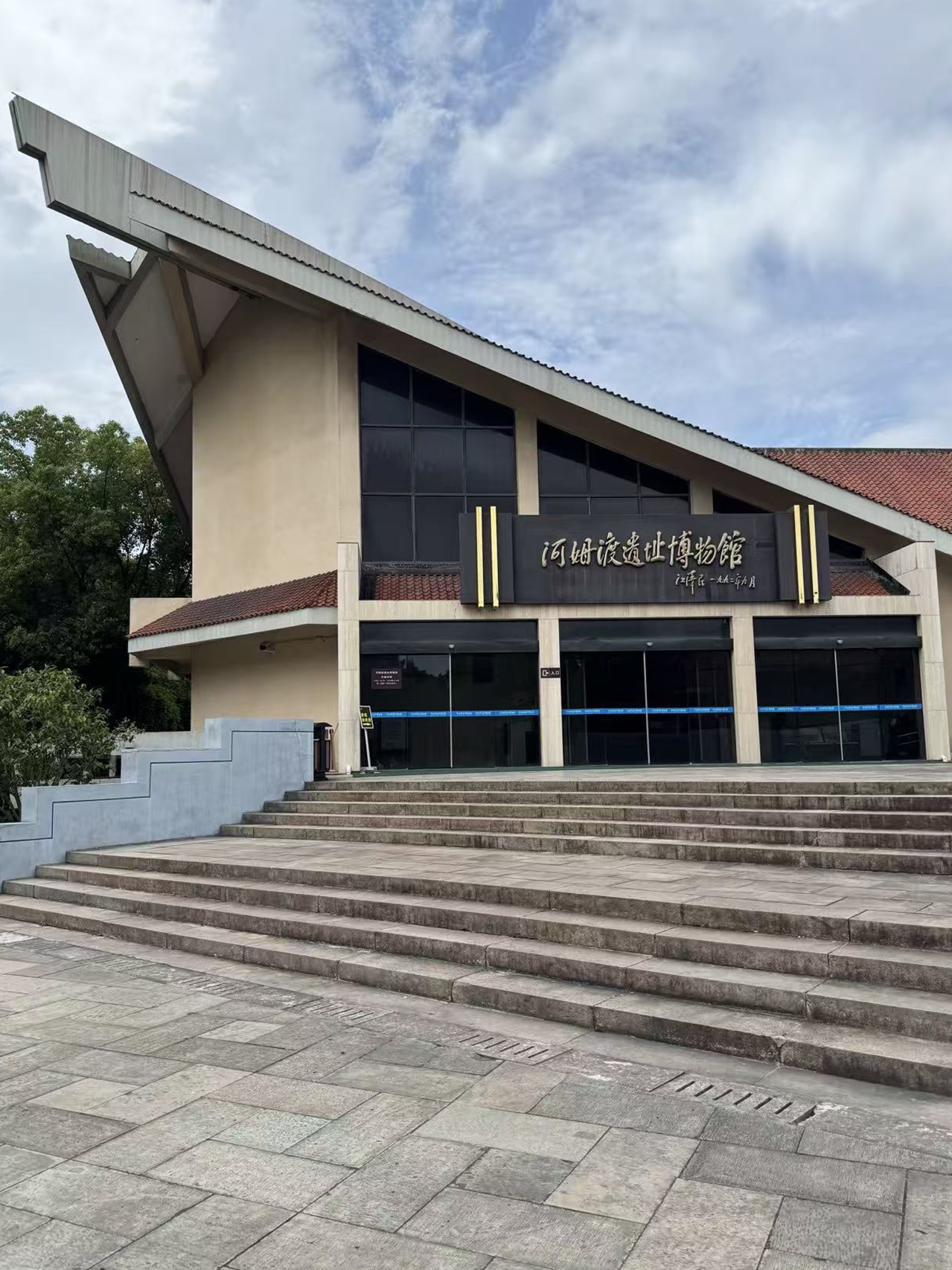
The Hemudu Site Museum in Ningbo, Zhejiang Province Photo: Li Yuche/GT
Dating back to around 7,000 years ago, the Hemudu site represents a cornerstone of prehistoric agriculture in southern China. Ye Kai, director of the Hemudu Museum, told the Global Times that on-site excavations have unearthed remains of rice grains and hundreds of gusi (bone ploughshare). Among these discoveries, the carbonized rice grains still radiated a golden glow when first excavated. These carbonized rice grains are among the oldest cultivated rice specimens ever discovered in the world.These findings not only confirm the "Chinese origins" of rice agriculture, but also reveal that Ningbo's civilization developed as a composite foundation in which maritime and agricultural traditions reinforced one another. This inclusive cultural bedrock finds clear expression in Ningbo's distinctive role as a "living fossil" of the Ancient Maritime Silk Road.
Unlike other nodes along the Maritime Silk Road such as Quanzhou in Fujian Province and Guangzhou in Guangdong Province, the prosperity of Ningbo's maritime silk culture did not rely "too much on an adventurous spirit." "Instead, it was driven by an agricultural hinterland-driven trade, rather than the Quanzhou-style ocean-voyaging adventure-driven model," Chen Feilong, an expert of the Yangtze River Delta Urban Economic Coordination Council and a port specialist, told the Global Times.
Such a drive enabled Ningbo to exchange the region's specialties such as agricultural products, porcelain, silk, and tea along the Maritime Silk Road, establishing itself as a center for cultural exchange in Northeast Asia. Beyond goods, architectural techniques and Buddhist culture also radiated from Ningbo to other regions through maritime routes.
"What's more, Ningbo's Maritime Silk Road culture has shown remarkable continuity since it has never been broken from the Tang Dynasty (618-907) till today," Chen remarked.
Today, this "unbroken" Silk Road exchange has evolved into new paradigms in Ningbo, telling the story of the 21st Century Maritime Silk Road.
With the Ningbo-Zhoushan Port as its gateway, manufactured products from the Yangtze River Delta are exported globally. Meanwhile, the traditional "land-sea symbiosis" has transformed into a maritime food trade. While exporting cold-chain fishery and grain products, Ningbo has also emerged as a magnet for foreign investors.
Andreas Thorud, a Norwegian salmon farmer, is a case in point. Drawn by Ningbo's pro-business environment, which is backed by strong government support, he not only set up his own operation in the city, but also helped forge partnerships between more Norwegian companies and Ningbo.
"Then as now, Ningbo's Maritime Silk Road spirit has never been about aggressive plunder. Rather, it champions mutually beneficial, equal, and inclusive interactions," Chen remarked.
RELATED ARTICLES