ARTS / CULTURE & LEISURE
Chinese artisan weaves Zhuang brocade into World Cup
When football meets heritage
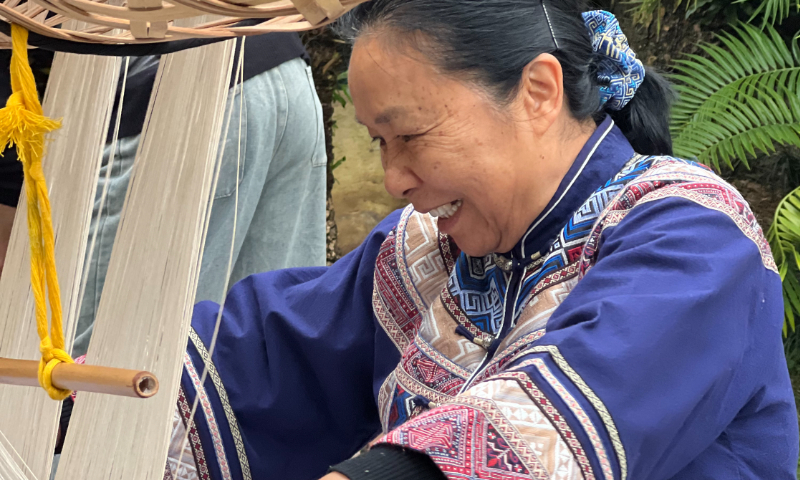
Tan Xiangguang weaves Zhuang brocade in her hometown in the Guangxi Zhuang Autonomous Region. Photos: Courtesy of Tan Xiangguang
Incorporating elements of Guangxi's Zhuang brocade into official licensed products for this year's FIFA World Cup, local artisans have recently been busy creating a range of Zhuang brocade-inspired souvenirs, including footballs, jerseys, caps, mouse pads and figurines at a studio in South China's Guangxi Zhuang Autonomous Region.
The Zhuang brocade-inspired cultural and creative products made by Tan Xiangguang's team have been selected as one of the official licensed products of the World Cup in China, marking the first time that the country's national intangible cultural heritage (ICH) has been incorporated into a top-tier global sporting event.
The collaboration with the World Cup represents an important opportunity for the growth of Zhuang brocade weaving craftsmanship, Tan Xiangguang, a Chinese artisan of the traditional handicraft of Zhuang brocade and an ICH inheritor of its weaving technique, told the Global Times.
Partnering with a global sporting event is also a valuable test and refinement of our skills, Tan noted.
Zhuang brocade is recognized as one of "China's four most famous brocades," together with the Shu brocade, Song brocade and Yun brocade.
Renowned for its vibrant colors, exquisite patterns, and superb hand-weaving craftsmanship, the weaving tradition dates back to the Han Dynasty (206BC-AD220). Several fragments of orange-red geometric-patterned brocade unearthed in a Han Dynasty tomb in Guangxi provide concrete evidence that this textile craft has flourished in southern China for more than 2,000 years.
In 2006, the Zhuang brocade weaving technique was included in the first national ICH list.
Other ICH-inspired products selected as official licensed World Cup merchandise feature traditional crafts such as boxwood carving from East China's Zhejiang Province, Ru porcelain firing technique from Central China's Henan Province and hemp weaving from Northwest China's Ningxia Hui Autonomous Region.
The 2026 World Cup, which will be co-hosted by the US, Canada and Mexico, is scheduled to kick off on June 11 and will be the first edition featuring 48 teams.
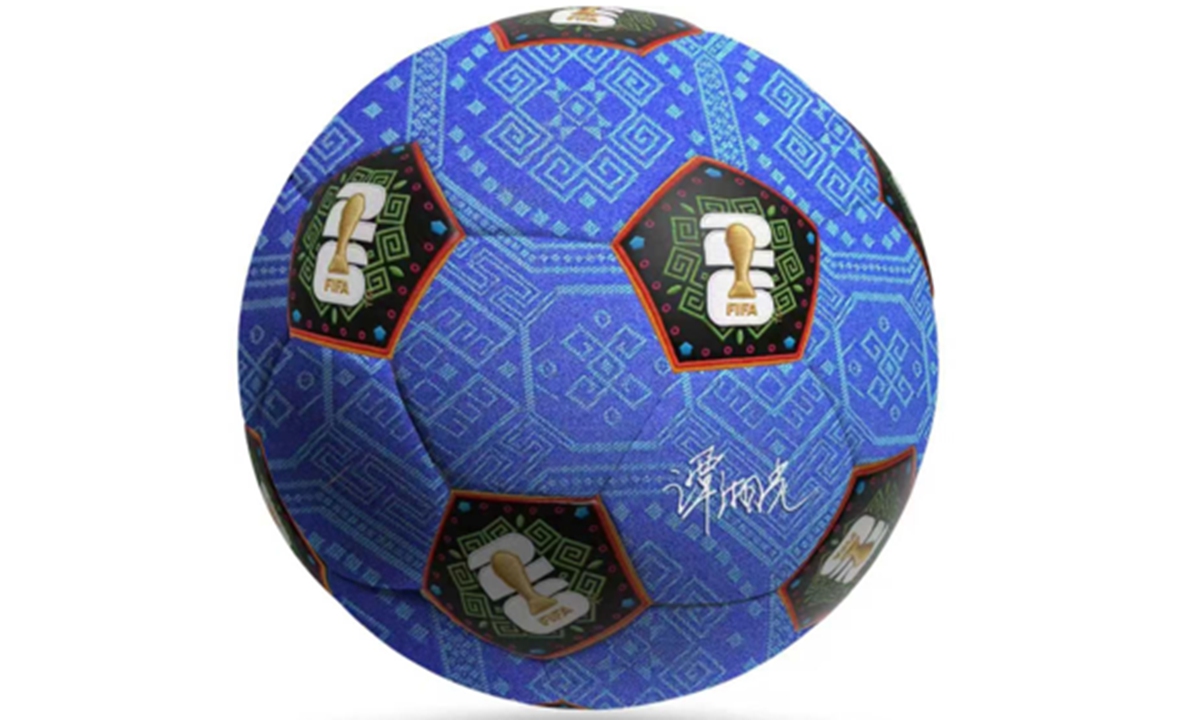
A Zhuang brocade football designed and autographed by Tan Xiangguang
Renewed spirit
One of the newly developed products combines a traditional Zhuang ethnic mascot with football.
The traditional mascot is modeled after a Zhuang mother carrying the seed of the sun's fire. In ancient Zhuang legends, she is a maternal figure who protects children.
Now, she has been reimagined as a Zhuang mother holding a football. The work symbolizes wrapping World Cup dreams in the warmth of Zhuang brocade, conveying a message of strength that is both open-hearted and gentle, said Tan.
The football in the doll's arms is crafted from 24 panels of Zhuang brocade featuring traditional python-and-dragon motifs. Black, the most understated and enduring color in traditional Zhuang attire, forms the base of the design, while the vibrant multicolored patterns symbolize the coming together of people of different nationalities and skin tones on the football pitch, said the 71-year-old master, who started learning brocade weaving at the age of 15.
Tan's team repeatedly refined the colors, patterns, and production techniques to preserve the distinctive characteristics of Zhuang brocade, such as its intricate warp-and-weft weaving and elaborate motifs, while ensuring that the designs align with modern aesthetics and the spirit of sports.
Another design Tan is particularly proud of is the Zhuang brocade football.
Zhuang brocade is a woven textile, while a football is smooth and elastic. If the patterns were printed directly onto the ball, they would not reflect the essence of the weaving craftsmanship. In addition, integrating the embroidery of the World Cup logo required repeated experimentation with color schemes and pattern selections, Tan said.
"We went through countless rounds of refinement before finally creating our Zhuang brocade-inspired cotton football," Tan noted. "Perhaps this is what it means to carry on a traditional craft: not fearing challenges, striving for perfection, and paying close attention to every detail."
She noted that every ICH inheritor should understand that preserving a craft does not mean keeping it unchanged. It means bringing it to life, allowing it to evolve and reach a broader stage with a renewed spirit.
Although the products will not go on sale until June, Tan's team has received over 5,000 orders from around the world, the team said on Wednesday.
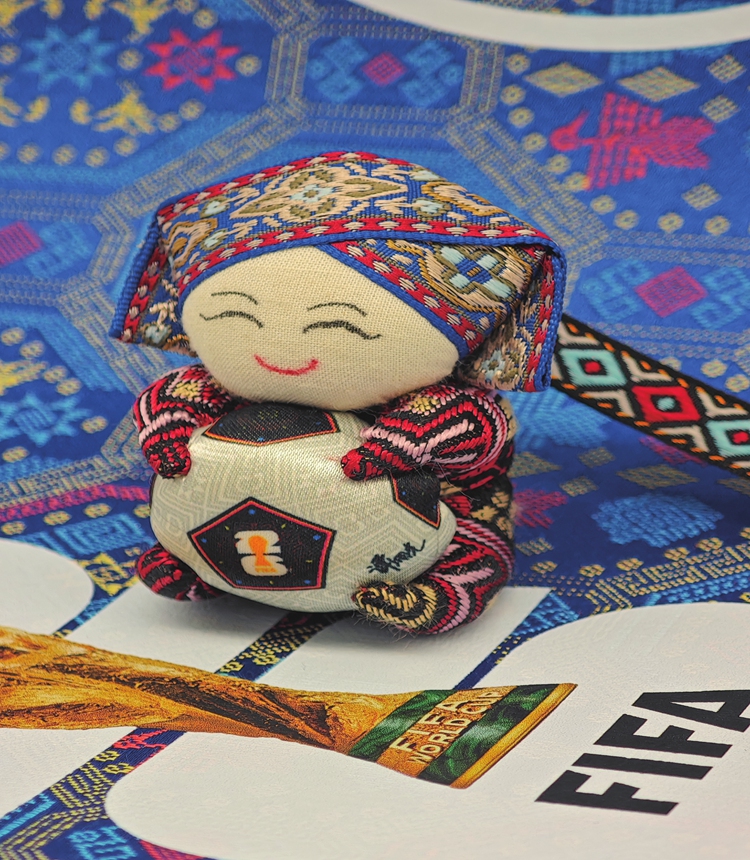
A World Cup licensed product inspired by a traditional Zhuang ethnic mascot, designed by Tan Xiangguang
Everyday useIn ancient times, Zhuang brocade was a precious textile presented as tribute and reserved for nobles and high-ranking officials. A skilled weaver could produce only about 10 centimeters of brocade in one day. Today, with the assistance of modern machinery, as much as 20 meters can be woven in a single day, according to Tan.
What was once a tribute item reserved for the elite has now been transformed into clothing and household products for everyday use. That, in Tan's view, is the best form of preserving and carrying forward this heritage.
The national standard for Zhuang brocade officially came into effect in May 2025. As China's first national standard for a textile-related ICH item of an ethnic minority group, it lays the groundwork for the digital preservation and industrial development of Zhuang brocade, while promoting the transition of this traditional craft from oral and hands-on transmission to a more scientific and standardized form of inheritance, the local Guangxi Daily reported.
Wu Weifeng, former curator of the Museum of Guangxi Zhuang Autonomous Region, told the Chinanews.com that Zhuang brocade reflects the beauty of cultural exchanges and integration among China's diverse ethnic groups. It features distinctive craftsmanship and patterns, enabling cross-cultural resonance between China and the rest of the world.
Wu said Zhuang brocade is being continuously revitalized, gradually integrating into modern lifestyles and becoming fashionable both in China and abroad.
Tan hoped this collection of Zhuang brocade-inspired products, which combines cultural significance with practical value, will allow football fans to experience the unique charm of Guangxi's traditional culture while encouraging more young people to appreciate and carry forward the craft.
RELATED ARTICLES