ARTS / CULTURE & LEISURE
After 18 years of closure, Beijing’s ‘underground city’ reopens as a historic urban space
The capital city’s ‘hidden chapter’
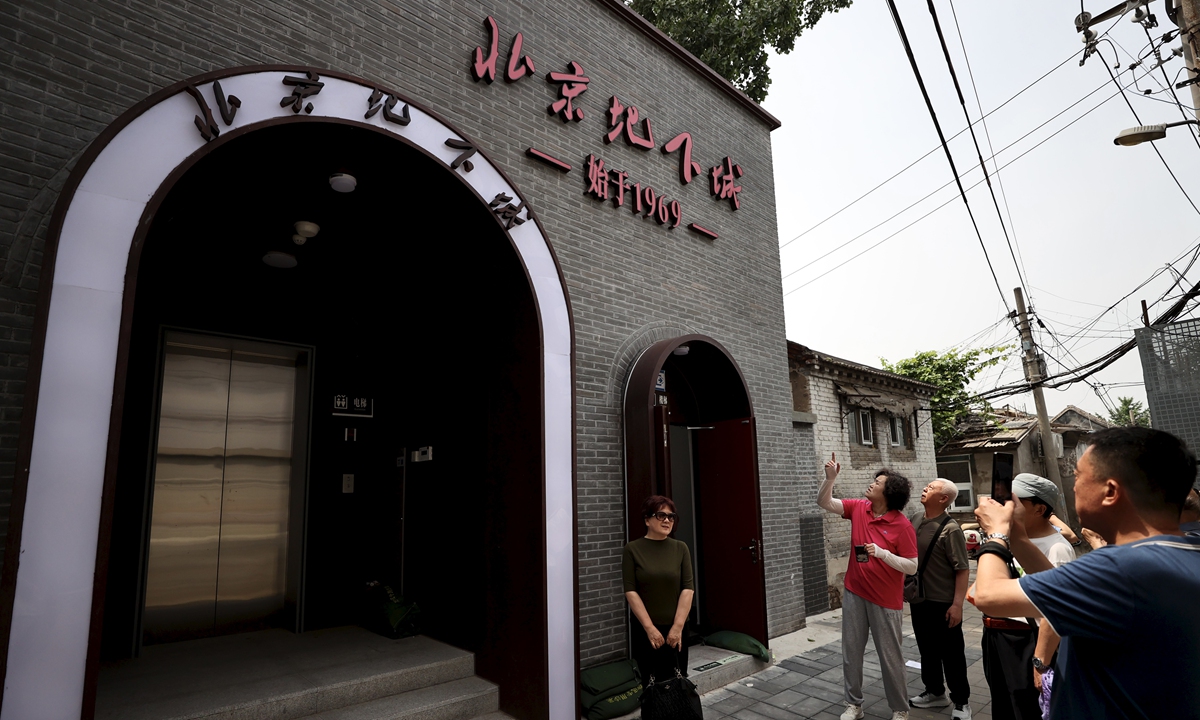
A visitor poses for photos in front of the entrance of the Beijing Underground City on April 19, 2026. Photos: VCG
In Tongle Hutong, Beijing's Dongcheng district, the entrance to the Beijing Underground City is easy to miss at first glance.A small doorway leads down to a concrete staircase, and the noise from the streets begins to fade step by step. Some visitors pause briefly at the entrance to check their reservation, while others lower their voices almost instinctively as they walk inside.
Along the corridor walls, faded surfaces and repaired marks line side by side. Some visitors lift their phones to film the narrowing passage ahead, while others continue walking in silence, adjusting to a space that feels increasingly separated from the streets above.
Built in 1969 as an early civil air defense project, the site was closed in 2008 for repairs and renovations.
After 18 years of closure, this underground space has now been transformed into the Beijing Civil Air Defense History Museum and opened to the public in May with free admission, the Beijing Daily reported.
The underground exhibition area covers about 2,500 square meters and preserves the original layout and facilities of the air-raid shelter, making it one of Beijing's best-preserved early tunnel-style civil defense sites, according to the Beijing Daily.
For museum representative Yu Hao, what sets it apart from a conventional exhibition space is that it is not simply a display of history, but it is the history itself.
"Ordinary museums display history, but the [Beijing] Underground City is part of history itself," Yu told the Global Times. "It is authentic, original, and cannot be replicated."
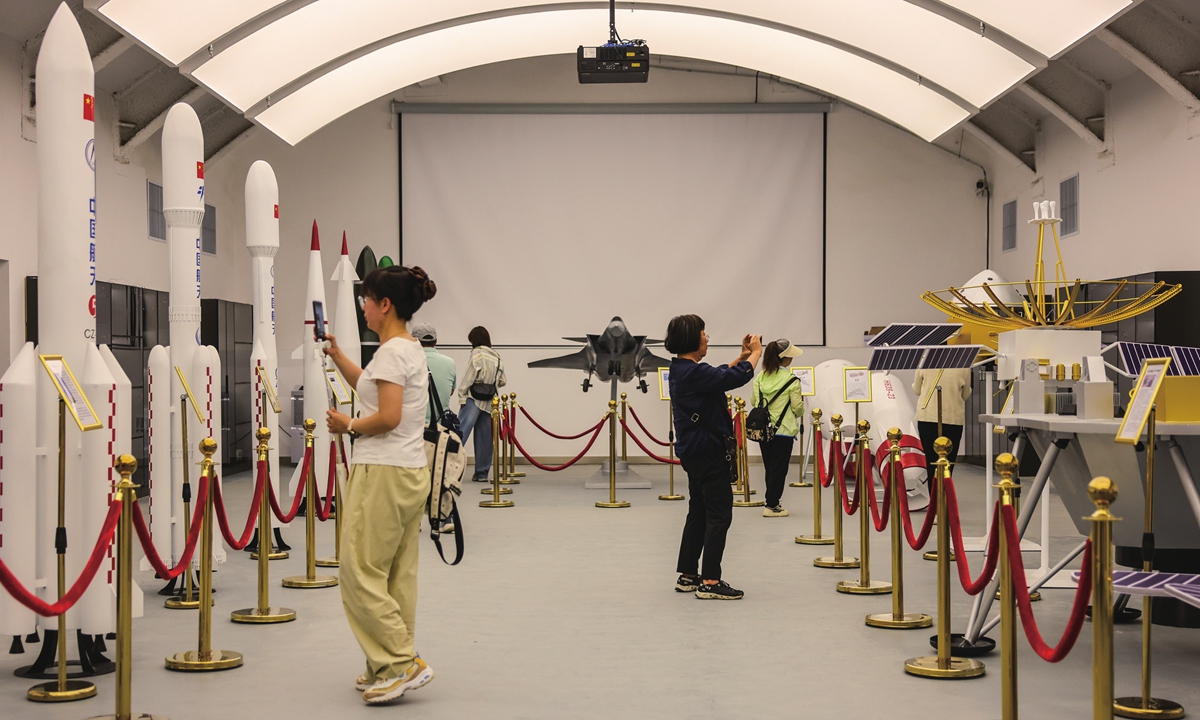
Visitors view models of aerospace equipment at the Beijing Underground City on May 13, 2026. Photos: VCG
Layers of historyNarrow, low-ceilinged corridors, a winding underground layout, and preserved loudspeakers and everyday objects make the visit to the underground place feel less like entering a modern exhibition space and more like stepping into a section of the city's live history.
In contrast to many contemporary museums, what makes the Beijing Underground City particularly interesting is that it has not been fully transformed into a polished, conventional tourist attraction.
Beijing resident Zhou Ning told the Global Times that he booked the visit out of curiosity, but his experience underground turned out to be very different from what he had expected.
"I always used to think places like this were far removed from the present, something more like a page in a history textbook," Zhou said. "But when you actually walk through it, you suddenly realize it has been right here under Beijing all along."
Zhou also noticed that many visitors instinctively slow down once they enter the underground space.
"Above ground, it's still a lively tourist area, and nearby is the Qianmen commercial area. But down here it suddenly becomes very quiet," he said. "Especially when you see the old slogans and historical photos, there's a very strong sense of layered history."
Like Zhou, many Beijing residents are already familiar with the name "Beijing Underground City." After 1980, the site was once converted into an arts and crafts service center. As the entrance long displayed the sign "Beijing Underground City," local residents gradually began using the name to refer to the surrounding tunnel-style air-raid shelter area, according to the Beijing Daily.
According to Yu, the underground city preserves a complete sense of its era, which makes it a very special collective memory for many older Beijing residents. For younger visitors, entering this real space offers a much more direct understanding of what the city was like at that time.
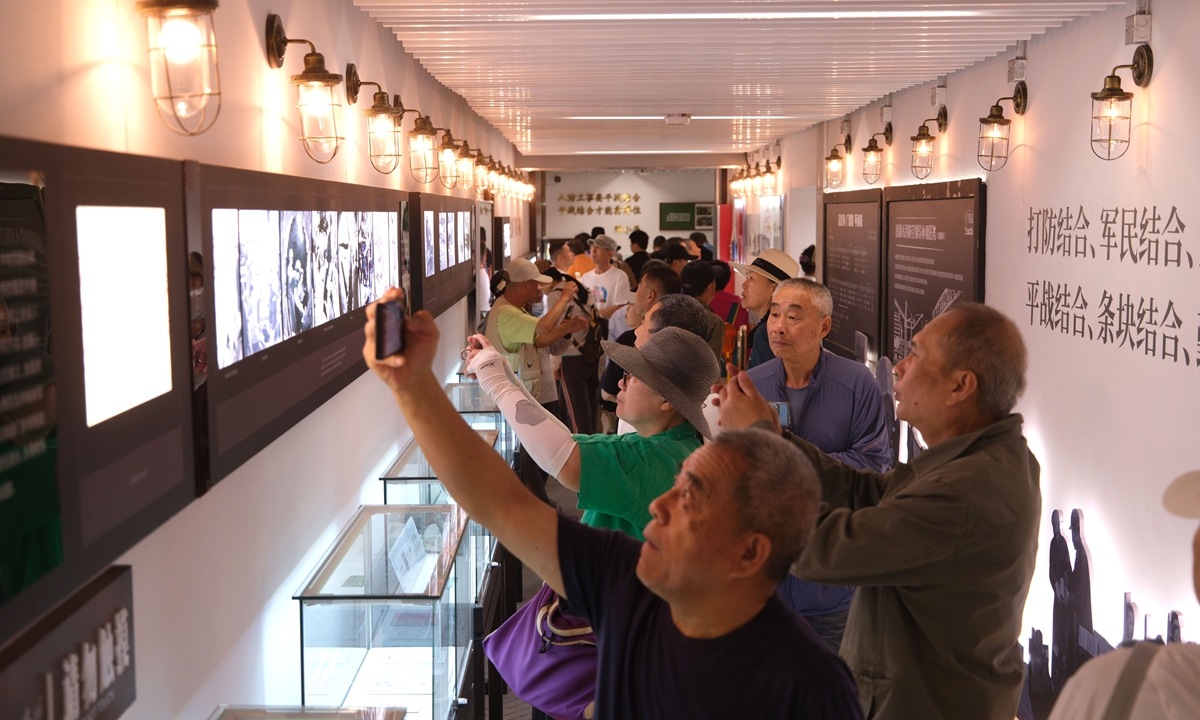
Visitors take photos at the Beijing Underground City on May 14, 2026.
Reopened memoryToday, the exhibition is organized along a clear historical timeline, presenting the development of Beijing's national defense mobilization and civil air defense.
In addition to historical photographs, old newspapers, and everyday artifacts, the exhibition also features models of the J-20 fighter jet (which made its first flight in 2011), Long March rocket series (which began with its first launch in 1970), the return capsule of the Shenzhou spaceship (with the program's first launch in 1999) and a lunar rover (first deployed in 2013), as well as a VR interactive zone. These exhibits allow visitors to directly experience the evolution of China's national defense capabilities, according to media reports.
Yu noted that after the reopening, the proportion of young visitors has exceeded expectations, with young urban visitors and families now making up a large share of attendees.
Yu shared with the Global Times that many young visitors look closely at the old loudspeakers, newspapers, and the original air-raid shelter layouts. "They actually show a strong interest in the city's history and civil air defense history."
What impressed him most, however, were two particular groups of visitors, one young and one old.
"One group consists of older Beijing residents who used to participate in the construction. Many of them dug the underground works with their own hands, shovel by shovel," Yu said. "Returning here brings back powerful emotions."
"The other group is children on the study tours, who interpret that history through a contemporary lens. That intergenerational connection is especially moving," Yu noted.
In Yu's view, the 18-year transformation of the Beijing Underground City also reflects a broader shift in Beijing's approach to urban renewal.
Yu told the Global Times that in the past, it was a closed, confidential space serving wartime preparedness. Today, it has been transformed into a public cultural venue, which also reflects the evolution of the city's renewal philosophy. "Urban renewal is no longer just about demolition and rebuilding, but about revaluing and reactivating existing historical remains."
When visitors finally walk up the stairs to street level, the bustle of the Qianmen commercial area quickly returns. The transition between above ground and below ground takes only a short flight of steps, yet many people pause briefly at the exit, as if adjusting to another layer of time they have just passed through.
RELATED ARTICLES