Ground broken on Guangzhou Aerospace Town as China’s commercial aerospace industry accelerates
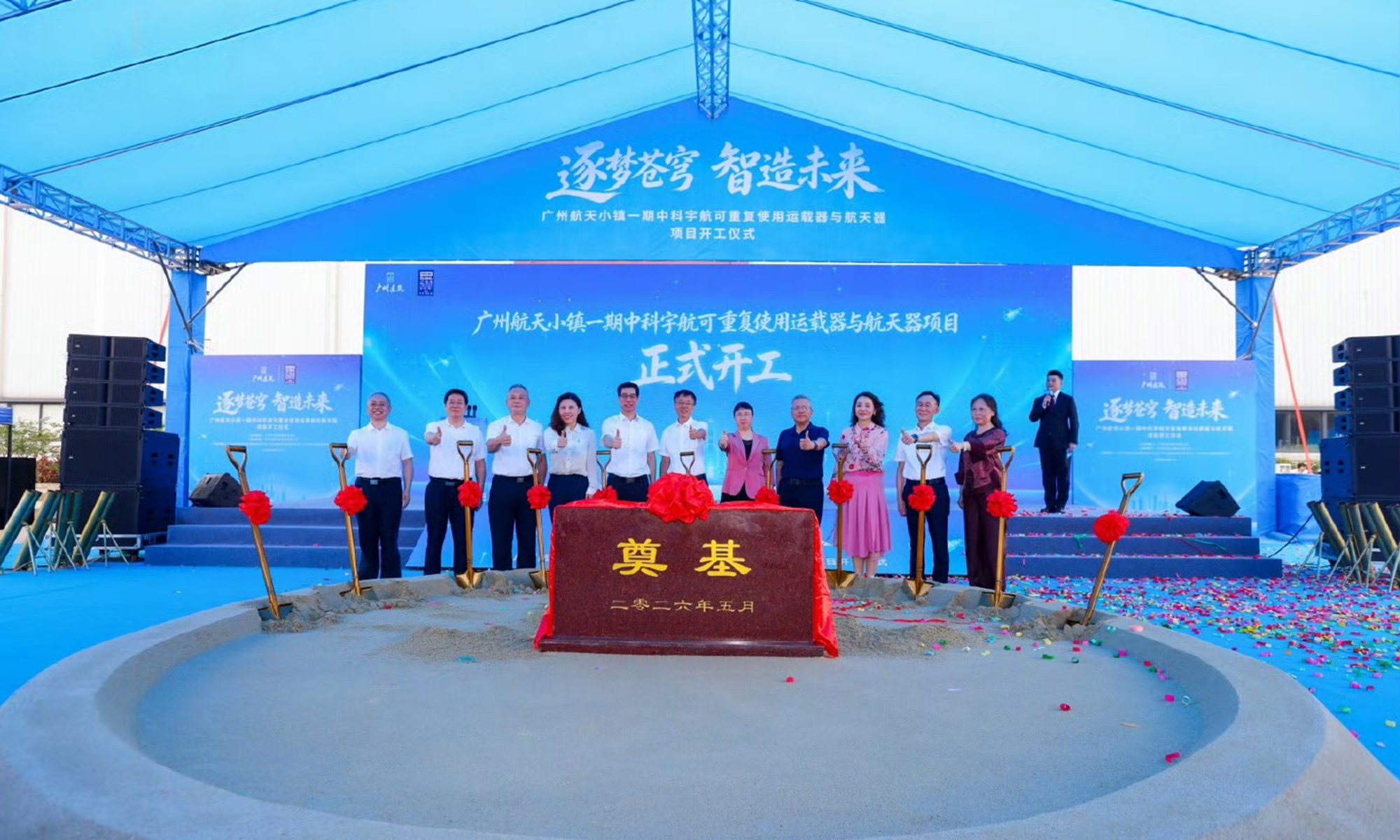
Ground is officially broken on an aerospace industry cluster, the Aerospace Town, in Guangzhou, South China's Guangdong Province on May 28, 2026. Photo: Screenshot from Radio The Greater Bay
Ground was officially broken on an aerospace industry cluster, the Aerospace Town, in Guangzhou, South China's Guangdong Province, on Thursday in the city's Huangpu district, marking another major industrial layout in the Guangdong-Hong Kong-Macao Greater Bay Area and highlighting China's accelerating push toward large-scale development of the commercial aerospace industry, Radio The Greater Bay under China Media Group reported.
The Guangzhou Aerospace Town, covering an area of 574,100 square meters, is situated along the river and adjacent to port facilities, with two 5,000-ton berths supporting the transportation of large aerospace equipment and the development of high-end manufacturing capabilities.
The project will focus on industrial segments including reusable space transportation systems, satellite manufacturing and related applications, aiming to establish a full industrial ecosystem for commercial aerospace while promoting deeper integration among industrial chains, innovation chains and capital chains, said the report.
Chinese commercial aerospace company CAS Space has become one of the first companies to establish operations at the site. The company told the Global Times on Thursday that its senior executives attended the groundbreaking ceremony. CAS Space's reusable launch vehicle, spacecraft and liquid engine manufacturing base, as the first flagship project in Guangzhou Aerospace Town, is scheduled to be completed and put into operation in 2027.
With the rapid growth of satellite constellation projects and various in-orbit infrastructure demands, China will face surging launch mission requirements in the years ahead, Wang Ya'nan, editor-in-chief of Beijing-based Aerospace Knowledge magazine, told the Global Times on Thursday, noting that the country's existing launch sites are unlikely to fully meet future demand, while China's coastal regions possess the basic conditions necessary for developing commercial aerospace industries.
Wang noted that transportation infrastructure and safety conditions are key factors for regions seeking to develop commercial aerospace industries, which can be met by China's Southern coastal cities. At the same time, satellite and rocket manufacturing activities involve large numbers of upstream and downstream enterprises as well as complex manufacturing processes, making industrial clustering beneficial for improving coordination efficiency and supply-chain support capabilities, he added.
The global commercial aerospace industry is developing rapidly. US commercial aerospace giant SpaceX has reportedly launched preparations for a trillion-dollar IPO, with market expectations suggesting it could become the largest listing in history.
Meanwhile, China's commercial aerospace market has remained highly active, with launch volumes ranking second globally. Industry insiders predict that driven by policy support, technological innovation and capital empowerment, China's commercial aerospace sector is entering a period of rapid growth.
Chinese rocket manufacturers are also strengthening their mass-production capabilities. According to the Wuxi Daily, Beijing-based commercial aerospace firm LandSpace's Wuxi production base in East China's Jiangsu Province, officially entered operation on May 27.
The project is China's first rocket mass-production factory based on high-strength stainless steel and intelligent laser manufacturing technologies. With a first-phase investment of 2.3 billion yuan ($339.28 million), the facility will primarily serve as the intelligent manufacturing center for the Zhuque-3 reusable launch vehicle and will possess integrated assembly, testing and support capabilities for up to 20 launches annually after completion, said the report.
RELATED ARTICLES