Chinese researchers develop first homegrown rapeseed gene chip, breaking foreign monopoly
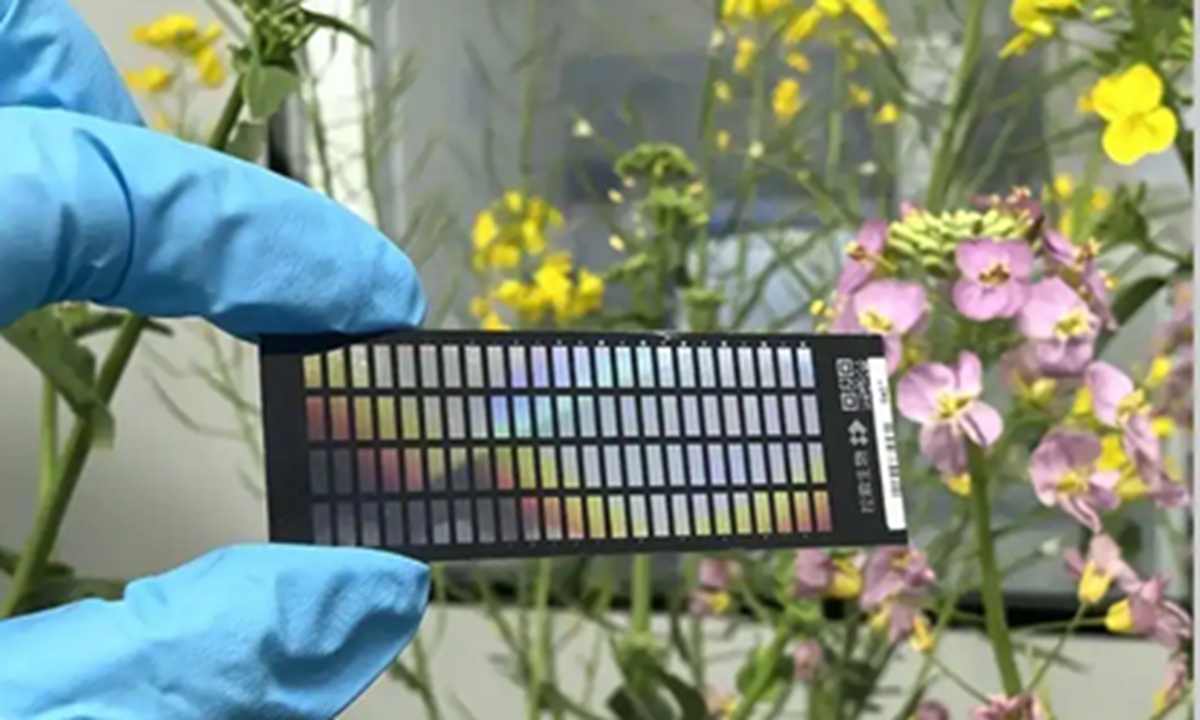
The Zhongxinyou No.1 gene chip Photo: screenshot of Science Daily's report
"Developing a new rapeseed variety used to take up to 10 years of field trials and breeding work. Now, with the 'Zhongxinyou No.1' gene chip and rapid breeding technologies that allow up to five growing cycles a year, the process can be shortened to as little as three years," said Chen Lunlin, a researcher with the rapeseed team at the Jiangxi Academy of Agricultural Sciences.
His remarks highlight how a homegrown gene chip is transforming China's rapeseed breeding industry.
China has officially launched its first 20K solid-state gene chip for cabbage-type rapeseed — the "Zhongxinyou No.1," developed by the Jiangxi Academy of Agricultural Sciences in collaboration with Huazhong Agricultural University and Suzhou Laso Biotech Co.
This tiny chip does not process data or run programs, yet it can "read" a rapeseed plant's potential for yield, disease resistance, and growth vigor. It not only breaks nearly two decades of foreign dominance but also moves China's rapeseed breeding from traditional, weather-dependent methods into an era of precision-guided smart breeding.
Recently, the Global Times spoke with Chen and Li Shuyu from the Jiangxi Academy of Agricultural Sciences, Yi Bin from Huazhong Agricultural University's National Rapeseed Improvement Center, and Li Zhi, a core researcher at Laso Biotech, to hear the story behind this "Chinese chip."
When people hear "chip," they usually think of semiconductors in computers or smartphones. But the Zhongxinyou No.1 gene chip is specially designed for rapeseed and works differently, while serving as a core tool in breeding.
"Both are chip matrices, but their cores are completely different," Chen explained. Computer chips use transistors and binary code, while Zhongxinyou No.1 integrates genetic markers across the rapeseed genome, effectively labeling each key gene.
"In the past, we had to wait until harvest to know oil content and had no insight into the genetic reasons behind it," Chen said. "The chip reveals the underlying genetic logic, allowing precise selection and targeted breeding."
As the lead institution, the Jiangxi Academy of Agricultural Sciences has spent over a decade studying rapeseed genetics, systematically identifying and cataloging key functional gene loci to provide a solid data foundation for the chip.
The Zhongxinyou No.1 chip carries more than 17,000 genome-wide markers and more than 1,500 function-related genetic loci, covering nearly all research needs for rapeseed — essentially a comprehensive "dictionary" of its key genes.
Li said the team has long focused on rapeseed gene-function research, systematically collecting gene loci linked to key traits such as oil content, disease resistance and yield. Researchers from Huazhong Agricultural University's National Rapeseed Improvement Center also contributed extensive genetic data, further enriching the chip's locus database.
The team eventually converted previously identified functional genes and sequenced genomic information into detectable probe sequences. "In the past, breeders found it difficult to directly apply abstract findings from academic papers," Yi said. "With these probe sequences, they can now use the chip to efficiently screen for germplasm resources with high oleic acid content and strong disease resistance."
The launch of Zhongxinyou No.1 addresses a long-standing "bottleneck" in China's rapeseed breeding sector. For nearly 20 years, the solid-state chip fabrication process had been monopolized abroad, forcing Chinese breeders to rely on imported chips and remain constrained by foreign technology.
"Previously, a single test using imported chips cost around 400 yuan ($56), making it too expensive," Chen said. "It was also impossible to upgrade imported chips based on China's actual breeding needs, leaving us constrained by foreign technology."
Traditional breeding methods were also inefficient, relying heavily on experience and trial-and-error. Breeders often had to wait until visible traits appeared before evaluation, while results could easily be affected by environmental factors.
"The Zhongxinyou No.1 chip has completely changed this situation," Chen said. "The chip can directly detect a rapeseed plant's genes, so regardless of environmental conditions, we can predict high oil content or strong disease resistance at the seedling stage - or even as soon as the seeds sprout."
After testing rapeseed samples, the team interprets the chip data and converts abstract genetic information into practical guidance for breeders, shortening the breeding cycle to as little as three years.
The chip-printing technology developed by Laso Biotech was key to breaking the foreign monopoly. "We are the third company in the world, and the first and only one in China, capable of producing silicon-based biochips," Li said.
By localizing the entire supply chain — from chip manufacturing and testing reagents to supporting equipment — the company significantly reduced production costs. "All of our manufacturing equipment, testing reagents and suppliers are fully domestic, with no remaining bottlenecks," Li said, describing the system as "truly self-reliant and controllable."
He added that full localization not only reduced China's reliance on foreign technology, but also lowered costs across the industry. "Breeding must ultimately deliver economic returns. Only when costs come down will companies be willing to invest and adopt the technology at scale."
Compared with similar international products, Zhongxinyou No.1 has several advantages. The cost of a single test is only about one-eighth that of imported chips, while its genetic loci are better tailored to China's breeding needs and offer internationally advanced accuracy.
The chip is also more flexible to upgrade. "With foreign photolithography-based chips, upgrading requires re-synthesizing all probes from scratch, which is costly and time-consuming," Li said. "Our bead-based chip only requires adding probes for new loci into the existing bead pool, making upgrades much more flexible."
"We still need to accumulate more yield-related genetic loci and more precise genetic data," Chen said. He added that the Jiangxi Academy of Agricultural Sciences plans to work with more research institutes to develop a 2.0 version of the chip, expanding the number of genetic loci to 60,000 — upgrading it from a "gene dictionary" to a more comprehensive "gene encyclopedia."
Chen said the team hopes Zhongxinyou No.1 will expand beyond China and eventually provide testing services for overseas breeding institutions, helping improve global rapeseed breeding efficiency.
RELATED ARTICLES