SPORT / MISCELLANY
China’s national football teams enter crucial June transition period
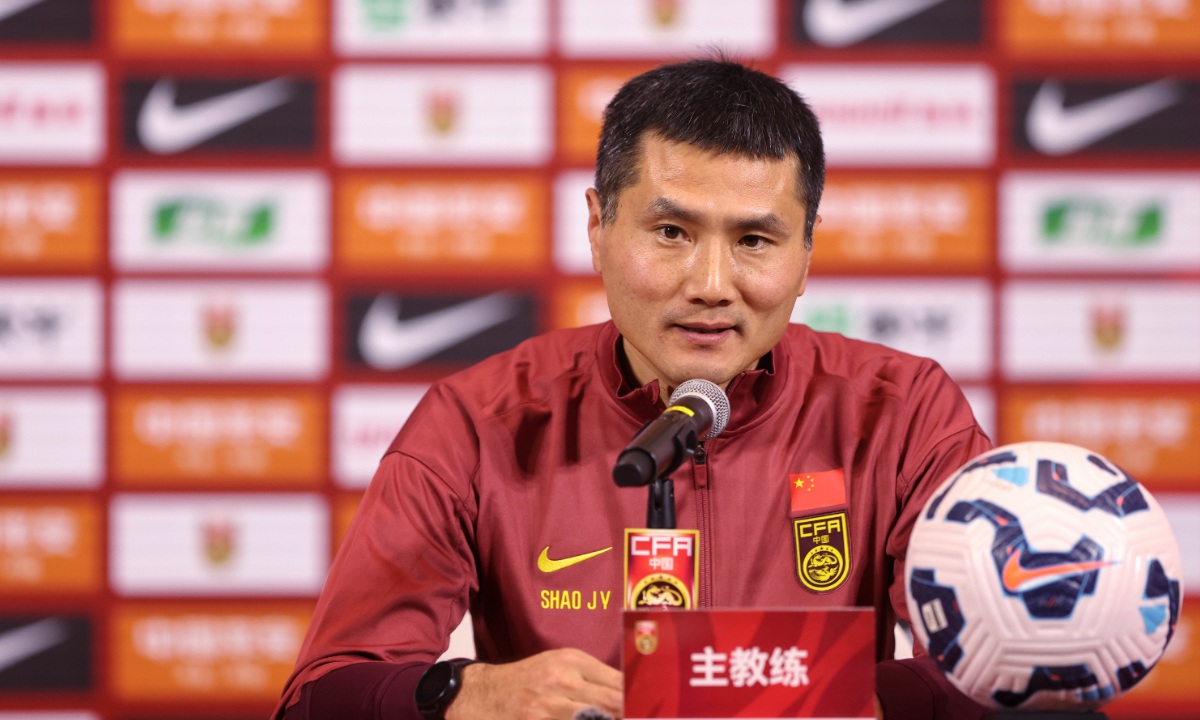
Shao Jiayi
China's men's national football program will enter a critical phase during the June international window, as both the senior national team and the U23 squad push forward on parallel tracks with clear objectives.The Chinese Football Association (CFA) confirmed that the senior national team, now under newly appointed head coach Shao Jiayi, will face Singapore away on June 5 before hosting Thailand in Jinhua, East China's Zhejiang Province on June 9. The Thailand match will also mark the first home appearance of the new coaching era, while veteran forward Wu Lei is expected to earn his 100th international cap.
On the surface, the fixtures may appear to be low-pressure friendlies. However, they could become important tests for a national team attempting to regain stability after years of inconsistency and disappointing tournament cycles, when stronger Asian teams are preparing for their World Cup matches.
Singapore, Thailand and China sit relatively close in the Asian football hierarchy. Matches against such opponents carry practical value beyond simple experimentation, especially in terms of FIFA ranking points and restoring confidence. More importantly, they offer Shao a rare opportunity to accelerate tactical adjustments while reshaping the squad's long-term structure.
The absorption of young players such as 19-year-old winger Wang Yudong, keeper Li Hao and defender Liu Haofan, both 22, into the senior national team reflects the team's transition period of blending the younger generation into the senior team, as the coaching staff aims to refresh an aging core while identifying younger players capable of competing at the Asian level over the next cycle.
But that ambition will not be achieved through short-term results alone. Recent national team performances have shown recurring issues in midfield control, attacking creativity and defensive organization under pressure. June's friendlies therefore become more than warm-up matches; they are effectively live tactical laboratories.
The coaching staff must continue refining the overall attacking and defensive structure, particularly in wide play and midfield progression, while also expanding the player pool before 2027's Asian Cup preparations intensify.
At the same time, the U23 national team faces a different but equally important mission.
China's U23 side will play two friendlies against Tajikistan's corresponding age-group team during the same international window. The matches form part of the squad's preparations for future continental competition and the Asian Games.
Unlike the senior team, the U23 squad's immediate focus is not rebuilding reputation, but sharpening competitive maturity.
The youth teams have shown signs of progress recently. Earlier this year, China reached the final of the U23 Asian Cup for the first time in tournament history after an impressive run that included victories over Australia and Vietnam before eventually finishing as the runners-up.
That breakthrough generated optimism for Chinese football, but sustaining momentum is often far more difficult than producing a single strong tournament.
The current U23 cycle must now prove it can translate isolated success into long-term competitiveness. Friendlies against the physically disciplined Central Asian opponents provide valuable tests for tactical discipline, defensive transitions and psychological resilience under pressure.
Just as importantly, these matches allow the coaching staff to continue to evaluate the roster ahead of future major tournaments while identifying which players can eventually transition into the senior national team setup.
This dual-track June schedule may ultimately say more about structural planning than about individual match results.
For years, one of Chinese football's biggest problems has been the disconnect between youth development and the senior national team. Promising youth generations frequently failed to transition smoothly into the top level, leaving positional gaps and forcing repeated rebuilds. The current approach appears aimed at reducing that fragmentation.
The senior team is now focused on establishing a stable tactical identity and restoring competitiveness at the Asian level, while the U23 side is expected to serve as a bridge for long-term talent succession.
Whether this strategy succeeds will depend on far more than a pair of June friendlies. But for a national program still searching for direction after years of turbulence, synchronized preparation across different age levels at least suggests a clearer roadmap than before.
The author is a reporter with the Global Times. life@globaltimes.com.cn
RELATED ARTICLES