IN-DEPTH / IN-DEPTH
China-Vietnam joint fishery stock enhancement and release injects vitality into Beibu Gulf
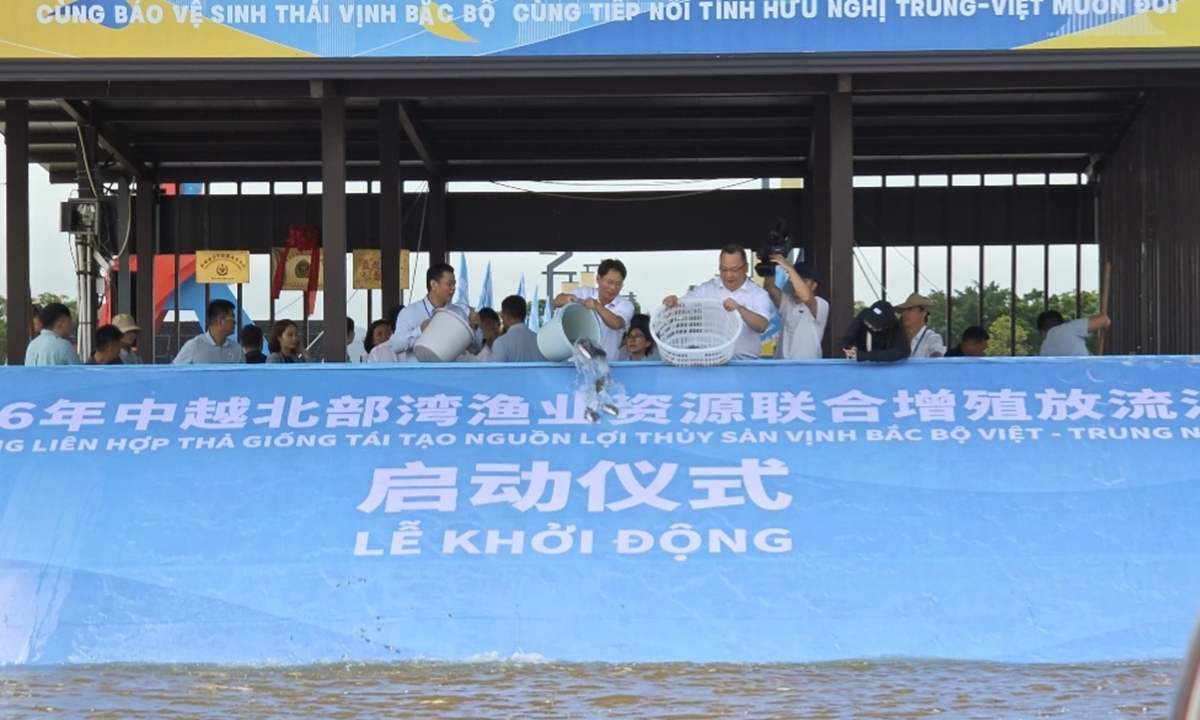
China and Vietnam jointly released 270 million fish fry and broodstock into the Beibu Gulf in Dongxing, South China's Guangxi Zhuang Autonomous Region, on May 19, 2026. Photo: Ding Yazhi/GT
A new wave of life entered the Beibu Gulf at the Beilun River estuary in Dongxing, South China's Guangxi Zhuang Autonomous Region, on May 19, as 270 million aquatic juveniles and broodstock were released into the sea during the 2026 China-Vietnam joint fishery resources stock enhancement and release activity. It was the ninth such joint release since China and Vietnam signed a memorandum of understanding in 2017 on cooperation in fishery resources enhancement, release and conservation in the gulf.
At around 5:30 pm on May 19, at the Beilun River estuary in Dongxing town, Fangchenggang, Guangxi, a sudden shower had just passed, leaving a faint salty smell of seawater in the air. On the release platform, dozens of barrels of fish fry were neatly arranged, and a chute stretched directly into the sea.
Amid bursts of cheers, fish fry of different sizes, including yellowfin seabream, black seabream and red seabream, slid down the chute into the Beibu Gulf. Kuruma prawns and redtail prawns were released by fishermen from boats, who cut open the bags and slowly poured them into the water. With just a few flicks of their tails, they vanished into the deep blue waves.
In Zhushan village, Dongxing town, the Global Times reporter met Ye Fengzheng, a fisherman who makes his living from sea angling. The young man has spent nine years on these waters.
"Those of us who fish with hand rods know best whether there are fish in the sea. We can tell as soon as we cast the line," Ye said.
Recalling his early days, Ye said, "When I first started sea angling in 2017, there really were not many fish in the sea. Sometimes I went a long way out, but after fishing for half a day, I still caught very little. I could not even earn back the fuel cost."
In 2017, China and Vietnam signed the memorandum of understanding on cooperation in fishery resources stock enhancement, release and conservation in the Beibu Gulf. For the first time, the two "neighbors" decided to join hands in "sowing seeds" into the sea.
Ye did not know this background. He simply noticed, little by little, that there were more fish in the sea. "I cannot say exactly when it started... In the past, it was enough if a day's catch could feed the family. Now, when I catch more, I can sell some," he said with a smile.
"More fish in the sea gives us greater peace of mind when we go out fishing," Ye said.
"The catch of major commercial fish species has risen by more than 10 percent, and the overall recapture rate of released fry is above 5 percent. This is a good level in the international field of stock enhancement and release," Zhang Dianchang, director of the South China Sea Fisheries Research Institute under the Chinese Academy of Fishery Sciences, told the Global Times.
Entering the sea
In Ye's village, hundreds of fishermen have benefited from stock enhancement and release. This raises a question: What kind of journey do the fish that eventually end up in Ye's catch box go through before they enter the sea?
At a nursery base not far from the Beilun River estuary, the reporter found the "growth records" of these fry. "These are black seabream fry, one of the main species to be released today," said Su Zhongxing, general manager of Guangxi Fuqun Marine Seedling Breeding Company.
What kind of fry can be called "high-quality fry"? "First, they must be local species," Su said. "They must be species that already exist in the Beibu Gulf. Alien fish cannot be introduced casually, as that would damage the ecological balance. Second, they must be healthy, active and uniform in size. Look at these fry. They are about the same size, swim vigorously and show no signs of illness. That makes them good fry." He told the Global Times that the species released are key conservation species screened and selected by research institutions.
Breeding companies are then chosen through open bidding, and the companies use wild local broodfish caught at sea to produce the juveniles. This means the safety and quality of the germplasm are guaranteed from the source.
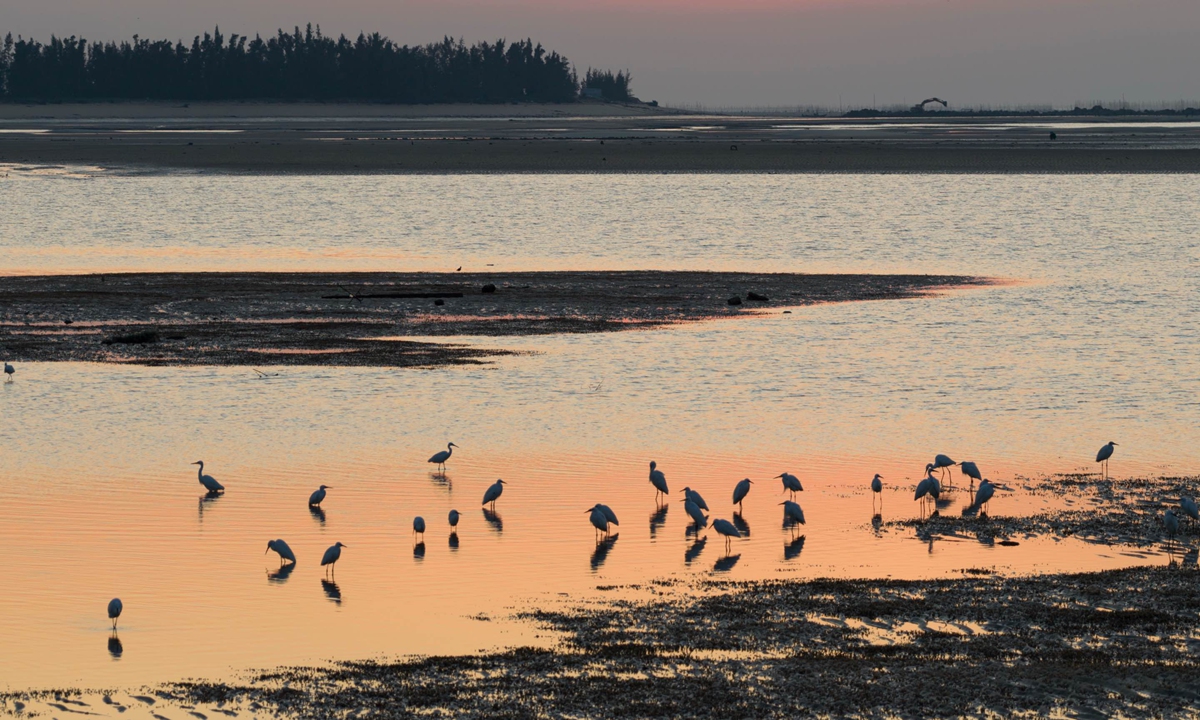
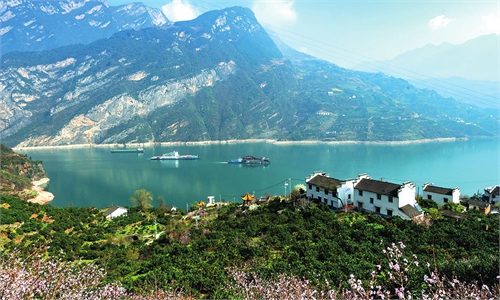
The beautiful scenery of Beibu Gulf Photo: VCG
Before the release, the base also carried out salinity acclimation after days of heavy rain lowered nearshore seawater salinity, allowing the fry to gradually adapt to the changed environment.The transportation process also leaves no room for carelessness. In an open space at the base, 21 transport vehicles for the release were parked. On the vehicles, fish fry were carried in large barrels, while prawns were packed separately in oxygenated bags, with different species transported separately.
From a nursery pond to the sea, a fish fry must pass through multiple stages, including broodstock selection, salinity acclimation, health quarantine, quantity verification and classified transportation. Behind all this is an increasingly refined scientific breeding system. It is precisely these little-known details that ensure fishermen can catch more and more fish closer to home.
Securing the future
The Beibu Gulf is a shared ecological home for China and Vietnam. Relevant materials show that the coastal waters of the Beibu Gulf are home to more than 500 fish species, over 40 crustacean species and abundant mollusks.
"The Beibu Gulf is an adjacent and connected sea area shared by China and Vietnam. Fishery resources are mobile and shared, so resource conservation cannot rely on the efforts of only one side. It requires joint participation and joint governance by both sides," Zhang said.
Since 2017, China and Vietnam have held nine joint stock enhancement and release activities, with the Chinese side releasing more than 770 million aquatic juveniles into the Beibu Gulf, making the program a model of fishery cooperation among countries around the South China Sea.
"Joint stock enhancement and release is by no means simply putting fry into the sea. It is a rigorous scientific conservation action," Zhang said.
"Look at these black seabream. Before the release, we attached external tags to some of the juveniles," a researcher said, pointing to the small fish swimming in a water tank. "It is like giving them an 'ID card.' Through subsequent recapture and tracking, we can find out where these fry went, how they grew and how much they contributed to resource replenishment."
In addition to the tags, this year's release used molecular genetic markers on redtail prawn juveniles to distinguish released individuals from wild ones, making it easier to calculate the pace of resource recovery. "We have long maintained in-depth cooperation with the Research Institute for Aquaculture of Vietnam," Zhang said.
An official with the Bureau of Fisheries under China's Ministry of Agriculture and Rural Affairs said that bilateral cooperation over the years, such as joint fish releases and maritime patrols in Beibu Gulf, has played a positive role in maintaining maritime order and conserving fishery resources, according to the Xinhua News Agency.
The Global Times reporter returned once again to the Beilun River estuary. The tide had receded, leaving shallow water marks on the mudflat. The fry released into the sea a few hours earlier may already have swum toward deeper and more distant waters. Carrying their tiny tags, they cross invisible maritime boundaries and swim toward a Beibu Gulf whose ecology is continuing to improve.
"Every fish fry we breed may one day be caught by Chinese fishermen, or by Vietnamese fishermen. Protecting this sea means protecting the future of fishermen along its shores," Su said.
RELATED ARTICLES