Nobel laureate Tagore’s legacy, message continue to resonate strongly even today: Indian Ambassador
Nobel laureate Tagore’s legacy, message continue to resonate strongly even today
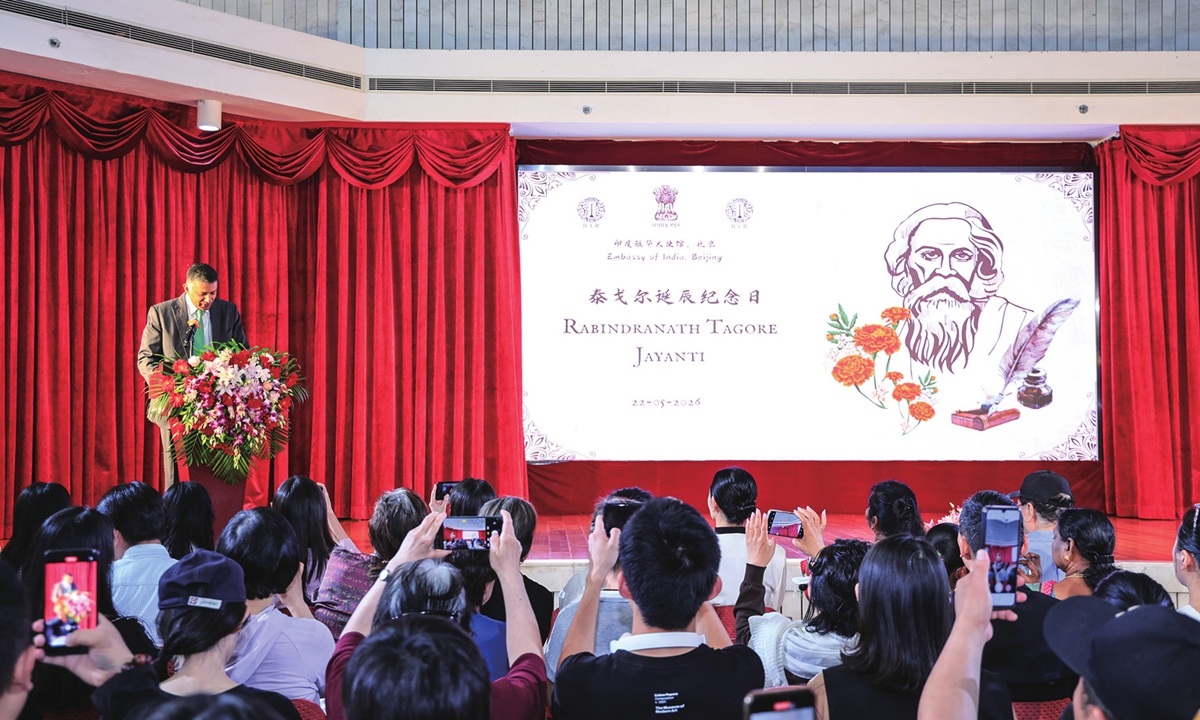
Indian Ambassador to China Vikram Doraiswami gives a speech at the celebration of Rabindranath Tagore in Beijing on May 22, 2026. Photo: Courtesy of the Embassy of the Republic of India in China
The Embassy of the Republic of India in China hosted a celebration session to commemorate the 165th anniversary of Gurudev Rabindranath Tagore, a renowned Indian poet, writer, philosopher and Nobel laureate, in Beijing on May 22. Indian Ambassador to China Vikram Doraiswami said that in many ways, Tagore belongs not only to India, but to the shared cultural heritage of humanity.In his opening remarks, Ambassador Doraiswami said Tagore, born on May 7, 1861, was also an educationist and global humanist who enjoyed a special status in China. Tagore's visit to China in 1924 opened an important chapter in India-China cultural exchanges.
"Tagore's legacy in China has endured. At a time of great change in Asia, Tagore was among the earliest modern thinkers to speak of the importance of Asian civilizations learning from one another while retaining their own cultural confidence and identity. His message continues to resonate strongly even today," Doraiswami said.
Doraiswami gave his speech in fluent Chinese, impressing the audience. The envoy told the Global Times that he learned Chinese in the 1990s at the Chinese University of Hong Kong.
Dong Youchen, a seasoned translator who gave a speech as an honorary guest at the event, said Tagore spent his life tirelessly advocating for justice. Through writings, Tagore criticized injustice. He practiced equality, becoming a spiritual banner for the awakening of Indian society.
Tagore abhorred aggression, opposed nationalism, and advocated for dialogue among civilizations, ethnic harmony, and peaceful coexistence among humanity. He was a great peace pioneer of the 20th century, Dong said.
As an educationist, Tagore broke down barriers of class, religion, and race. Tagore opposed rigid and inflexible education. "This inclusive, open, and people-oriented educational philosophy continues to profoundly influence global education development and nurture generations of young people," Dong added, saying that the Indian philosopher also reflected on civilization and revered life and nature.
Liu Jian, research fellow at the Chinese Academy of Social Sciences, talked about the translation and introduction of Tagore's works in China, tracing the dissemination of Tagore's thought in China over the past century and its profound influence on modern Chinese literature and intellectual circles.
At the session, students from various universities performed music and a dance-drama, and recited poetry.
Tagore also placed immense faith in young people and in the power of education to nurture creativity, harmony and peace, said Doraiswami.
Through establishing Visva-Bharati University, a public central university and also an Institute of National Importance located in Shantiniketan, India, Tagore envisioned a space where cultures and ideas from around the world could meet in a spirit of openness and mutual respect, Doraiswami said.
Doraiswami concluded his speech quoting Tagore's timeless words,
"I slept and dreamt that life was joy.
I awoke and saw that life was service.
I acted and behold, service was joy."
RELATED ARTICLES