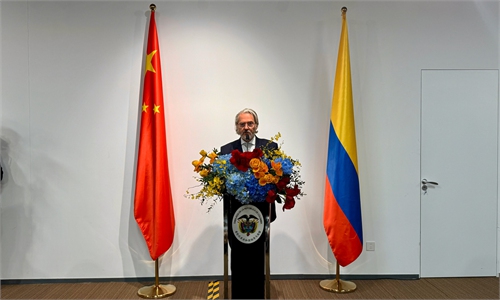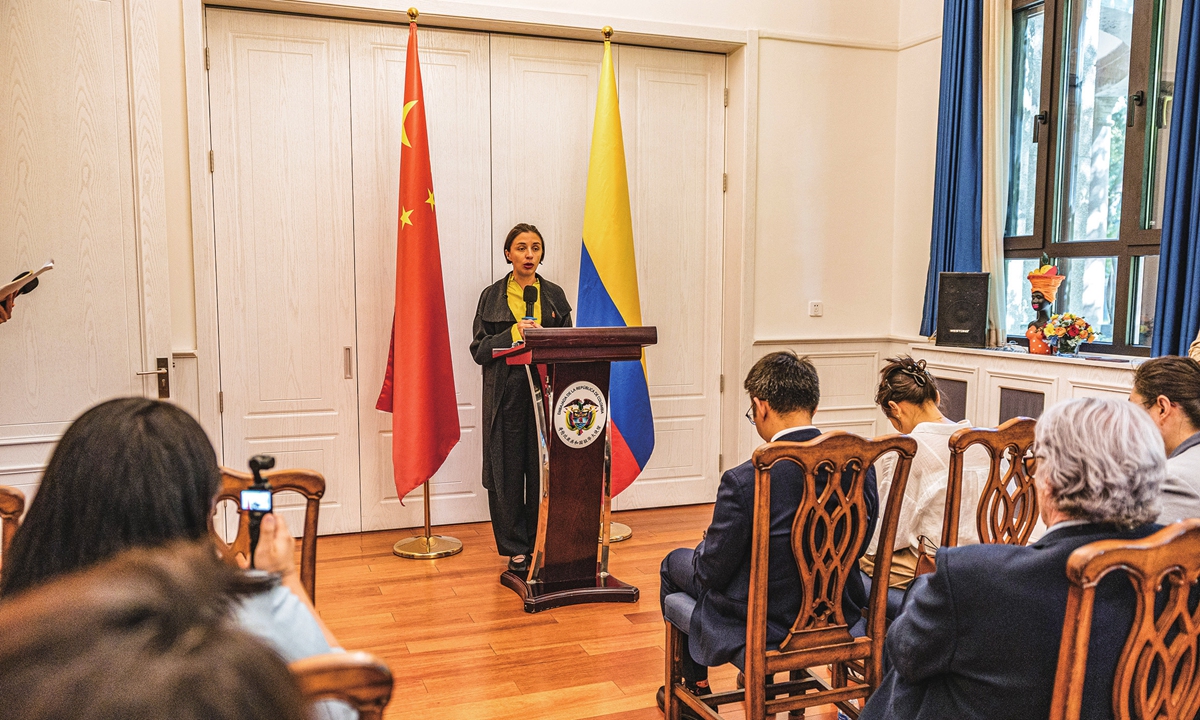
Martha Viviana Carvajalino Villegas, Minister of Agriculture and Rural Development of Colombia, speaks at a press conference at the Embassy of the Republic of Colombia in China on May 28, 2026. Photo: Li Hao/GT
Martha Viviana Carvajalino Villegas, Minister of Agriculture and Rural Development of Colombia briefed media about her visit in China at a press conference on May 28 at the Embassy of the Republic of Colombia in China, underscoring aspiration for deeper bilateral agricultural cooperation.Latin American and Caribbean (LAC) countries officials told the Global Times in recent interviews that China's achievements in poverty elimination are remarkable and they want to refer to the country's experience and develop together through deepened cooperation.
Minister Carvajalino briefed the media that her visit aimed to achieve three goals: participate in the Global Forum on Poverty Reduction and Development 2026 in Beijing, review the progress in the implementation of the memorandum of understanding signed in 2023 with the Ministry of Agriculture and Agrarian Affairs of China for rural development and technology transfer; advance in admissibility and requirements with the customs authority to expand the categories and scale of agricultural exports to China and promote bilateral agricultural trade, with special interest in opening the Chinese market to Colombian cocoa beans and their derivatives.
Minister Carvajalino told the Global Times that in Colombia, most agricultural land is held by smallholder farmers and the agricultural sector employs 15 million people, who are the main group with employment but also a high-risk group for poverty.
China's experience in lifting people from poverty is very relevant and valuable for Colombia to refer to, she said.
Currently, agricultural exports have surpassed coal exports, marking Colombia's transition to green and sustainable energy. The Colombian government is stepping up efforts to build a digital agricultural system to improve agricultural productivity and export efficiency; promote the diversification of agricultural and export products, Minister Carvajalino said.
From her observation, cooperation with China in technology and innovation, agricultural product processing, agricultural machinery and infrastructure as well as sharing of experiences in poverty elimination will be the sectors to work on.
Carvajalino gave examples of agricultural cooperation in technology and innovation: introducing Chinese agricultural technologies such as breeding, precision drip irrigation, and high-efficiency irrigation; establishing collaborative research and development centers with academic institutions; and strengthening the resilience of the agricultural system.
As for agricultural machinery and infrastructure, Carvajalino highlighted importing Chinese machinery adapted to soil and water conditions in Colombia; leverage Colombia's geographical location to improve its sea and land logistics and infrastructure network.
The minister also stressed that Colombia eyes to encourage more young people to take up farming, return to rural areas and support rural development. This will not only safeguard the country's food security and ensure people's basic livelihoods, but also improve overall support for farmers, Carvajalino said, adding that the government hopes to elevate infrastructure and services for farmers, as well as boost their sense of dignity.
Carvajalino told the Global Times that global poverty reduction is a shared endeavor for all countries and cannot be achieved alone. China's achievement of lifting hundreds of millions out of poverty is a global success, and its development experience is highly valuable for reference.
Colombia advocates for strengthening Global South cooperation, with each country exploring its own path to poverty reduction and development based on its national circumstances, and it is optimistic about the potential for cooperation between China and LAC countries such as sustainable agriculture, poverty reduction, and green development, she added.
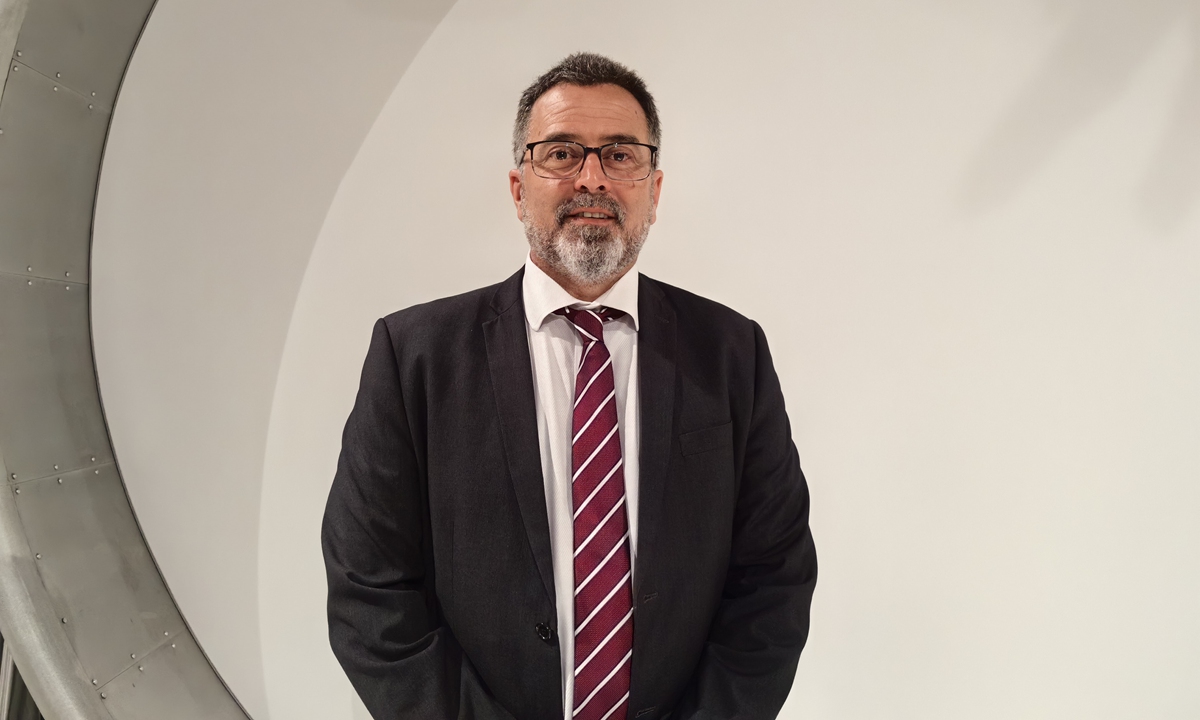
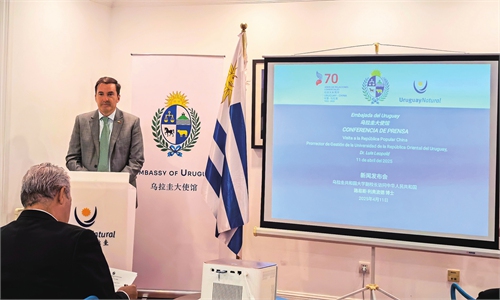
Matias Carambula, deputy minister of Livestock, Agriculture, and Fisheries of Uruguay in Beijing on May 21, 2026 Photo: Dong Feng/GT
Potential of China-LAC cooperation in agriculture is echoed by Matias Carambula, deputy minister of Livestock, Agriculture, and Fisheries of Uruguay, who led a delegation to China last week. In Shanghai, they participated in the 2026 edition of SIAL China, a major food and beverage trade fair in Asia.Carambula conducted official exchanges with Chinese food sector players, focusing on topics including upgrading veterinary drug residue supervision, deepening cooperation in sanitary and quarantine, and granting new access to factories and products, injecting new momentum into China-Uruguay beef trade.
Carambula told the Global Times that he gained great experience during the trade fair in Shanghai. Uruguay has exported 60 percent of its meat products to China. Renowned for high quality and natural production without growth hormones, Uruguayan meat products were well showcased, he said, adding that a series of bilateral meetings were held between government officials and trade partners of the two countries.
The deputy minister said that the trade fair trip has laid a solid foundation for bilateral cooperation. Highlighting that China-Uruguay comprehensive strategic partnership has been further strengthened, Carambula said the two countries' agricultural cooperation has expanded to trade of other products including by-products such as beef tripe bezoar, as well as soybeans and pulp.
"China is Uruguay's largest export destination for pulp," Carambula said.
Talking about his outlook for future cooperation, Carambula said the two sides can also deepen scientific and technological cooperation between universities and enterprises. Uruguay is ready to attract Chinese investment to boost the country's logistics and food sectors, he said.
So far, the deputy minister has visited China three times, he can see the second largest economy is undergoing rapid and constant changes.
Given the country's achievements in development and innovation, "China is a role model," Carambula said, adding that China and Uruguay also have space to expand communication on education, culture, sports and people-to-people exchanges.
RELATED ARTICLES