Tokyo, Manila elevate ties, push for closer security ties during Marcos’ visit; hyping ‘China threat’ narrative to form small circles risks fueling confrontation: Chinese analysts
By Published: May 29, 2026 01:06 AM

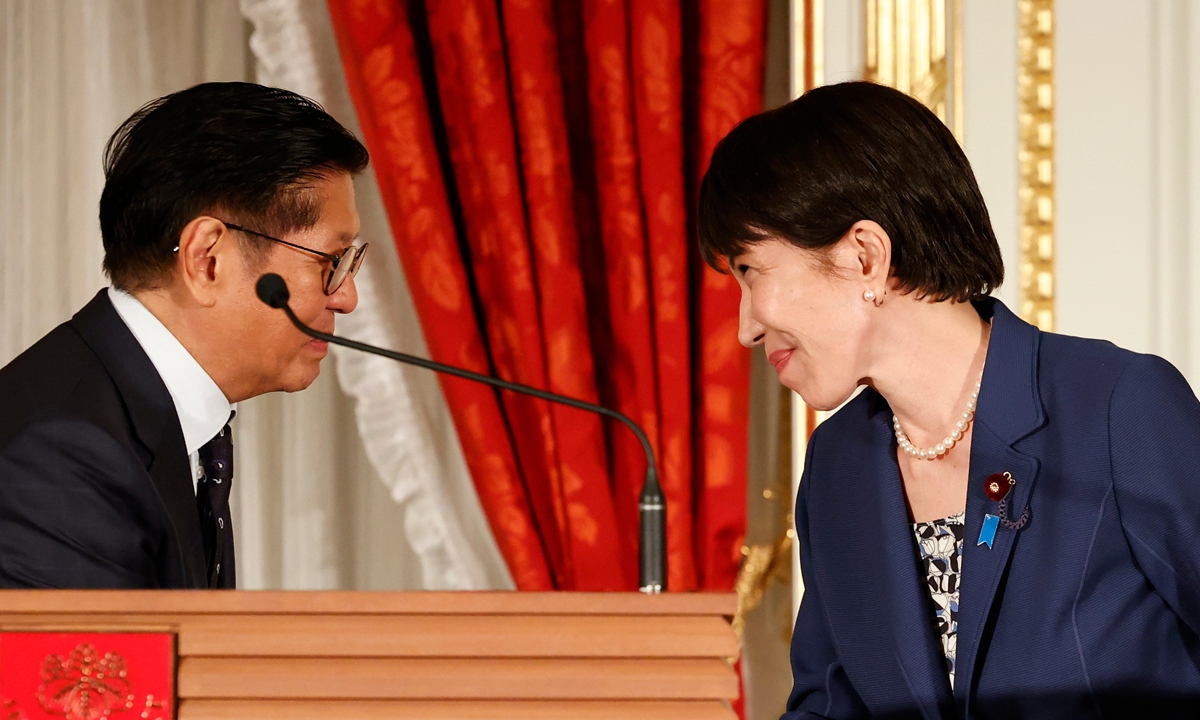
Philippine President Ferdinand Marcos Jr and Japanese Prime Minister Sanae Takaichi shake hands during a joint press conference at the Akasaka Palace State Guest House, on May 28, 2026, in Tokyo, Japan. Photo: VCG
A red-carpet welcome at the airport, a palace banquet and a prestigious national decoration — Japan has rolled out what media described as "highest-level" honors for visiting Philippine President Ferdinand Marcos Jr, as Tokyo and Manila moved to further elevate ties with China clearly in mind, according to media reports.Chinese observers said that by hyping the so-called "China threat", Japan and the Philippines are each advancing their own calculations with Tokyo seeking to use closer ties with Manila to loosen its postwar military constraints while Manila is relying on external forces to internationalize and inflame South China Sea disputes. Such bloc-style cooperation runs counter to the region's pursuit of stability and development, risks fueling geopolitical rivalry in the Western Pacific, and could undermine regional security, they said.
Hidden calculations
Japanese Prime Minister Sanae Takaichi held talks with Philippine President Ferdinand Marcos Jr, who is visiting Japan as a state guest, for about one hour on Thursday in Tokyo, according to Japanese media outlet NHK.
At the start of the meeting, Takaichi claimed that as the international situation becomes increasingly severe, the importance of close coordination between Japan and the Philippines has never been greater in realizing an evolved "Free and Open Indo-Pacific." Calling the Philippines one of Japan's closest like-minded countries, Takaichi said she was very pleased that the two sides were able to upgrade their bilateral relationship to a "comprehensive strategic partnership" during the visit, per NHK.
After the meeting, the two leaders issued a joint statement pledging broader cooperation, including launching formal negotiations on a General Security of Military Information Agreement, or GSOMIA, to enable the immediate sharing of highly sensitive military information and promoting defense equipment transfers after Japan eased rules on lethal weapons exports, according to the NHK report.
Meanwhile, a Jiji Press report noted that "the two sides discussed responses to China, which they claimed is intensifying military coercion in the East China Sea and South China Sea, as well as to the US, which is leaning toward an America-first approach. They confirmed strengthened cooperation in the security field and in the energy sector in response to the situation in the Middle East."
Japan and the Philippines deliberately hyping maritime issues in the East China Sea and South China Sea reflects a dangerous form of geopolitical coordination. Differences over relevant waters should be handled through dialogue and consultation by the parties directly concerned, but Tokyo and Manila have chosen to amplify so-called "concerns", effectively manufacturing confrontation and fueling regional tensions, Xiang Haoyu, a distinguished research fellow at the China Institute of International Studies, told the Global Times on Thursday.
A Reuters Japanese-language report noted that Marcos visited Japan as a state guest, marking the first state visit to Japan by a Philippine president since President Benigno Aquino's visit in 2015.
In an April 2025 Japan-Philippines summit between Marcos and then Japanese Prime Minister Shigeru Ishiba, the two sides agreed to strengthen bilateral security cooperation and "oppose attempts to unilaterally change the status quo in the East and South China Seas."
In response, Chinese Foreign Ministry spokesperson Guo Jiakun said China has always maintained that exchanges and cooperation between countries should not target any third party or harm their interests. "We oppose any moves that forge groupings and escalate tensions in the region," Guo said.
Japan's efforts to court the Philippines reveal a clear strategic calculation. Through high-level diplomatic honors and an upgrade of bilateral ties, Tokyo is seeking to tighten political and emotional bonds with Manila while accelerating cooperation in defense, maritime security, and defense equipment transfers, said Xiang.
During a meeting with the Japan-Philippines Parliamentary Friendship League on Wednesday, Marcos Jr claimed that he considers Japan one of the Philippines' "most reliable partners" amid growing global uncertainty, which has resulted in "disruptions in supply chains, and mounting pressures on the rules-based international order," according to Philippine media outlet Business Mirror.
Marcos also claimed both the Philippines and Japan share a common goal of strengthening defense and security cooperation to maintain freedom of navigation in crucial international waterways such as the South China Sea. Currently, the defense-related partnership between Manila and Tokyo includes the Reciprocal Access Agreement (RAA) and the Acquisition and Cross-Servicing Agreement (ACSA). per Business Mirror.
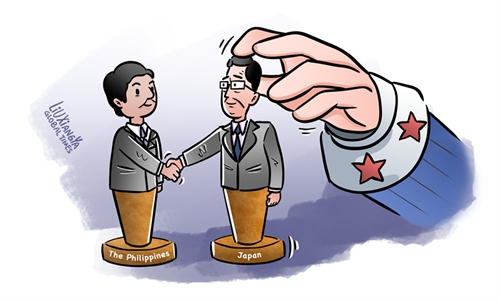
Both countries are hyping the so-called "China threat", but each has its own calculations. For the Philippines, the main goal is to use external forces in the South China Sea to increase its bargaining power and confrontation leverage. Manila is well aware that bringing in outside powers carries risks, even the danger of "inviting the wolf into the house", but it has still chosen to rely on them and continue hyping maritime disputes to defend its own interests, Song Zhongping, a Chinese military affairs expert, told the Global Times.
Japan is, in effect, treating the Philippines as a pawn in its regional strategy. By providing Manila with various types of defense equipment and strengthening defense and maritime security cooperation, Tokyo seeks to widen the rift between the Philippines and China, fuel more confrontations and tensions in the South China Sea, create a pretext for deeper Japanese involvement in regional affairs, and build its own security clique, said Song.
Small circle
Many Japanese and Philippine media outlets, as well as some Western media, have covered Marcos Jr's visit to Japan and mentioned China. An Associated Press report titled "Japan woos visiting Philippine leader during state visit with arms sales and China in mind" noted that Marcos Jr is "receiving an exceptional level of hospitality" during his state visit to Japan. It also said Marcos is "the first potential major customer" for Japanese arms since Takaichi's government scrapped a ban on lethal weapons exports.
Commenting on Bloomberg's news report on Takaichi and Marcos Jr's meeting to discuss strengthening security cooperation amid China's "hardline stance in East and South China Sea", Ukeru Magosaki, a former Japanese Foreign Ministry official, wrote on X on Thursday that "Doing such things doesn't strengthen Japan's security by even a millimeter."
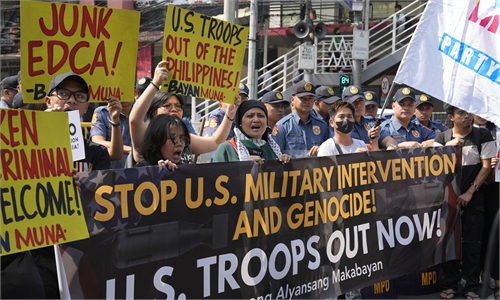
A group of Filipino activists and their supporters on Tuesday evening staged a protest in Roppongi District, central Tokyo, to demonstrate their opposition to the state visit of the President of the Philippines to Japan. Participants displayed banners bearing slogans such as "Marcos is not welcome in Japan" and "No to military relations between Japan and the Philippines," according to Arab News Japan.
Xiang noted that Japan and the Philippines are forging an exclusive security clique, and such kind of military-oriented cooperation undermines the ASEAN-led security framework, pushes the South China Sea issue toward bloc confrontation, and raises the risk of maritime friction.
RELATED ARTICLES