AI-enabled robotic mastiff unveiled at military expo, boasting auxiliary surveillance and strike functions for combat personnel: expert
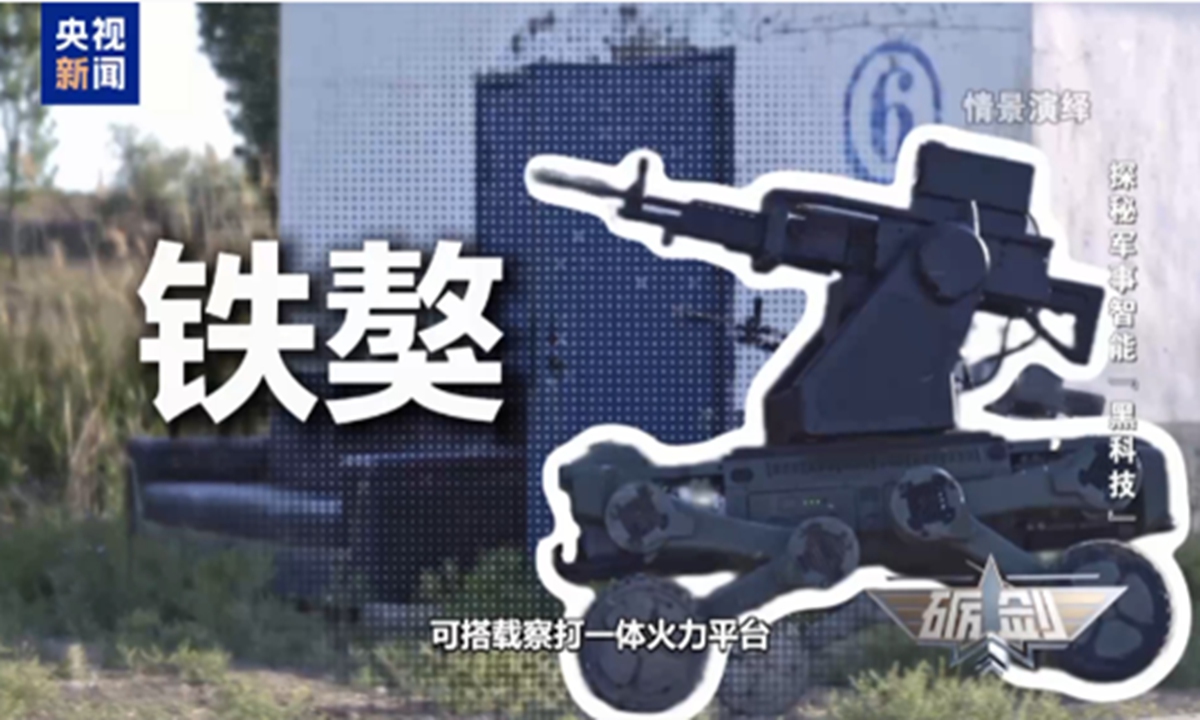
Photo: Screenshot of the larger-sized robotic mastiff "Tie'ao"
A cutting-edge artificially intelligent (AI) military device, named "robotic mastiff," made its debut at this year's China (Beijing) Military Intelligent Technology Expo. A Chinese military affairs expert said that such robotic mastiff serves as an extra pair of "eyes" for frontline combat personnel, allowing them to detect threats and conditions in otherwise inaccessible areas maximizing battlefield effectiveness.A major strength of the robotic mastiff lies in its open base, which can be fitted with a wide range of equipment. Depending on its size, the robotic mastiff can be divided into two types. The smaller one, named the "Ying'ao," can be equipped with machine guns, reconnaissance devices, and self-detonation gear, according to CCTV News.
Built for stealth surveillance, behind-enemy-line infiltration and silent mobility, it conducts detection and reconnaissance across visible light, infrared and laser spectrums, and performs well in complex terrains such as mountainous areas and wilderness.
The larger one, called the "Tie'ao," can carry an integrated fire platform for surveillance and strike, transport containers, and rocket launchers. It supports wide-range firing up to 240 degrees and is capable of autonomous pursuit, undertaking missions such as forward assault and fire support, the report said.
Chinese military affairs expert Song Zhongping told the Global Times on Friday that the robotic mastiff is capable of performing high-risk, arduous combat missions, demonstrating advantages in counter-terrorism operations and street battles in traditional warfare. Powered by AI, it can autonomously detect and engage targets, which is its core operational strength, he added.
Operating in coordination with combat personnel, it also enables precision strikes against hostile targets, extending operational reach and enhancing battlefield precision, Song said, adding that the equipment is specifically deployed to neutralize hardened fortified positions and point targets that are difficult to defeat through conventional means.
In addition to size-based classification, the robotic mastiff also comes in wheeled and quadrupedal forms. The wheeled-legged version is designed for speed, excelling at pursuit missions on flat, open terrain, while the quadruped one offers superior accessibility, enabling it to navigate buildings and obstacle-strewn terrain.
Such robotic mastiff will be integrated into future system‑of‑system combat operations, forming a closed operational loop encompassing group control, coordinated engagement, task allocation, autonomous situational awareness, autonomous task distribution, and mission execution, CCTV News, citing exhibitors, reported.
In counter-terrorism and street combat scenarios, battlefields feature extensive visual blind spots, with complex terrains that are inaccessible and risky for infantry personnel, Song said, adding that therefore AI-powered robotic mastiff effectively serve as "eyes" for ground troops, endowing them with auxiliary surveillance and strike capabilities to detect visual and acoustic cues.
CCTV News also reported that all types of unmanned equipment are expected to achieve collaborative operations within a unified command system.
By leveraging artificial intelligence to operate alongside the robotic mastiff, our forces can achieve maximum battlefield effect while minimizing casualties, Song said.
RELATED ARTICLES