Shenzhou-21 crew returns to Earth; taikonaut brings back apple from space, wishing future missions safe
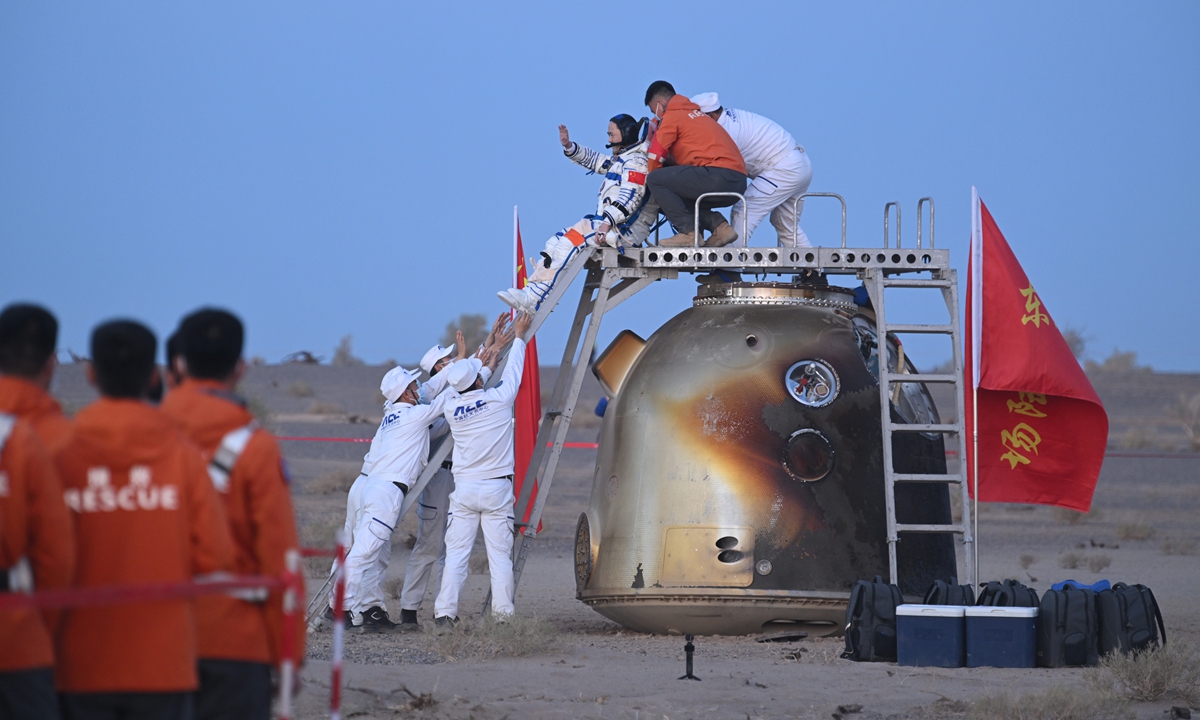
Taikonaut Zhang Lu, commander of the three-member Shenzhou-21 crew, is out of the Shenzhou-22 spaceship's return capsule after it touched down at the Dongfeng landing site in North China's Inner Mongolia Autonomous Region, May 29, 2026. Photo: VCG
After a historic 210-day orbital stay that set a new record for the longest in-orbit duration by a Chinese taikonaut crew, the Shenzhou-21 astronauts concluded their extraordinary space journey on Friday by returning to Earth aboard the Shenzhou-22 spacecraft.
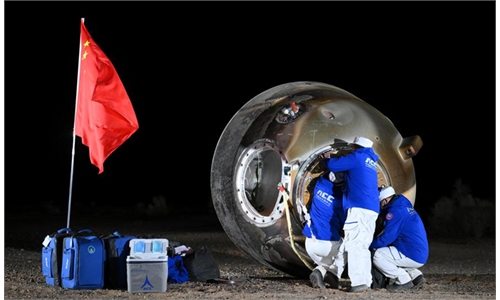
The return capsule of China's Shenzhou-22 spaceship carrying the Shenzhou-21 astronauts touched down at the Dongfeng landing site in North China's Inner Mongolia Autonomous Region at 20:11 on Friday, with on-site medical and health support personnel confirming the taikonauts are in good physical condition, making the Shenzhou-21 spaceflight mission a complete success, according to the China Manned Space Agency (CMSA).
At 20:59, taikonauts Zhang Lu, Wu Fei and Zhang Hongzhang of the Shenzhou-21 crew left the return capsule, all in sound health. This marks the successful conclusion of their space mission, with Zhang Lu now holding the record for conducting the most extravehicular activities among China's taikonauts. Meanwhile, Wu Fei and Zhang Hongzhang have accomplished their maiden space flights, the CMSA said.
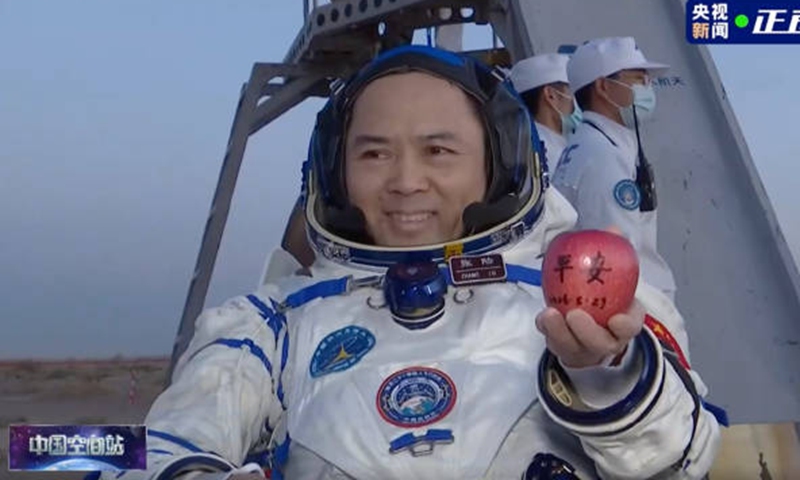
Photo: Screenshot of livestreaming
Zhang Lu, who is also the commander of the three-member Shenzhou-21 crew, shared his thoughts after out of the capsule. According to China Central Television (CCTV) News, Zhang Lu said "Tomorrow is the National Science and Technology Workers Day. We brought back an apple from the space station to give it to all tech professionals. Thank you for your dedication and hard work! May China's aerospace endeavor thrive endlessly, and may all our future missions stay safe and successful!" CCTV footage showed the apple bears the Chinese characters Pingan (safety).
Having docked with the China Space Station on November 1, 2025, the three taikonauts of the Shenzhou-21 crew stayed in orbit for 210 days, setting a new record for the longest single mission duration by a Chinese astronaut crew, per the CCTV News.
"The entire return went off perfect. Guided by the spacecraft's GNC (Guidance, Navigation and Control) system, the return capsule maintained steady flight throughout and landed with pinpoint accuracy," a developer from the Fifth Academy of the China Aerospace Science and Technology Corporation told the Global Times.
According to a statement by the 502 Research Institute of the China Academy of Space Technology (CAST) shared with the Global Times, the Shenzhou-22 mission marks China's second three-orbit fast return for a crewed spacecraft. The three-orbit fast return was first successfully accomplished during the Shenzhou-21 mission, wrapping up in just 5.5 hours.
The mature application of the three-orbit fast return technology fully demonstrates the leaps and flexibility of China's manned spaceflight capabilities. It also greatly boosts the safety and reliability of manned space missions.
According to developers, this technology enables the Shenzhou manned spacecraft to better tackle major malfunctions during autonomous flight and complex assembly flight phases. It ensures taikonauts can return to safety in the shortest possible time. Additionally, it cuts down the emergency response time for unexpected anomalies aboard the space station, provides an efficient evacuation route for on-orbit crews, and strongly underpins the long-term stable operation of China's space station.
China launched the Shenzhou-21 spaceship on October 31, 2025 to send the Shenzhou-21 crew to its space station for rotation with the Shenzhou-20 crew. However, the Shenzhou-20 crew later found that the Shenzhou-20 spaceship's return capsule viewport window suffered a suspected impact from space debris during its mission and was unfit for the crew return mission.
On November 14, 2025, the Shenzhou-20 crew returned safely aboard the Shenzhou-21 spacecraft. On November 25, China launched the Shenzhou-22 spaceship to provide a return vessel for the Shenzhou-21 crew.
The crew reaped remarkable achievements throughout their stay. According to previous announcement from the CMSA, the Shenzhou-21 crew aboard China's orbiting space station completed a total of three extravehicular activities (EVAs) during their mission. The first was carried out on December 9, 2025, with the crew working for approximately eight hours, while the second on March 16, for roughly seven hours.
On April 17, the crew completed their mission's third series of EVAs, working for roughly 5.5 hours and completing the installation of space debris protection equipment and the inspection of extravehicular equipment.
The CMSA disclosed that since the second EVAs, the Shenzhou-21 astronauts have been steadily advancing their experimental missions in space life science, human body research, and microgravity physics. They have continued to conduct station environmental monitoring, equipment inspection and maintenance, and supply organization. The crew has also completed full-system pressure emergency drills, in-orbit emergency rescue training, and EVAs preparations.
Furthermore, the crew witnessed several historic firsts in China's manned space program during the orbital mission: the first delay of a spacecraft's return due to space debris impact, the first crew return aboard a different spacecraft, and the first emergency launch of a crewed spaceship. They experienced the inspiring moment when all teams across the manned space sector stood united to respond to the emergency, CCTV News reported.
RELATED ARTICLES