Global brands pick China for debut stores amid steady growth, policy support
Steady growth and opening-up policies draw foreign investments
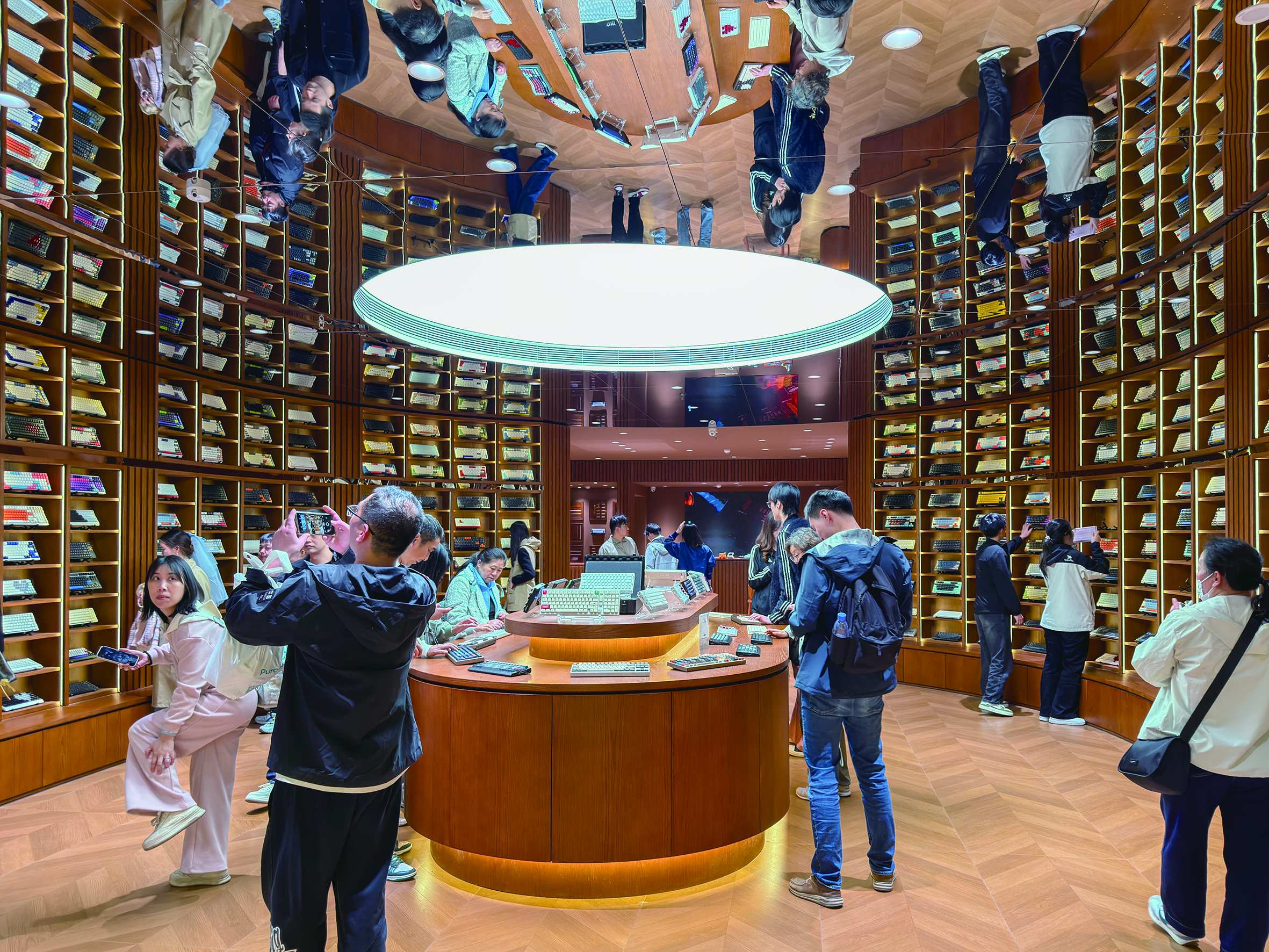
Customers experience mechanical keyboards at the IQUNIX flagship store in Guangzhou, South China's Guangdong Province, on May 5, 2026. Photo: VCG
From streetwear brands and chocolate marques to fashion labels, foreign companies have been accelerating their entry into China this year, opening their first stores in major cities as a springboard for entering the Chinese market. Experts attribute this trend to the certainty of China's economic growth and the potential of its consumer market.
At the same time, China's consistent, stable, and innovative opening-up policies are also helping attract global businesses.
In late May, British skateboard brand Palace Skateboards opened its first stand-alone store in Chinese mainland in Shanghai, attracting many fashion enthusiasts. To mark the occasion, the brand released a Shanghai-exclusive collection featuring a "Shang-Hi" logo, a Chinese zodiac rabbit mascot, and a design inspired by the Shanghai Oriental Pearl TV Tower, the Global Times learned from the brand.
A month earlier, in April, Swiss premium chocolate maker Lindt opened its first China flagship store on Shanghai's bustling Huaihai Road. The shop drew steady crowds with a giant chocolate wall and a pay-by-weight "self-mix" selection. A Lindt executive told Shanghai-based newspaper Jiefang Daily that it was the first time the brand had offered such a customized service anywhere in China, adding that the store also launched three limited-edition gift boxes themed around Shanghai city elements which also sold very well.
Also in April, South Korean fashion brand MUSINSA opened its fourth China flagship store in Hangzhou, East China's Zhejiang Province. This came less than six months after its first China store opened in Shanghai in December.
"We are very optimistic about the resilience of China's economy and the huge potential of its consumer market," said Kim Dae-hyun, head of Musinsa China, in a press release on the company's official website.
He outlined that within the next five years, the company plans to expand to more Chinese cities and open over 100 stores. By 2030, it aims to achieve combined online and offline revenue of 1 trillion won (4.78 billion yuan) in China, while continuing to increase local investment.
'First‑store economy' booms
These are not isolated cases. Global brands are increasingly choosing China for their new product launches and first-store openings. Data shows that in Shanghai alone, 1,093 "first stores" were opened in 2025, with global or Asian first stores accounting for 16.8 percent, ranking first in China both in quantity and quality, Jiefang Daily reported.
In the first quarter of 2026, Beijing added 238 "first stores" of various types, up 2.6 percent from a year earlier, according to Beijing Municipal Commerce Bureau. Hangzhou introduced 39 "first stores," while Guangzhou, South China's Guangdong Province reported 68 new brand "first stores" in the first quarter, surpassing its 2025 level, according to market analysis platform Winshang Data.
Why are so many foreign brands accelerating their first-store openings in China? Chinese experts point first to the resilience and long-term stability of China's economic growth.
As a major global economy, China continues to expand steadily, a core source of confidence for foreign investors. Moreover, first-tier cities like Shanghai offer mature commercial ecosystems, professional buying systems, active social media networks, and rapid consumer feedback loops, allowing brands to efficiently test products and operating models, Zhang Yi, CEO and chief analyst at iMedia Research, told the Global Times on Sunday.
Nationwide, data from the National Bureau of Statistics showed that first-quarter retail sales of consumer goods reached 12.77 trillion yuan, up 2.4 percent year-on-year — a clear indicator of the continued vitality of China's consumer market.
Meanwhile, governments at all levels have made the "first-store and debut economy" a policy priority to boost consumption, providing streamlined approvals and support — measures that lower trial costs and signal a clear welcome to overseas businesses, Zhang noted.
Take Shanghai as an example. The Shanghai Municipal Commission of Commerce in March launched the version 4.0 of its policy aimed at fostering a world-class business ecosystem for the "debut economy." It expands financial support for premium brand debut shows and launch events, with grants of up to 1.2 million yuan. Since 2025, a whitelist scheme has shortened customs clearance time by 80 percent, benefiting 30,000 new brands, including 60 international brands.
South China's Hainan Province has recently rolled out new fiscal incentives to boost tourism and consumption. The province offers subsidies covering 50 percent of municipal spending on introducing brands to open debut stores. It also covers 40 percent of local government costs for promotional campaigns, brand debut shows and exhibitions.
Growing market confidence
Broader investment data reinforces the picture. According to the Ministry of Commerce (MOFCOM), in the first four months of 2026, China saw 20,113 newly established foreign-invested enterprises, up 6.8 percent year-on-year. Total foreign investment stood at 287.69 billion yuan.
High-tech industries showed particularly strong growth, with actual foreign investment rising 20.3 percent to 116.33 billion yuan, accounting for 40.4 percent of total foreign investment - a jump of 10.3 percentage points from a year earlier.
Within high-tech sectors, research and design services, computer and office equipment manufacturing, and electronic and communication equipment manufacturing all saw rapid growth. Luxembourg, Switzerland, France, and the US all posted strong growth in actual investment in China.
This real-world data directly contradicts the "decoupling" narrative pushed by some Western politicians. Contrary to the "decoupling" political rhetoric, global brands are demonstrating their confidence through continued investment, using first-store launches, localized product designs, and long-term commitments to show that the Chinese market remains irreplaceable, Zhang said.
MOFCOM data showed that over the past three years, the number of existing foreign-invested enterprises in China has risen year by year, surpassing 530,000, while China's accumulated stock of foreign capital has exceeded $3.6 trillion.
The vast majority of foreign companies already operating in China are choosing to deepen their presence. In the first four months of this year alone, more than 3,000 foreign-invested enterprises added further investment.
RELATED ARTICLES