Why the tone of this year’s Shangri-La Dialogue has clearly shifted: Global Times editorial
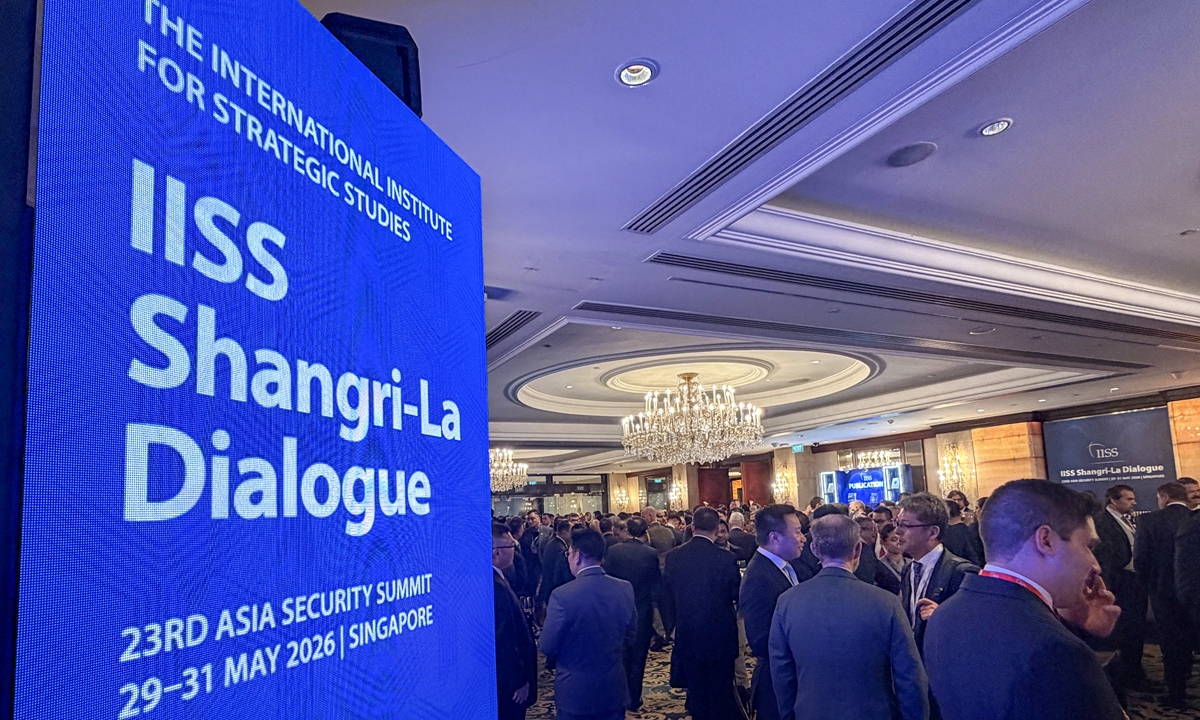
Participants attend the 23rd Shangri-La Dialogue in Singapore on May 29, 2026. Photo: Su Yaxuan/GT
The 23rd Shangri-La Dialogue (SLD), held in Singapore from Friday to Sunday, reflected continued improvement in major-country relations under the guidance of heads of state, raising expectations for greater stability and development in the world. Speaking at the forum, US Defense Secretary Pete Hegseth characterized the China-US summit held two weeks earlier as "historic," saying that bilateral relations are "better than they've been in many years." Hegseth's remarks aligned with the head of the Chinese People's Liberation Army expert delegation's call for China and the US to meet each other halfway, turn consensus into action, and guide military ties toward healthy, stable and sustainable development. The noticeable shift in the tone of this year's SLD reflects the growing recognition of China's governance wisdom and ideas and demonstrates that strategic stability is the fundamental way for major powers to manage their relations.Two major diplomatic engagements in mid-May had already injected much-needed certainty into global strategic stability. At the Beijing summit between the Chinese and US heads of state, the two sides embraced a new vision of building a constructive bilateral relationship of strategic stability, providing strategic guidance for bilateral relations over the next three years and beyond. Meanwhile, the meeting between the Chinese and Russian presidents marked that bilateral relationship has entered a new stage of greater achievements and faster development. One brought a "new vision," the other ushered in a "new stage." At a time when the world is yearning for peace and development, China has maintained communication and cooperation with major powers simultaneously, offering a responsible answer to safeguarding the current international order and maintaining peace and stability in the Asia-Pacific and beyond. It has also demonstrated the confidence and composure of major-country diplomacy with Chinese characteristics in the new era.
On the eve of the SLD, the Group of Friends for Global Governance convened at the UN headquarters in New York City. During the meeting, Wang Yi, a member of the Political Bureau of the CPC Central Committee and Chinese Foreign Minister, put forward nine directions on reforming and improving global governance, which received positive responses among participating parties. Any regional security mechanism must reflect the purposes and principles of the UN Charter and strengthen the status and role of the UN. Through its statements and exchanges at the SLD, the Chinese delegation successfully elevated these proposals from the UN platform to the forefront of Asia-Pacific security discussions, thereby once again allowing the international community to clearly see that China is not only a guardian of peace and stability in the Asia-Pacific but also an active contributor to reforming and improving global governance.
Adhering to the one-China principle serves not only as a basic expression of respect for China's core interests but also as an important safeguard for regional peace and stability. Notably, Hegseth made no mention of the Taiwan question in his speech at the SLD, leaving the Democratic Progressive Party authorities visibly embarrassed and reminding the "'Taiwan independence'" separatist forces seeking to rely on the US, as well as certain external forces attempting to exploit the Taiwan question to hype up regional tensions, to recognize reality as soon as possible. It also underscores the value of strengthened communication and effective dispute management between the two major powers across the Pacific for security across Asia-Pacific region.
In recent years, Japan has significantly increased its defense spending, developed offensive military capabilities, relaxed restrictions on the export of lethal weapons, and pushed for revisions to its pacifist constitution. All these moves have long gone beyond the scope of its postwar "exclusively defense-oriented policy" and raised concerns within the international community about Japan's return to militarization.
At this year's SLD, the Chinese representative pushed back the Japanese defense minister's bid for international support for Japan's military expansion, pointing out the dangerous trend and stressing the need to remain vigilant against any revival of militarist thinking. This position reflects China's longstanding stance and echoes the concerns of many Asian countries and the broader international community, representing China's concrete efforts to uphold the outcomes of World War II and the postwar international order.
Now in its 23rd year, the SLD was originally a forum that largely reflected Western perspectives on international security and Asia-Pacific affairs. Today, however, it is undergoing notable changes. One of the most striking features of this year's SLD was the growing divisions within the West and the weakening of its dominance, contrasted with the steadily increasing influence of security concepts and proposals put forward by emerging economies and developing countries in the Asia-Pacific. To be sure, some still call for bloc politics, exclusive clubs and camp confrontation. But the crises and conflicts bred by such outdated concepts and practices have made many countries cautious, and even the US has been forced to rethink its approach and adjust policies.
A close look at this year's SLD reveals that China's posture was pragmatic, open and, above all, confident. In an era marked by uncertainty, China is injecting stability into the world through a steady and predictable approach. That stability stems from its commitment to the purposes and principles of the UN Charter, its defense of the postwar international order, its efforts to promote a new model of major-country relations, and its pursuit of a fairer and more just global governance system. This year's SLD once again demonstrated that stability in the Asia-Pacific requires not only strategic consensus among major powers but also all parties' genuine adherence to international law and the basic norms governing international relations, as well as stronger cooperation in global governance.
RELATED ARTICLES