Chinese embassy intrusion with a knife reveals dangerous right-wing trends in Japan: Global Times editorial
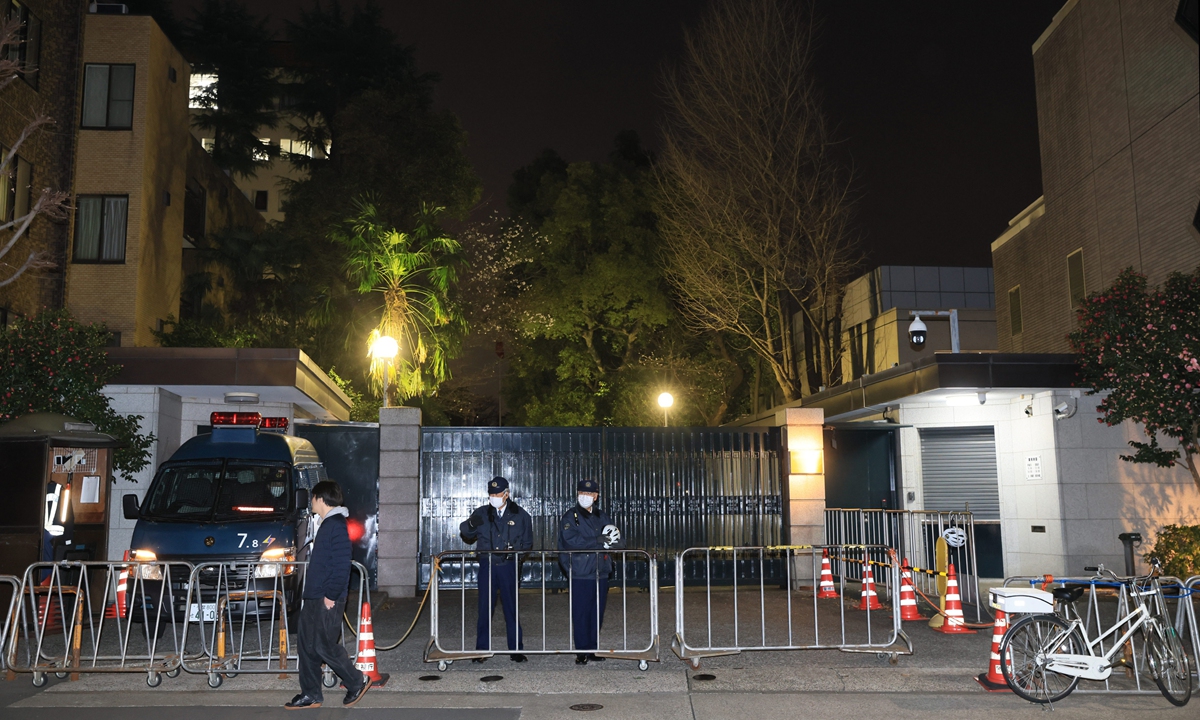
A photo shows the Chinese embassy in Japan, where a man believed to be a member of the Japan Self-Defense Forces trespassed in Minato Ward, Tokyo, on March 24, 2026. Photo: VCG
On Tuesday morning, a man who claimed to be a sitting officer of Japan's Self-Defense Forces scaled the wall and broke into the Chinese embassy in Tokyo. The individual admitted that his actions were illegal and threatened to kill Chinese diplomats in the so-called "name of god." According to NHK, a knife was found at the scene, but fortunately, no embassy staff were injured. This is by no means an isolated case of individual extremism; rather, it serves as a mirror reflecting the grim reality of rampant far-right ideology and the resurgence of militarism within Japan today.Armed with a knife, scaling the wall, forcibly breaking in, and threatening to kill - from both legal and diplomatic perspectives, this constitutes a blatant international crime. The Vienna Convention on Diplomatic Relations explicitly stipulates that the diplomatic courier shall enjoy personal inviolability; the premises of the mission shall be inviolable, and the agents of the receiving State may not enter them, except with the consent of the head of the mission.
The Chinese embassy in Japan is an important representative institution of the People's Republic of China overseas; its security and dignity must not be subjected to any provocation or violation. The man's actions constitute a serious violation of international law, directly threatening the personal safety of Chinese diplomatic personnel and the security of diplomatic facilities. The nature of these acts is egregious, and their impact is extremely detrimental.
The Vienna Convention on Diplomatic Relations further stipulates that the receiving State shall treat the person of a diplomatic agent with due respect and shall take all appropriate steps to prevent any attack on his person, freedom or dignity. As the host country, Japan bears an inalienable obligation under international law to ensure the security of foreign embassies in Japan. However, the fact that a lawbreaker was able to easily breach the embassy's perimeter defenses while carrying a weapon and intrude into the premises with the intent to commit murder reveals a major flaw in the Japanese police's security arrangements. If this individual is indeed a member of the Japan Ground Self-Defense Force, then the Japanese government bears undeniable responsibility for its failure to properly supervise and educate its Self-Defense Force personnel. The Chinese Ministry of Foreign Affairs immediately lodged strong démarches and protests with Japan, asking the Japanese side to thoroughly investigate the incident at once. This action is entirely justified and beyond reproach.
Committing violence "in the name of god"? This sounds more like the fanatical ravings of a medieval Inquisition than something compatible with the values of a modern, 21st-century civilized nation. At its core, it represents a blatant contempt for the modern international order and the basic norms of civilization. After the incident, most Japanese media outlets chose silence or avoidance; the few reports that did appear were cursory and downplayed, attempting to evade Japan's responsibility, obscure the spread of far-right ideology at home, and avoid triggering international scrutiny and criticism. Such selective reporting only further illustrates how a right-leaning political climate exerts a strong grip over public discourse. Recently, criminal offenses in Japan targeting the Chinese nationals have occurred with increasing frequency, including incidents involving attacks from butsukari otoko or "bumping men," unprovoked violent assaults, and acts of provocation and harassment. Safety risks targeting Chinese tourists have been on the rise. The intrusion incident can be seen as an extreme manifestation of the steadily worsening public sentiment toward China within Japan over a period of time.
One cannot help but ask: Why has this malignant surge of far-right ideology been able to ferment and spread so freely in Japanese society? Such developments do not emerge overnight, and the Japanese government cannot evade responsibility for the current situation. For years, the Japanese government's misguided policies on core issues in China-Japan relations, such as historical interpretation and the Taiwan question, have had deep and lasting repercussions. The revision of historical textbooks to downplay, whitewash, or even deny acts of aggression; insular, echo-chamber-style narratives on the Diaoyu Islands issue; the amplification of the so-called "China threat" narrative; the stoking of public anti-China sentiment, hostility, and exclusion; and the long-standing rightward shift in propaganda alongside calls for military expansion - all of these have created fertile ground for the distorted logic and extreme violence seen in incidents such as the intrusion.
Since the Takaichi government came to power, it has accelerated the opening of the "Pandora's box," indulging in constitutional revision, military expansion, and historical distortion - three devilish actions that tear apart the post-war peace seal and allow Japan's rightward shift to accelerate, posing a real threat to regional peace.
The Japan Self-Defense Forces are exhibiting a series of dangerous trends: large-scale restructuring and expansion, strengthening military deployments on the southwestern islands, forming a "space operations group," developing long-range offensive missiles, and even testing modifications to the "Three Non-Nuclear Principles."
The Self-Defense Forces are rapidly surpassing the limitations of an "exclusively defense-oriented" posture and transitioning toward offensive military capabilities. In this context, can the recent incident be viewed as a dangerous footnote to this shift?
The incident has sounded alarm bells around the world. It confirms the grim reality of the rising threat of Japan's "neo-militarism." The international community should remain highly vigilant. The Japanese government indulges extremist ideologies, incites divisive emotions, and glorifies right-wing actions. Its policies not only undermine China-Japan relations but also threaten Japan's own social order, the foundation of the rule of law, and its international credibility. Japan must promptly investigate the incident, severely punish the perpetrator, and implement effective measures to ensure the absolute safety of Chinese diplomatic missions and personnel in Japan, providing a responsible account to China and the international community.
RELATED ARTICLES