Pallas's cat cubs found in herders' homes got protected in place and released back into the wild
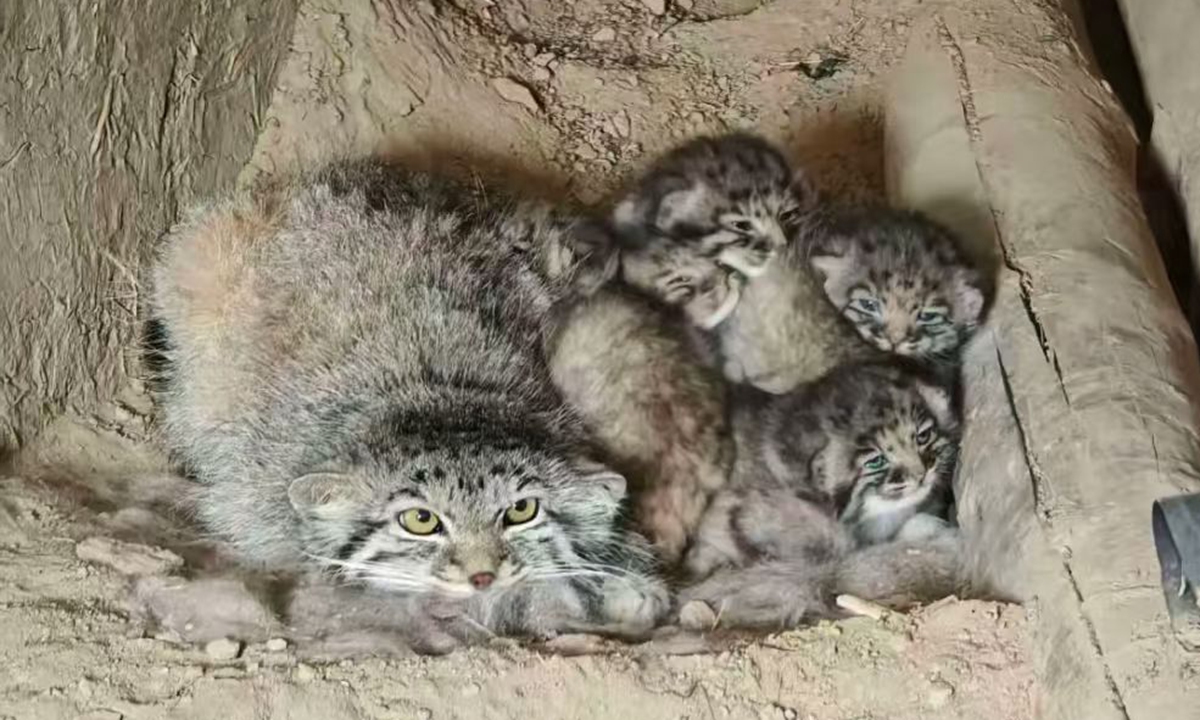
A pallas's cat mother and her cubs found at a local herder's home in Shawan county, Tacheng prefecture in Northwest China's Xinjiang Uygur Autonomous Region Photo: official WeChat account of people.cn
A mother Pallas's cat, also known as the manul, and her five kittens found at a local herder's home in Northwest China's Xinjiang Uygur Autonomous Region were safely released back into the wild after 40 days of monitoring and protection by local police, people.com.cn reported on Sunday.Recently, a herder in Shawan, Tacheng prefecture in Xinjiang, unexpectedly discovered that a wild animal had given birth in a hut and reported the matter to the police for assistance. Upon careful identification, the police officers confirmed the animals as a mother Pallas's cat, a national second-class protected species, with young cubs.
As Pallas's cats are highly sensitive, the local police opted against relocation of the family and instead chose to protect the mother and cubs in place to avoid disturbing their survival.
The police installed monitoring equipment and conducted round-the-clock surveillance to track the movements of the Pallas's cat family in real time.
Meanwhile, the police organized ecological volunteers to carry out regular patrols, restricted access, and minimized disturbance to preserve their habitat and protect the Pallas's cat family.
After 40 days of monitoring and protection, the Pallas's cat and her cubs were safely released back into the wild.
Coincidentally, a herder's summer pasture home in North China's Inner Mongolia's Xilin Gol League received some unexpected guests, and he reported it to local natural reserve zone on May 28.
The reserve staff came to the herder's home and confirmed they were five Pallas's cat cubs and judging from their healthy and lively situation, the mother is capable of taking good care of them.
After consulting the herder, the reserve staff also adopted a minimal-intervention approach, avoiding capture or relocation, and installed infrared cameras for round-the-clock monitoring, ensuring the cubs could grow naturally in a safe environment before eventually returning to the wild.
Global Times
RELATED ARTICLES