Washington moves to block Chinese firms located outside China from accessing advanced AI chips; Chinese experts call latest US step discriminatory and counterproductive
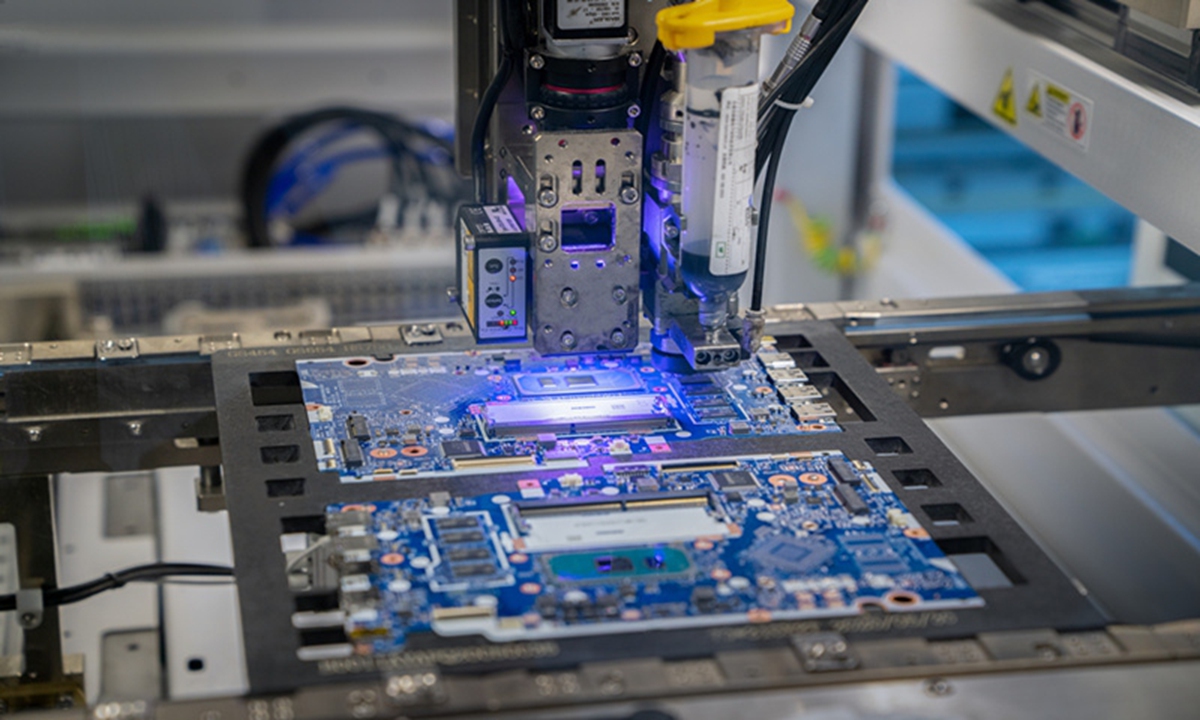
A chip manufacture machine Photo: VCG
Washington has once again moved to escalate its chip suppression against China. According to a Reuters report on Monday, the US Department of Commerce on Sunday moved to close a potential loophole that may have led companies to export the world's most advanced chips - such as Nvidia's most sophisticated Blackwell processors - to subsidiaries of Chinese companies located outside China. Chinese experts described the latest restrictions as targeted and discriminatory, arguing that the measures are unlikely to achieve their intended goals and could instead harm US companies while accelerating China's technological development.
The Reuters report claimed that the latest move suggests that the best US artificial intelligence (AI) chips may have been making their way to the subsidiaries of Chinese AI firms based in locations such as Malaysia, despite broader US efforts to cut Chinese companies off from semiconductors that are essential for AI development.
In its guidance, the department's Bureau of Industry and Security claimed that it would enforce license requirements for advanced chips to entities based in China when the entities were located outside China.
However, the new guidance does not require data centers to stop using the chips or cut off servicing of the advanced computing items such as servers, Reuters reported.
Zhou Mi, a senior researcher at the Chinese Academy of International Trade and Economic Cooperation, told the Global Times on Monday that treating Chinese companies differently simply because their headquarters are in China runs counter to the principles of the multilateral trading system and lacks a solid legal or economic basis.
It is unclear how many of the chips were exported during the year that the Trump administration left the door open. Reuters cited one chip industry source with deep supply-chain knowledge, who estimated that it was in the hundreds of thousands.
Ma Jihua, a veteran telecom industry observer, told the Global Times that Washington's latest move is part of a broader pattern of repeatedly tightening chip restrictions.
Zhou said that the measures are also likely to hurt US companies. He noted that previous export controls have already caused American firms to lose market share in China, one of the world's largest technology markets, while creating opportunities for competing suppliers.
According to Zhou, so-called efforts to "close loopholes" cannot eliminate underlying market demand. The continued interest in advanced chips reflects strong commercial needs, and attempts to restrict trade are more likely to increase costs, uncertainty and inefficiencies across global supply chains.
Shipments of Nvidia's H200 chips to China have been stalled due to disagreements over sales terms in both China and the US, Reuters reported on April 22. Addressing the issue during a Senate hearing in April, US Commerce Secretary Howard Lutnick said that "The Chinese central government has not let them, as of yet, buy the chips." He added "We have not sold them chips as of yet."
As of press time, Nvidia had not responded to the Global Times' request for comment.
Zhou added that China's large market, deep talent pool and comprehensive industrial ecosystem will continue to support technological innovation. He said that attempts to contain China's development through restrictions are unlikely to achieve their intended goals and could instead accelerate technological upgrading and industry restructuring.
Ma said that the restrictions could create long-term risks for Nvidia and the broader US semiconductor industry. By limiting access to the Chinese market, US policies may provide more room for competitors and domestic Chinese suppliers to grow. Over time, losing access to one of the world's largest technology markets could weaken the global competitiveness of American chipmakers, he said.
Ma also argued that China's semiconductor industry has continued to advance despite years of restrictions, with growing capabilities in manufacturing, research and commercialization. Supported by a vast domestic market and an increasingly complete industrial ecosystem, China's chip sector is likely to continue upgrading, while attempts to artificially restrict technology flows may ultimately accelerate the development of alternative supply chains and technologies.
Chinese Foreign Ministry spokesperson Lin Jian previously said that China's position on opposing the politicization and weaponization of technology and trade issues, and on malicious blockades and suppression against China, is consistent and clear. Such practices disrupt the stability of global industrial and supply chains and are in no one's interests.
RELATED ARTICLES