Blue Momentum: From aquaculture to green energy, Fangchenggang in S.China’s Guangxi charts sustainable path toward the sea
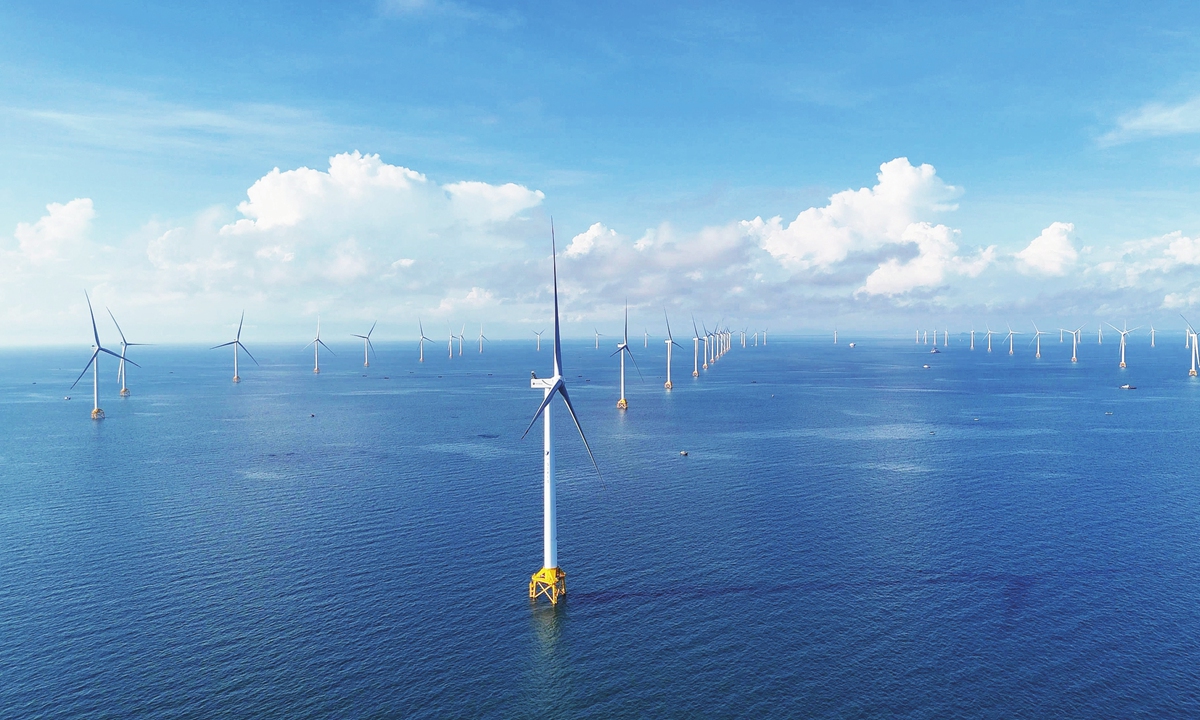
The Fangchenggang offshore wind power demonstration project in South China's Guangxi Zhuang Autonomous Region on May 28, 2025 Photo: VCG
China has put high-quality development of its rich marine resources on the agenda. With a mainland coastline stretching 18,000 kilometers and a sea area under its jurisdiction of around 3 million square kilometers, China is a major maritime country with vast potential for developing the marine economy. To document its development, the Global Times is launching the "Blue Momentum" series of in-depth articles from local marine economic powerhouses. The third installment focuses on Fangchenggang, South China's Guangxi Zhuang Autonomous Region.
Balancing on stilts nearly five feet high, fishermen wade through shifting tides with wooden poles tied to fishing nets in their hands. Beneath them, seawater one to two meters deep surges with every step. Working in unison, they struggle against the waves to haul in their catch, watched by crowds of tourists onshore.
From May to October each year, often before typhoons arrive, large numbers of small shrimp gather in the shallow coastal waters off Dongxing, Fangchenggang, South China's Guangxi Zhuang Autonomous Region, making it the best season for local fishermen to practice stilt fishing. This ancient fishing method is passed down from generation to generation and continues to this day.
Today, it is no longer the primary means of livelihood. Instead, it has been preserved and adapted into an intangible cultural heritage performance, becoming part of the region's coastal tourism.
That same transition from traditional fishing to broader use of marine resources is also reflected in Fangchenggang's development. The marine economy has moved beyond small-scale nearshore fishing toward deep-sea aquaculture and technology-driven maritime activities, supported by advances in marine engineering, navigation, and digital systems.
Alongside this shift, industries such as aerospace, offshore wind power, nuclear energy, and new materials are blossoming in parallel, adding further momentum to the city's marine economic structure. In 2025, Fangchenggang's GDP grew by 6.3 percent, ranking among the top in Guangxi for three consecutive years. The city's gross ocean product rose by 8.5 percent year-on-year, outpacing its GDP growth rate, the Economic Daily reported.
Fangchenggang's trajectory reflects China's broader drive to develop the marine economy. During the 14th Five-Year Plan period (2021-25), the gross ocean product accounted for 7.8 percent to 7.9 percent of China's GDP, while its growth rate exceeded overall GDP growth for five consecutive years, the People's Daily reported.
During the 15th Five-Year Plan period (2026-30), promoting high-quality development of the marine economy has been be elevated as one of China's major development priorities.
China's 15th Five-Year Plan period is expected to bring the marine economy into a more prominent position within the country's broader development agenda, Liu Shuguang, a professor at the Ocean University of China, told the Global Times.
Liu noted that the push for higher standards in marine development signals a broader shift in approach, moving away from growth driven by scale toward a model that prioritizes efficiency, innovation, and long-term sustainability. The expert said this reflects a growing recognition of the ocean as a key pillar in China's future development strategy.
Booming industries
In a small seaside village in Dongxing, 48-year-old Su Haibing sits in front of the village ancestral hall, enjoying the sea breeze. Built in a traditional Chinese architectural style, the hall serves as a gathering place for the local Jing ethnic group. Though modest in size, it houses memorial tablets dedicated to generations of ancestors who made their living from the sea.
As a local fisherman, Su began learning the art of stilt fishing from his grandfather at the age of 10. Back then, the small fish and shrimp they caught not only fed the family, but could also be sold at local markets for a meager income. Life was hard, and every yuan earned came through exhausting labor on the water.
Now, those difficult days are long gone. Su told the Global Times that the wealth the ocean once provided through fishing has now transformed into a thriving tourism economy. Every summer, the village welcomes more than a million visitors from China and abroad, including many from neighboring Vietnam. Local villagers have opened guesthouses and seafood restaurants, while their average annual disposable income has risen to over 30,000 yuan, more than double what it was a decade ago.
As Su puts it, "now people can become their own 'boss' right at their doorstep."
Moreover, the marine economy has rapidly diversified and new industries are booming. Inside the building of the satellite program of AIRSAT Technology Group in Fangchenggang, the achievements in the region's aerospace industry are on display.
In late 2025, the Beibu Gulf No 1, Guangxi's first satellite developed with independent intellectual property rights, was launched into space. The satellite, jointly developed by AIRSAT Technology Group and jointly operated by the Fangchenggang City Investment Development Group Co, has since provided a wide range of data services for the region and beyond, including navigation support for fishermen and marine resource exploration.
Dong Weidong, chief designer of satellite models at the Guangxi-based satellite company, said that all technologies are independently developed and designed to serve multiple sectors.
"We provide fishermen and shipping companies with services such as maritime weather forecasting and positioning support, helping fishermen locate more efficiently and sail more safely at sea," Dong said, noting that the company has signed letters of intent for satellite and data services with companies in countries including Malaysia and Vietnam, with cumulative intended sales exceeding 100 million yuan.
Talking about the region's advantages for satellite development, Dong said that Fangchenggang's geographic conditions make it well suited for aerospace operations, while strong policy support and industrial infrastructure have accelerated its development.
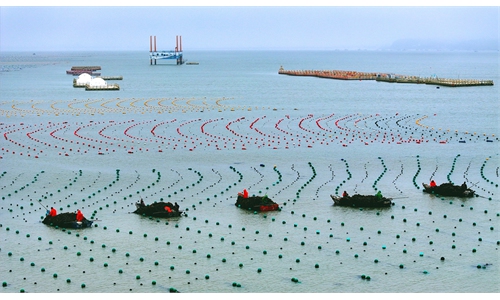
Beyond the digital layer of marine management enabled by satellite technology, Fangchenggang's transformation is also visible on the water itself. In the offshore waters of Fangcheng district, a large cluster of deep-sea golden pompano aquaculture platforms floats on the sea surface, showcasing the region's shift from traditional fishing to modern aquaculture.
"Recently, we released 1.5 million high-quality fingerlings over a three-day period. These golden pompano fingerlings all came from our independently developed breeding system at the Fangchenggang base, and feature strong genetic traits, higher immune activity, and enhanced adaptability to harsh environments," Li Nan, deputy general manager of Jinse Haiyang Industrial Development Co, told the Global Times.
He added that, supported by the marine ranch intelligent management system and precise nutritional supply, market-sized fish are expected to be harvested and supplied in batches starting in November this year.
Supported by a large-scale local fisheries processing center, the city has developed a complete industrial chain integrating breeding, aquaculture, processing, cold-chain logistics, and sales. Its products are supplied not only to markets across China but are also exported to multiple countries, including those in ASEAN, the Global Times learned.
In 2025, the city's total aquatic output reached 649,200 tons, up 4.72 percent year-on-year. Marine aquaculture totaled 507,400 tons, nearly 80 percent, while capture fisheries were only 88,700 tons, according to the regional government. Growth is now driven not by "extracting fish from the sea," but by sustainable, large-scale aquaculture, a local report said.
Bluer, greener growth
The development of Fangchenggang's marine economy is not merely about speed and scale, but about "bluer and greener" growth.
At the city center, there is a large mangrove area that is impossible to miss, where egrets can often be seen taking flight overhead, while small shore crabs move through the roots and mud below. These scenes reflect the region's notable achievements in ecological conservation.
According to the Fangchenggang Municipal Ocean Bureau, the city protects the largest contiguous mangrove forest area along the Chinese mainland coastline, covering more than 2,258 hectares.
Although this coastal city lacks abundant coal and oil resources, it has not fallen behind in building a national integrated energy security system. Each year, it generates enough energy not only to meet its own demand, but also to supply other regions, including parts of Southeast Asia, the Global Times learned.
Major energy projects such as nuclear power, offshore wind, solar photovoltaics, and energy storage are being actively developed. Clean energy has become the dominant source of power in the city's energy supply mix.
A series of landmark green energy projects, including the Nanshan Wind Farm, have brought the city's clean energy installed capacity to 7.384 million kilowatts, accounting for more than 60 percent of the city's total installed capacity. The city's total installed power generation capacity exceeds 12.35 million kilowatts, while clean energy accounts for 64 percent of total electricity output, according to the city's development and reform commission.
Greater connectivity
With its location bordering ASEAN countries and an expanding sea-rail intermodal transport network, Fangchenggang has recently strengthened its role as a regional land-sea gateway. It handles growing flows of ASEAN agricultural products and bulk commodities entering China, while serving as an export channel for Chinese goods heading toward Southeast Asia.
In 2025, the total import and export value of the Dongxing Port (including border trade) reached 170.55 billion yuan, up 10.3 percent year-on-year; the number of inbound and outbound vehicles reached 348,000, up 29.3 percent, Huang Wei, deputy director of the Dongxing Municipal Bureau of Commerce and Port Administration, told the Global Times.
Meanwhile, cargo volume of imports and exports reached 2.623 million tons, up 29 percent, and the total value of cross-border e-commerce exceeded 6.2 billion yuan, according to Huang.
From bulk commodities imported by sea from South America, Africa, and other regions, to tropical fruits shipped from Malaysia and Vietnam, and to electronic products and daily consumer goods exported from China, Fangchenggang has become an important hub connecting domestic and international markets through its expanding land-sea integrated trade network.
Against the backdrop of China's broader maritime development strategy, this coastal city in southern China is reshaping its relationship with the sea as its marine economy continues to thrive.
From mangrove conservation to energy development from traditional fishing to a full industrial chain, Fangchenggang is strengthening connectivity and economic links with ASEAN countries and beyond.
RELATED ARTICLES