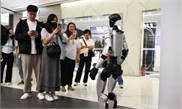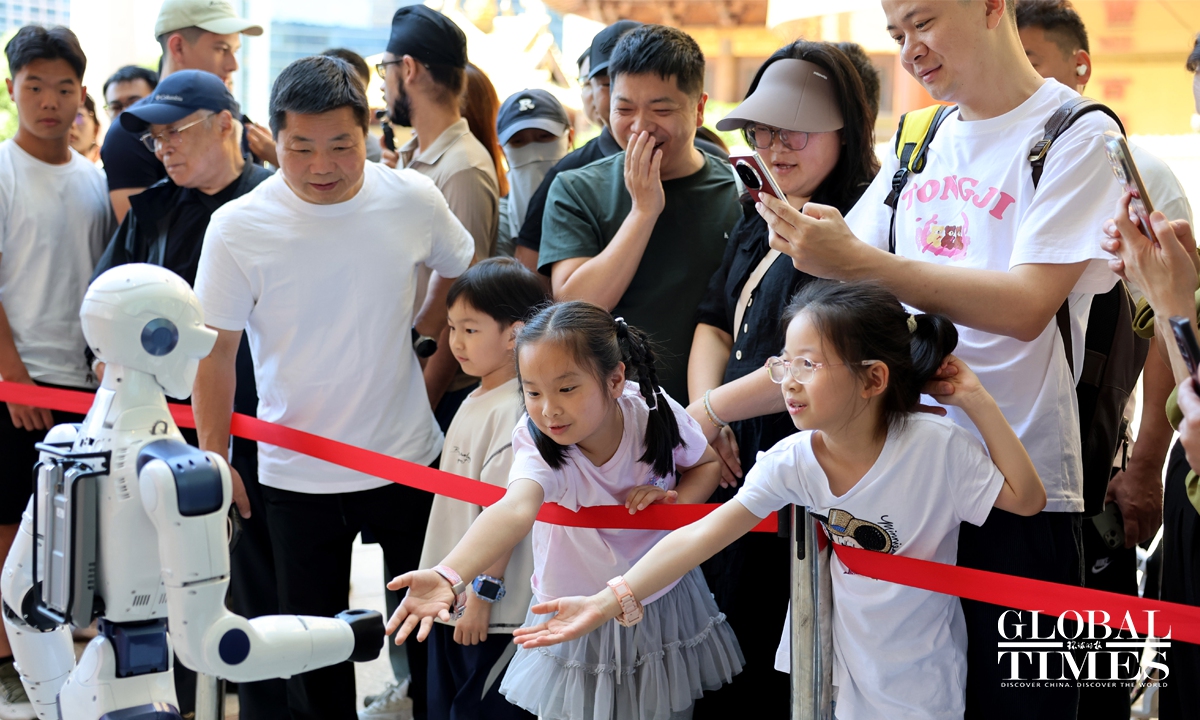
Chinese start-up Unitree Robotics opened its Asia's first embodied intelligence experience store in Jing'an district in downtown Shanghai on Sunday. Spanning over 100 sqms, the store features and sells a range of end-user products, including the G1/R1 humanoid robot and Go2 robotic dog.
China’s humanoid robot sector is shifting from tech showcases to growing consumer adoption, with major players accelerating commercial roll-outs.
UBTech’s consumer-focused brand UWorld has launched pre-orders for the world’s first full-size hyper-realistic humanoid robot on JD.com on Tuesday, targeting emotional companionship, with an official release set for June 30, the Global Times learned from UBTech on Tuesday.
Customers can secure early units with 3,000 yuan ($443) deposit through July 15. As of press time, 38 units had been pre-ordered on JD.com.
Meanwhile, another Chinese tech company AgiBot robot will open its first offline store in Shanghai on June 13, showcasing its Expedition-series humanoids and quadruped robots for interactive experiences, the Global Times learned from AgiBot robot on Tuesday.
The store offers an immersive robotic experience, where robots manage the full retail journey—from in-store guidance to backend operations—marking the first time robots are effectively “selling themselves.”
Prior to those launches, Unitree Robotics opened Asia’s first embodied AI experience store in Shanghai’s Jing’an District on May 31, displaying humanoids and quadruped robots for public interaction.
Liu Dingding, an industry analyst, told the Global Times on Tuesday that companies are opening offline experience stores intensively, not primarily for short-term sales, but to cultivate market awareness.
“This trend signals that consumer-side commercialization of humanoid robots is gaining momentum. It is expected that leading domestic manufacturers could reach an annual shipment scale of around 10,000 units as early as next year,” Liu said.
As more humanoid robots move beyond exhibition displays and enter practical scenarios such as households, logistics and manufacturing, the pace of mass production is likely to accelerate gradually.
According to China Media Group (CMG), the country’s domestic humanoid robot shipments reached about 18,000 units in 2025 and are projected to climb to 62,500 units in 2026.
Breakthroughs in major component technologies for domestic humanoid robots have emerged continuously, while the localization rate of key parts has climbed markedly. The advancements lay a solid foundation for large-scale mass production and multi-scenario deployment of humanoid robots, according to CMG.
Since last year, the core component segment has attracted surging capital inflows. According to incomplete statistics, the humanoid robot sector saw remarkable investor enthusiasm in Q1 2026. Total financing across the whole industry reached 68.1 billion yuan, exceeding the full-year financing volume of 2025 alone; financing deals closed in March alone hit 50 cases, CMG reported.
The booming capital market sentiment for the industry is further embodied by the IPO progress of Unitree Robotics. The firm’s STAR Market IPO application has passed the review by the Shanghai Stock Exchange Listing Committee on Monday.
Unitree Robotics plans to raise 4.2 billion yuan through this listing. The proceeds will be used for projects involving the research and development of intelligent robot models and robotic bodies, the development of new intelligent robot products, and the construction of an intelligent robot manufacturing base.
The accelerated research and development investment and the rapid advancement of China’s smart manufacturing sector are projected to drive further cost cuts for humanoid robots. Meanwhile, incessant technical upgrades will enable those robots to carry out a wider range of delicate household movements. With the advances in place, humanoid robots are well positioned to make their way into Chinese households across the country, Liu said.
He expected that humanoid robots may see small-scale household adoption within three to five years, while large-scale market penetration across Chinese families could materialize in five to 10 years.