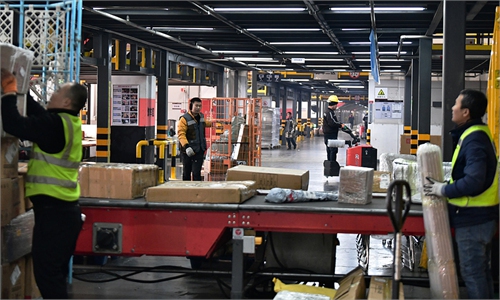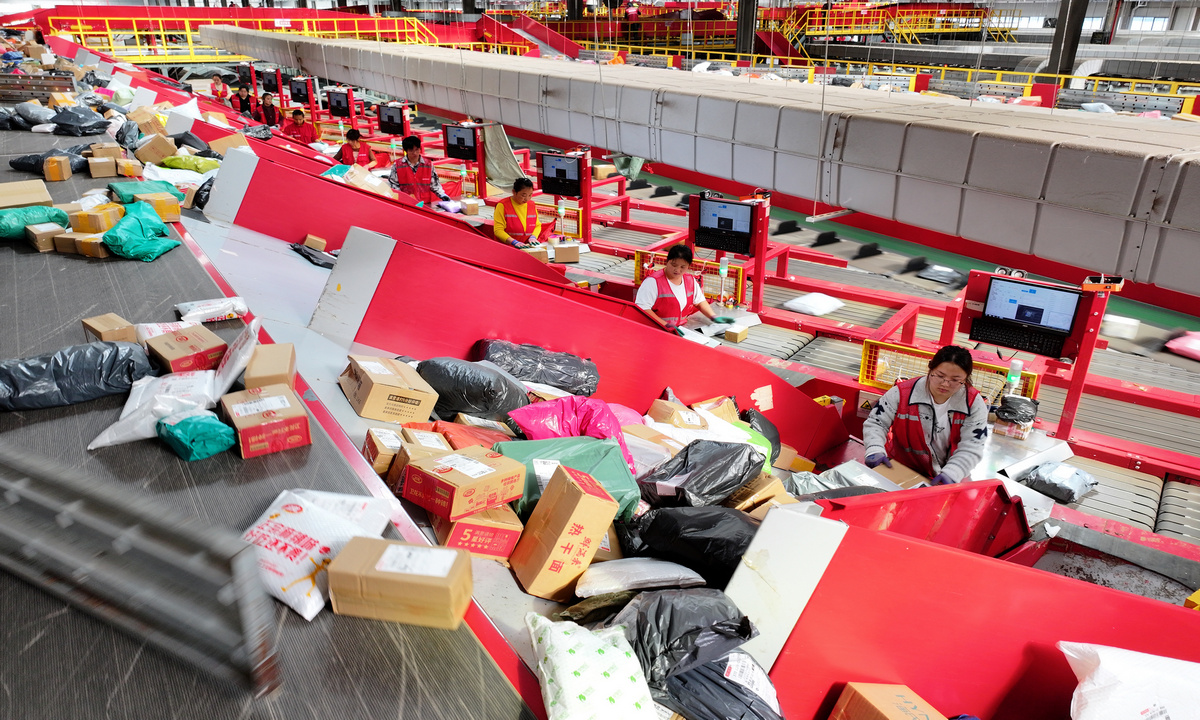
Workers sort parcels at an express delivery company in Yangzhou, East China's Jiangsu Province, on November 11, 2025. China's Double 11 shopping festival is hitting its peak, with major domestic e-commerce platforms and courier firms seeing a surge in cross-border parcel shipments. Photo: VCG
China's annual "618" shopping festival has delivered an encouraging first round of results, with the artificial intelligence (AI) emerging as an important growth driver of online sales.
Nearly 100 products powered by JD.com's AI JoyInside, an AI agent for smart hardware, have been launched, with the "AI Home" product portfolio making its first collective debut during the promotion. In the first 52 hours, transaction volume of new AI home appliance and home living products integrated with JoyInside increased by 200 percent from one month earlier, according to the data provided by JD.com on Tuesday.
Digital tools help merchants and brands improve efficiency. JD.com's digital avatar livestreaming solution JoyStreamer continued to scale, serving more than 80,000 merchants and reaching more than 800,000 cumulative livestreaming hours. Overall transaction volume generated through JoyStreamer exceeded 240 million yuan ($35.47 million), the company said.
AI-powered smart hardware grew by 80 percent year-on-year, while sales of AI glasses increased nine-fold, Taobao said on Tuesday.
Taobao said that as of Sunday, over 40,000 brands saw their sales double, the number of brands exceeding 100 million yuan increased by 40 percent year-on-year, and the number of livestreaming rooms exceeding 100 million yuan with double-digit growth increased by 50 percent year-on-year.
The results came after China's annual "618" shopping festival — originally launched around June 18 but now spanning several weeks — showed a strong focus on AI, with major Chinese e-commerce platforms embedding AI into every link of the supply chain, from logistics to customer service.
Since mid-May, major platforms such as JD.com, Taobao, and Douyin have rolled out their specific "618" promotion plans. However, unlike previous several years when the focus was on overwhelming consumers with subsidies and rock-bottom prices,the most striking trend this year is the integration of AI.
Alibaba has made strides in AI-driven shopping services by integrating its Qianwen large language model with Taobao.
Users can select, compare, and purchase goods simply by chatting with the AI on the Qianwen app. The Qianwen AI shopping assistant is also available on Taobao, offering features such as virtual try-ons, preferential price calculations, and flash purchase assistance, the Global Times learned from Alibaba.
JD.com said that its "618" shopping festival this year will feature a major industrial innovation driven by AI in cost control and operational efficiency, delivering consumers an upgraded shopping experience empowered by AI.
This year's "618" shopping festival shows how AI is becoming deeply integrated into every part of JD.com's supply chain, creating new momentum across the entire ecosystem. JD.com is working more closely with brands and merchants to continuously innovate across product formats, service models, and technology applications, according to the company.
Chinese experts said that AI enables companies to better understand consumer needs and match products and services with real market demand. This profound transformation helps create new consumption growth and brings a fundamental upgrade to the consumer sector.
This booming trend is backed by clear policy guidance. In April, six central government departments, led by the Ministry of Commerce, jointly issued a guideline aimed at advancing the high-quality development of e-commerce and better serving the real economy.
The document explicitly advocates for the integration of AI and e-commerce, encouraging leading platforms to scale up the research and application of large language models. It also encourages the industry to optimize consumer experiences, reduce operational costs, and improve overall efficiency.
Global Times
RELATED ARTICLES