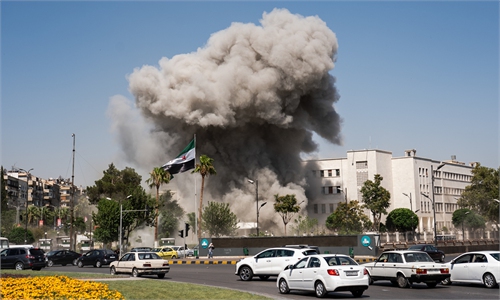
US President reportedly lashes out at Israeli PM over Lebanon escalation; Washington seeks to return conflict to talks despite maritime risks: Chinese expert
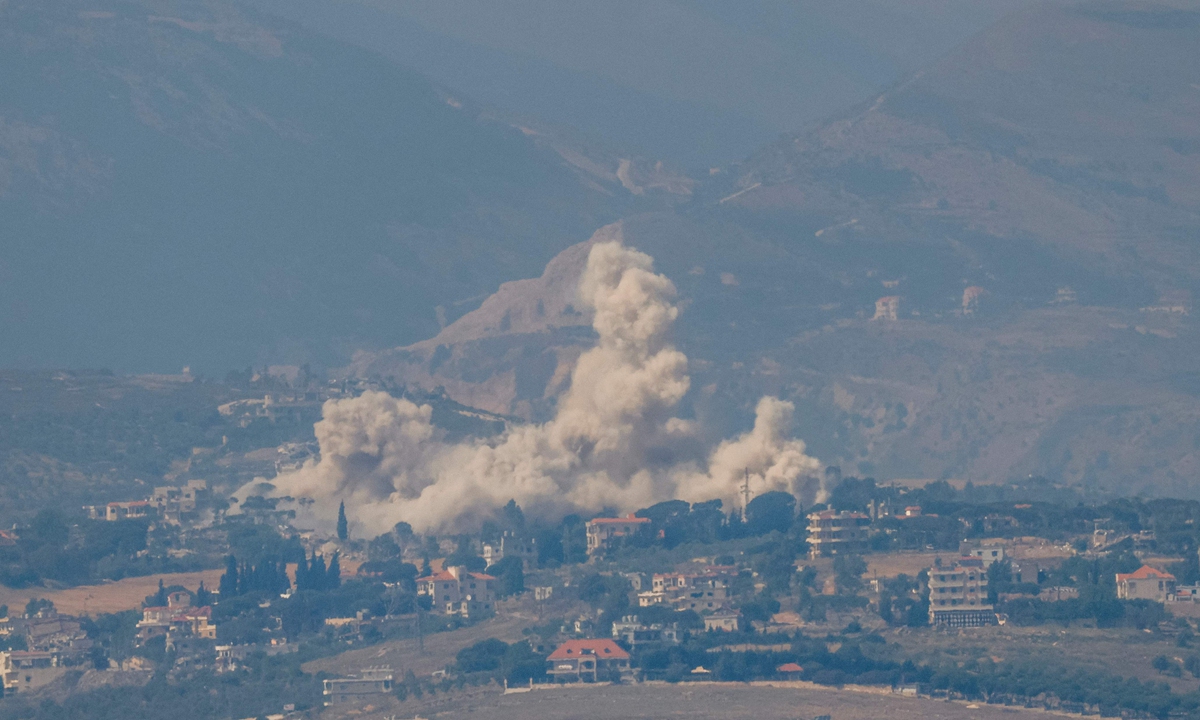
Smoke rises from southern Lebanon after Israeli strikes, as seen from northern Israel's Upper Galilee region on June 1, 2026. Photo: VCG
US President Donald Trump has reportedly lashed out at Israeli Prime Minister Benjamin Netanyahu over Israel's military escalation in Lebanon in a phone call on Monday, Axios reported, as Washington claimed progress on Israel-Hezbollah de-escalation and US-Iran talks while Israel and Iran released conflicting signals over Lebanon and key maritime chokepoints.A Chinese expert said Washington has been trying to find a relatively "decent" way to reduce the risk of being further drawn into the conflict, with the US president's priority being to end the war-related entanglement with Iran and return to negotiations. However, Israel's moves may complicate Washington's efforts to bring the situation back to negotiations.
According to Axios report, one US official said Trump told Netanyahu that following through on his threats to bomb the Lebanese capital would further isolate Israel around the world.
A second source briefed on the call said Trump was "pissed" and at one point yelled at Netanyahu.
Trump's anger appeared to be driven by the fact that Netanyahu's decision to escalate in Lebanon was threatening to implode his negotiations with Iran. One official said this was one of Trump's worst calls with Netanyahu since he returned to office, according to the Axios report.
Zhu Yongbiao, director of the Center for Afghanistan Studies at Lanzhou University, told the Global Times on Tuesday that Trump's reported warning to Netanyahu showed that Washington had become more alert to Israel's attempts to shape US policy, as Israel's moves risk disrupting Washington's effort to bring the situation back to negotiations.
The Axios report followed Trump posting on Truth Social that he "had a very productive call with" Netanyahu, and said that there will be no Troops going to Beirut, and any Troops that are on their way, have already been turned back.
In his post, Trump also said that he "had a very good call with Hezbollah, and they agreed that all shooting will stop — That Israel will not attack them, and they will not attack Israel."
Regarding having an agreement to extend the ceasefire and reopen the Strait of Hormuz, Trump reportedly said that he thinks he will have one with Iran "over the next week," according to ABC News.
The US president described the situation as "a little glitch," referring to that Iranians were upset about Israel's attacks on Lebanon, but said he "turned that one around very quickly."
However, a statement posted by the verified Facebook account of the Israeli Prime Minister on Monday local time said Netanyahu told Trump that if Hezbollah does not stop firing at Israeli cities and citizens, Israel will strike targets in Beirut. "This position of ours remains unchanged," Netanyahu said, adding that the IDF would continue operations in southern Lebanon as planned.
Reuters reported on Sunday that Netanyahu had ordered troops to move further into Lebanon against the Hezbollah group, despite a ceasefire announced more than six weeks earlier.
In response, Tehran's negotiating team is stopping exchanges of messages with the US through mediators due to attacks on Lebanon, as diplomatic efforts to end the three-month-old Iran war continue, according to Reuters on Monday, citing Iran's Tasnim news agency.
Iranian Foreign Minister Seyed Abbas Araqchi on Monday wrote on X that the ceasefire between Iran and the US is unequivocally a ceasefire on all fronts, including in Lebanon. Its violation on one front is a violation of the ceasefire on all fronts. The US and Israel are responsible for the consequences of any violation, he wrote.
Zhu pointed out that Iran's latest signals represent more of a strategic warning than a sign of imminent large-scale escalation. Tehran appears to be using the risk of spillover to key maritime chokepoints to raise pressure on Israel and the US. The more likely scenario is that the US will continue to press for de-escalation and bring the situation back to negotiations, even if the talks remain deadlocked, Zhu added.
Lebanon's sovereignty, security and territorial integrity must be respected, and Israel should immediately withdraw all its troops from Lebanon, Fu Cong, China's permanent representative to the United Nations, said at an emergency UN Security Council meeting on the Lebanon-Israel situation on Monday afternoon local time, calling for an immediate ceasefire to end the fighting and ease tensions, according to China's Permanent Mission to the United Nations.
"We have noted that the parties concerned are holding negotiations toward a ceasefire, and we welcome all efforts aimed at peace. We hope that countries with important influence over the parties concerned will take active steps to help achieve a ceasefire as soon as possible," said Fu.
RELATED ARTICLES