Is falling pork prices a sign that Chinese consumers are 'reluctant to spend money on meat'?: Global Times editorial
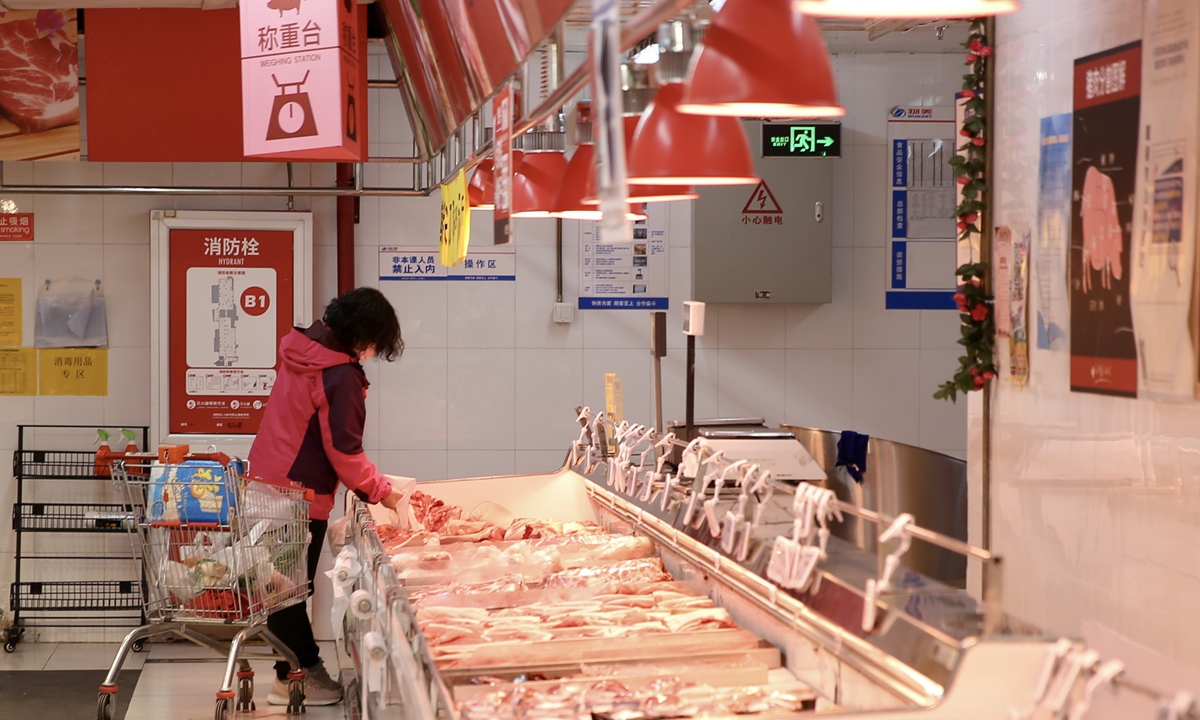
Photo: cnsphoto
Editor's Note:Currently, China's economy is steadily advancing along the path of high-quality development, even as domestic and international circumstances become increasingly complex. Some Western media, due to misunderstanding or bias, have repeatedly questioned or even distorted China's economic development. Accordingly, the Global Times launches the "Q&A on China's Economy" column to publish opinion pieces to present facts and clarify perceptions.
Over the past few months, pork prices in China have continued to decline. Some Western media outlets have seized on this trend, portraying it as an "ominous sign" for the Chinese economy. They argue that falling pork prices reflect "anemic consumer spending," claiming that a surge in production following previous price increases has now collided with consumers' supposed preference for "saving rather than spending," resulting in a glut. Such arguments are either astonishingly lacking in basic economic understanding or driven by ulterior motives.
Are pork prices falling because Chinese consumers are reluctant to spend money on meat? Clearly not. According to data from the UN Food and Agriculture Organization (FAO), China's per capita daily protein supply now exceeds that of the US and ranks among the highest in the world. China also accounts for roughly 30 percent of global meat consumption, consistently ranking first worldwide. This figure has remained broadly stable while continuing to edge upward in recent years. The modest decline in pork consumption mainly reflects structural changes, with dietary preferences shifting toward beef, mutton, poultry and seafood. Additionally, benefiting from China's market opening-up, a wide range of high-quality imported meat products has enriched market supply. Consumers now enjoy more diverse food choices; it is not a matter of "being reluctant to spend money on meat." Using lower pork prices as evidence of "anemic" overall demand and then concluding that China's economy is "weak" is clearly a case of drawing sweeping conclusions from a single data point.
In fact, the "pork cycle" is one of the classic cyclical phenomena in animal husbandry and is by no means unique to China. When pork supply tightens and prices rise, higher profits encourage farmers to expand breeding sow inventories and increase production. However, pig farming follows a fixed biological cycle. It can take anywhere from several months to more than a year for additional capacity to reach the market. Once these new supplies are released in large quantities, the market shifts from shortage to surplus, and prices naturally begin to fall. This is a basic law of market self-regulation.
The US, a mature market economy, has experienced multiple sharp declines in pork prices. Yet few people attribute such fluctuations to weak consumer demand or slower overall economic growth. Instead, they are widely recognized as the result of industry cycles, oversupply and external disruptions. In fact, the concept of the "pork cycle" was first proposed by American economist Mordecai Ezekiel based on his observations of the US pork market. Similar studies have also emerged in Europe.
In China, a "pork cycle" typically lasts three to four years. In the current cycle, the downward phase has indeed persisted longer than usual. However, this is not because consumers are "reluctant to spend money on meat." Rather, it is largely the result of rising production efficiency. Advances in precision feeding, intelligent temperature control and disease prevention technologies have significantly improved productivity, keeping pork supply capacity at elevated levels. Moreover, the industry is transitioning from a traditionally fragmented, smallholder-dominated model to one characterized by large-scale consolidation. Traditional backyard farming is steadily being replaced by modern, large-scale and intelligent breeding operations. Leading enterprises possess integrated supply chains, stronger financial reserves and greater resilience against losses, which has prolonged the process of capacity clearing.
From a longer-term perspective, China is experiencing industrial upgrading and increasingly diversified consumer demand. Persistently low pork prices will gradually eliminate small-scale producers that lack risk resistance, technological capability or environmental compliance while accelerating the industry's shift toward larger-scale, standardized and greener production. This is a necessary, albeit painful, stage of transformation. The US pork industry underwent a similar process in the past, evolving from a fragmented sector into a highly concentrated and industrialized one. As a result, the dramatic fluctuations associated with traditional "pork cycles" have become less pronounced, and the industry's resilience to global market volatility has strengthened considerably.
China has already established a mature production-capacity adjustment mechanism, including state pork reserves and regulatory guidance for major producers. This set of countercyclical management tools has been tested and refined through years of practice. When prices fall excessively, reserve purchases are activated in a timely manner. When production capacity becomes too high, adjustment targets are proactively revised downward. China's "No. 1 central document" for 2026 explicitly called for strengthening comprehensive regulation of hog production capacity, consolidating the achievements made in supporting the beef cattle and dairy sectors, and promoting a healthy balance between supply and demand for sustainable industry development. In recent months, as the combined effects of supply, demand and industry factors have disrupted the normal market cycle, authorities have introduced a series of regulatory measures. Since May, pork prices have begun to show signs of stabilization. Some analysts expect the effects of capacity reductions to gradually emerge in the second half of the year, paving the way for a sustained recovery in prices.
Ultimately, using the pork prices to paint a bleak picture of the entire Chinese economy is less an exercise in analysis than a familiar script repeatedly employed by certain Western media outlets. Rather than making a fuss over every rise and fall in pork prices, some Western journalists would do well to brush up on some basic economics. More importantly, they should take a longer-term view, because China's economy is an ocean that has never been defined by the price of pork — or any other single commodity.
RELATED ARTICLES