India, Australia expand defense ties days after Quad meeting; move to create tensions through forming exclusive blocs: Chinese expert
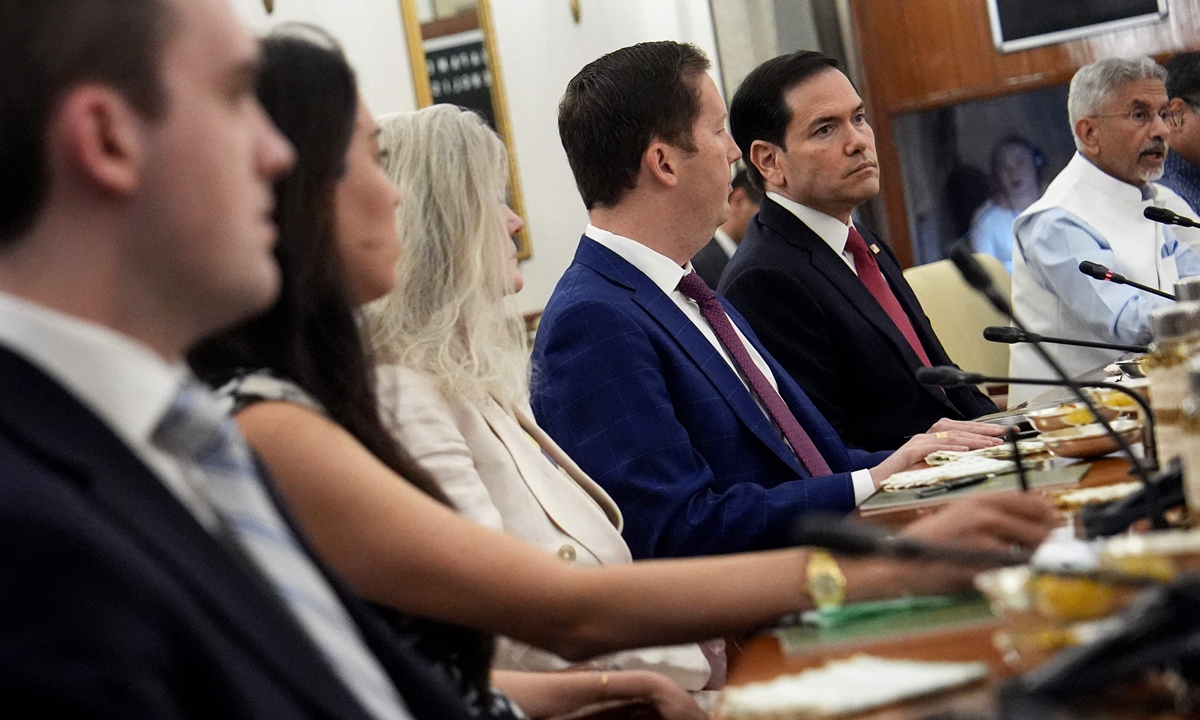
India's Foreign Minister Subrahmanyam Jaishankar (R), US Secretary of State Marco Rubio (2R) and US ambassador to India Sergio Gor attend the Quad Foreign Ministers meeting at the Hyderabad House in New Delhi, India on May 26, 2026. Photo: VCG
Days after the Quad foreign ministers' meeting, India and Australia have agreed to deepen cooperation on maritime surveillance and undersea monitoring in a commitment toward what they described as a "free and prosperous Indo-Pacific," media reported on Monday. A Chinese expert noted on Tuesday that such a move intends to promote bloc-based alignment of regional waters under the banner of a "free and prosperous Indo-Pacific," which in reality serves as military deployments, intelligence sharing and maritime surveillance, pushing a shift that runs counter to the prevailing development aspirations of regional economies.India and Australia agreed to coordinate activities involving maritime patrol aircraft and explore opportunities to enhance undersea awareness, according to a joint statement issued Monday. The announcement came during Australian Deputy Prime Minister and Defense Minister Richard Marles's visit to India for the second India-Australia Defense Ministers' Dialogue with his counterpart, Rajnath Singh, the Bloomberg reported.
The ministers also reaffirmed their commitment to a "free, open, peaceful, stable and prosperous Indo-Pacific" and pledged to work more closely with regional partners. They further "underscored the importance of freedom of navigation and overflight, and their strong support for unimpeded trade in the region," the report said.
While India and Australia frame their cooperation around the vision of a free and prosperous so-called "Indo-Pacific," their moves appear to promote bloc-based alignment of regional waters, serving as part of the US' so-called "Indo-Pacific Strategy," Chen Hong, director of the Asia-Pacific Studies Center at East China Normal University, told the Global Times on Tuesday.
Chen said that such defense coordination carries undertones of Cold War-style bloc logic, which may inject heavy military overtones into regional cooperation and runs counter to the prevailing development aspirations of regional economies.
Some Indian media outlets have hyped the bilateral defense links between India and Australia with China as a cited contextual factor. The Times of India said that "India, Australia strengthen defense ties as China asserts dominance in Indo-Pacific," while The Print wrote that "Eye on China, India and Australia pledge deeper maritime security ties, defense cooperation."
Chen noted that some Indian media outlets tend to hype up related developments in ways that could stoke strategic friction by framing China's legitimate development and regular regional economic cooperation as potential security concerns, in an attempt to help New Delhi build public justification for deeper security partnerships with other Quad members.
Such narratives may turn bilateral exchanges into an antagonistic dynamic against China and spark strategic misjudgments. However, China is neither an outsider in the Asia-Pacific nor an obstacle to regional growth, and smearing China cannot fix India's woes in domestic development, security and ties with surrounding countries, the expert said.
The bilateral meeting between Australia and India came after the Quad Foreign Ministers' Meeting held in New Delhi on May 26, focusing on the launch of new initiatives, including on maritime surveillance and critical minerals, according to the ANI News.
During the Monday meeting, India and Australia further reaffirmed support for Quad-led maritime initiatives and agreed to work towards developing a Common Operational Picture across the "Indo-Pacific," strengthening regional maritime security and cooperation, the Hindu reported.
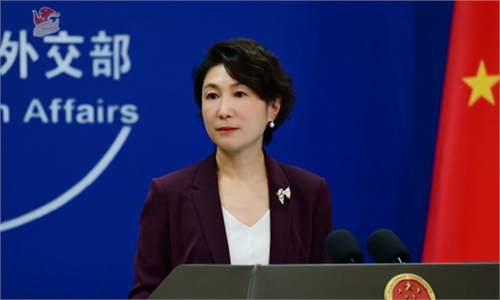
Asked to comment on the US, Japan, India and Australia's launching of a maritime surveillance initiative for the "Indo-Pacific" region and plans to partner with Fiji on port infrastructure, Chinese Foreign Minister spokesperson Mao Ning told a regular press conference on May 26 that "China has stated its position on Quad on multiple occasions. Cooperation between countries should be conducive to regional peace, stability and prosperity, and not target any third party. We oppose forming exclusive groupings or engaging in bloc confrontation."
Chen noted that certain countries forming exclusive blocs stand in sharp contrast to China's pragmatic maritime cooperation with ASEAN rooted in dialogue to manage disputes and expand shared gains. "Regional nations seek development benefits over geopolitical tensions, as such exclusive groupings tend to fuel tensions and hinder genuine regional prosperity and openness," the expert said.
RELATED ARTICLES