ARTS / ART
Global artists finding home in ‘millennium porcelain capital’
Drawn by clay and kilns
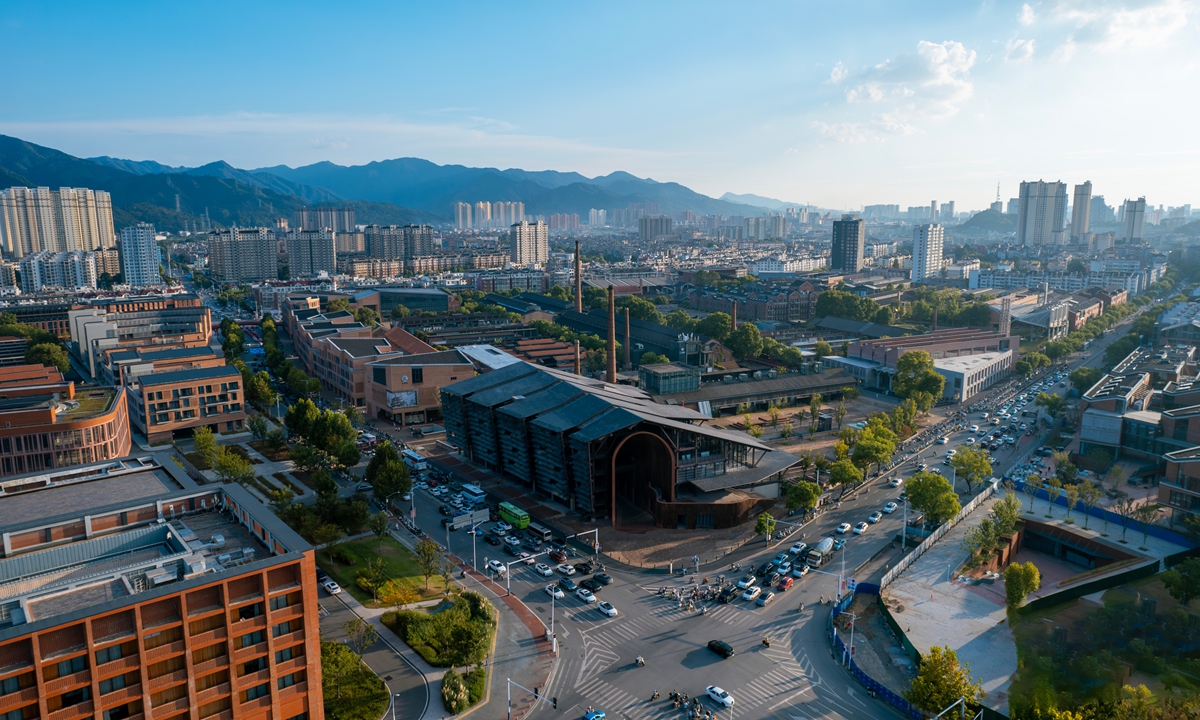
An aerial view of Taoxichuan, or Ceramic Art Avenue in Jingdezhen, Jiangxi Province. Photo: Courtesy of Yan Zhuangzhuang
As the first light of morning spread across Lantian village in Fuliang county, Jingdezhen, East China's Jiangxi Province, French international student Colleu Yann Cyril from Jingdezhen Ceramic University was already crouched beside a kiln, feeding firewood into the furnace. After checking the kiln temperature, he picked up a porcelain bowl he had just finished trimming, and examined it carefully in the morning light. The bowl's walls were so thin that they seemed almost translucent."Keep your hands steady and your mind calm," he murmured softly in Chinese, tinged with a southern accent. It was a lesson a local master craftsman had taught him three years ago.
Located in northeastern Jiangxi, Jingdezhen is renowned both in China and abroad for its porcelain and is widely known as the "Millennium Porcelain Capital."
In January 2025, Jingdezhen's handmade porcelain industry heritage sites were officially submitted to UNESCO as China's nomination for the 2026 World Heritage List.
Jingdezhen is defined not only by its thousand-year-old kiln traditions but also by its spirit of openness and inclusiveness. Today, around 5,000 foreign residents, often referred to as "foreign Jing drifters" (yang Jingpiao), live in the city.
Immersed in everyday life, international residents are not merely observers of ceramic culture but also promoters and contributors to the city's development. Together, they help shape the distinctive character of this historic and cultural city, which is recognized as a global city of crafts and folk arts.
Source of inspiration
Cyril comes from the French overseas island La Reunion. After studying the fine arts in France, he traveled extensively across Europe but always felt that something was missing. In 2017, he came to Jingdezhen for a short-term academic exchange and was immediately captivated by the city's unique atmosphere.
"It was as if I was under a spell," Cyril told the People's Daily. "People from all over the world who share a passion for ceramic art gather here, and everyone brings the same enthusiasm. In Jingdezhen, I found a constant source of creative inspiration."
In Cyril's view, Jingdezhen's porcelain-making tradition is not a piece of history preserved behind glass cases. Rather, it is passed down through gestures, language, customs, and patience, becoming woven into people's daily lives from one generation to the next.
In 2024, Cyril and his wife returned to Jingdezhen, renting a three-story house in Lantian village and turning it into their studio.
In the beginning, Cyril could not speak a word of Chinese. The first time he stepped into a workshop hoping to seek advice, he found himself unable to say anything.
Sensing his embarrassment, a local craftsman brought over a lump of clay and gestured, "Go ahead, give it a try."
Awkwardly, Cyril placed the clay on a potter's wheel, but it collapsed three times in a row. The craftsman remained patient, helping him re-center the clay each time and repeatedly saying, "Take it slowly."
He gradually came to understand the unique pull of the city. By 2025, Jingdezhen's ceramic industry had generated a total output value exceeding 100 billion yuan ($14.7 billion). The city was home to more than 58,000 handmade porcelain workshops and around 150,000 ceramic industry practitioners. Its products were exported to dozens of countries and regions worldwide, and it had established cooperative relationships with more than 180 cities across 72 countries.
"No matter where you come from, as long as you show genuine respect for tradition and sincere devotion to the craft, the people here will welcome you as one of their own," the Frenchman noted.
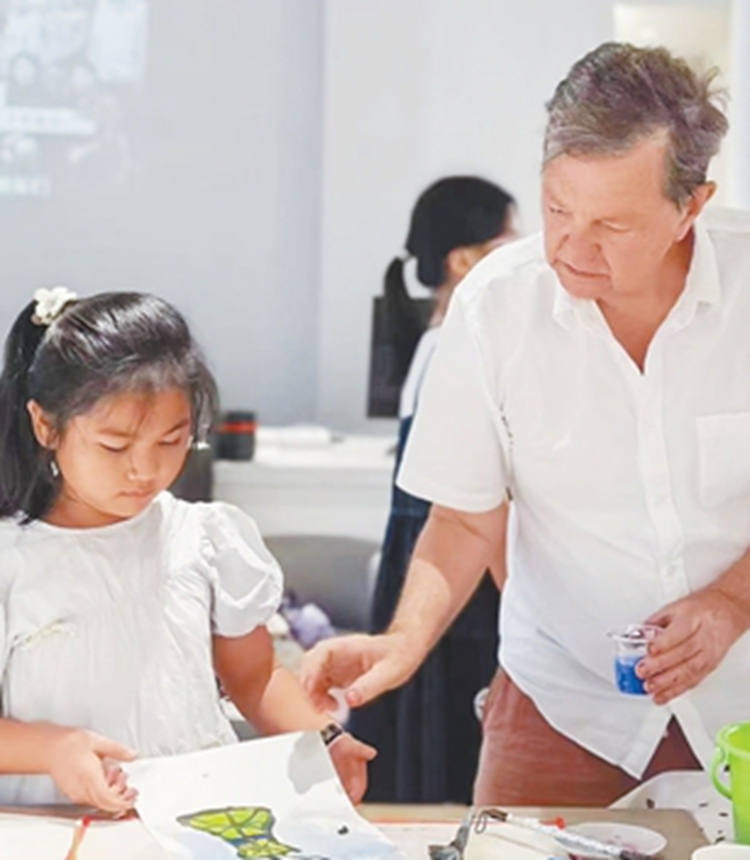
Australian artist David Reid creates an artwork with a girl. Photo: Courtesy of David Reid
Remarkable transformationIn 2006, when Australian artist David Reid first arrived at Taoxichuan, or Ceramic Art Avenue in Jingdezhen, he was greeted by a desolate landscape of old factory buildings. A former porcelain factory stood abandoned, its red-brick walls overgrown with creeping vines.
When he returned in 2018, Reid set up his own studio in a former chemical factory. The transformation he witnessed left him hardly able to believe his eyes.
The old factory buildings had been reinvented as art galleries, artist studios, and creative marketplaces. Former firing workshops now host exhibitions, while raw-material processing facilities have been converted into ceramic experience spaces.
At night, young artists set up stalls in the market, proudly displaying shelves filled with freshly fired works.
The emergence of this vibrant cultural ecosystem has been closely tied to a shift in the city's approach to urban governance.
Through urban renewal initiatives, Jingdezhen has revitalized its old porcelain factory sites and transformed them into hubs of creativity and innovation.
Today, Taoxichuan is home to more than 33,000 entrepreneurial "Jing drifters" from across China, nurturing over 4,500 independent ceramic brands and generating billions of yuan in related industrial output each year.
Rather than fading away in the course of urban development, old factory buildings, historic kiln sites, and traditional alleyways have found new purposes while preserving the city's cultural heritage. They have evolved into public spaces for artistic creation, cultural consumption, and international exchange, allowing Jingdezhen's historical legacy to thrive in contemporary life.
"Today, Taoxichuan has become an internationally renowned art destination," Reid noted.
In his view, Jingdezhen's evolution has not been about tearing down the past and starting over. Rather, it has been about giving old factories, historic neighborhoods, and traditional kiln sites new purposes. Ceramic heritage sites, creative spaces, youth markets, and international exhibitions have become interwoven with everyday life in the city's streets and alleys, breathing new vitality into the ancient porcelain capital.
This was compiled and translated by the Global Times based on an article originally published on page 17 of the People's Daily on June 3, 2026.
RELATED ARTICLES