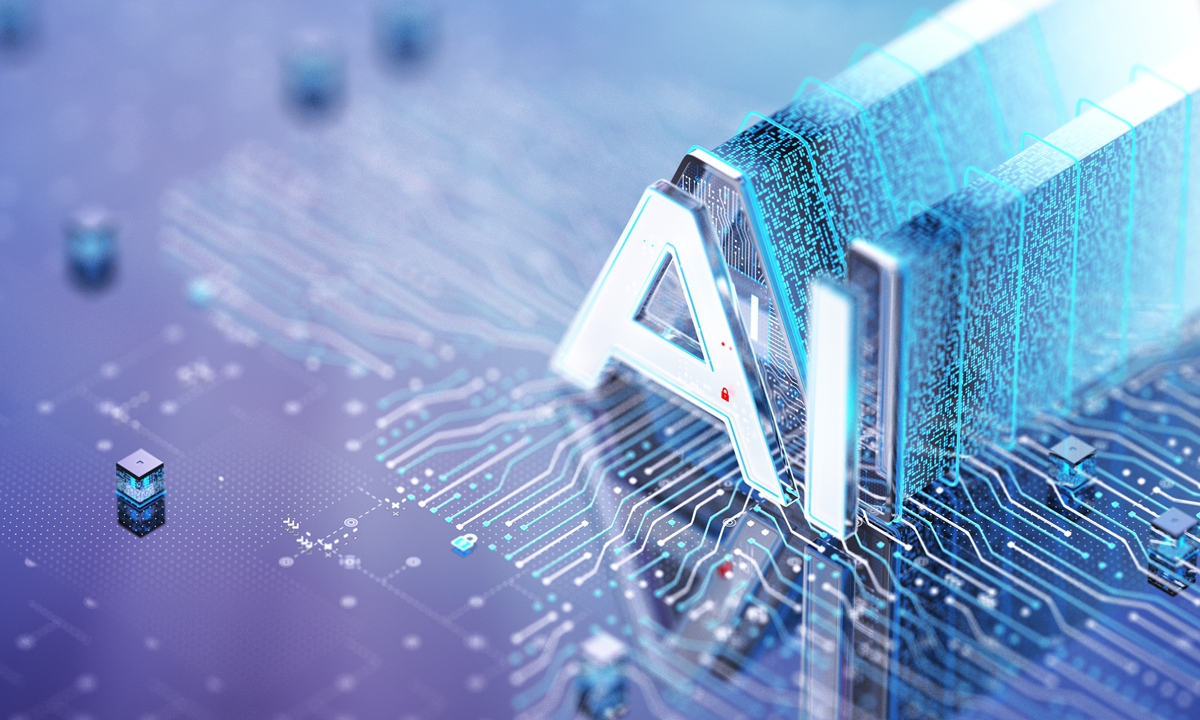
Artificial intelligence Photo: VCG
The World Economic Forum on Tuesday announced on its official website the third cohort of its MINDS program, recognizing organizations using artificial intelligence (AI) and frontier technology to tackle complex global challenges, with more than half of the selected pioneers from China.This recognition is a clear testament to the solid results of China's AI industrialization. The business value and social benefits unleashed by this progress explain why Chinese people are actively embracing the wave of intelligent transformation amid varying global perspectives on the impact of AI.
In some Western countries, young people generally hold skeptical views toward AI, primarily driven by widespread concerns over unemployment risks and the unpredictability of technological disruption. For many young people outside China, AI represents uncertainty and potential crisis rather than opportunity and progress.
According to a survey conducted by Deutsche Bank in 2025 across the US, Germany, France, Italy, Spain, and the UK, nearly one-quarter of adults aged 18 to 34 gave high scores to concerns about losing their jobs to AI, signaling a widespread expectation that AI threatens longer-term job security, Fortune reported. This emotional gap directly affects their willingness to engage with the technology.
In China, the picture is different. According to the 55th Statistical Report on China's Internet Development released by the China Internet Network Information Center, 41.5 percent of internet users aged 20 to 29 had used generative AI products as of December 2024, the highest share of any age group, followed by the 30 to 39 cohort at 23.9 percent. These numbers reflect a genuine, widespread enthusiasm among Chinese youth for actively learning about and using AI.
There are multiple factors behind the positive attitude toward AI in China, but the most direct one is the visible, tangible improvements that AI has brought to daily life. Intelligent recommendation algorithms streamline information acquisition, AI-powered writing, painting and programming tools substantially lower creative and technical barriers, and smart voice assistants, intelligent home devices and digital healthcare solutions have thoroughly penetrated daily life. For Chinese young people, AI is an accessible tool embedded in daily routines.
More deeply, mastering AI capabilities has become a professional competency for career development. As traditional industries undergo digital upgrading and emerging sectors pursue technological innovation, recruitment requirements increasingly prioritize AI-related skills and practical operational capabilities. While phasing out obsolete manual positions, AI in China has fostered a wealth of emerging occupations, including AI trainers, data labeling specialists, intelligent system operation and maintenance engineers, and human-computer interaction designers.
When young people clearly observe that AI-related capabilities directly enhance their employability and boost their income, their willingness to learn and explore AI grows naturally.
The positive attitude of Chinese youth toward AI does not mean ignoring challenges such as algorithmic bias, data security, and other issues. Yet, it is precisely through practical applications that these problems can be identified and solved. Only when technology runs in real‑world scenarios can its potential risks be fully exposed; only when it is widely used and feedback is collected can regulatory rules become targeted.
From a global perspective, AI applications still hold enormous untapped potential. Different countries have their own advantages in data resources, use‑case scenarios, and industrial foundations. Enhanced international cooperation can help each country complement the others' strengths. Some have deep expertise in fundamental research and technological innovation, others have vast space for diverse and large‑scale deployment, and China has developed strengths in application innovation and business model experimentation.
Only through open dialogue and practical collaboration can the world jointly address the puzzles and challenges that AI presents, and only then can AI truly become a progressive force that benefits all of humanity.
RELATED ARTICLES