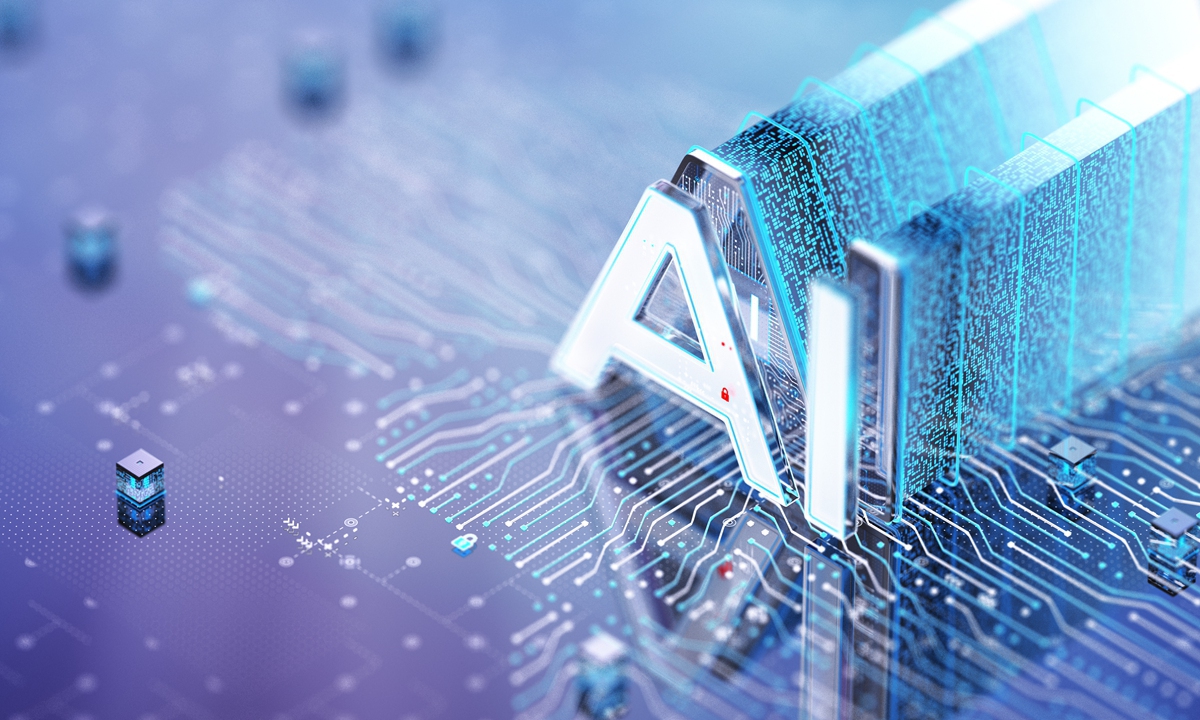
Artificial intelligence Photo: VCG
As artificial intelligence (AI) and robotics technologies rapidly weave themselves into daily life, China's embodied AI market is projected to reach 400 billion yuan ($58.96 billion) by 2030, potentially surpassing 1 trillion yuan by 2035, while creating more than 1 million jobs, CCTV News reported on Monday.These figures vividly demonstrate the substantial value of AI, which has evolved into a powerful engine for economic growth, industrial innovation and employment.
Yet, alongside this optimism, anxiety looms large. There is fear that AI will disrupt traditional labor markets and replace human workers, and this concern is not unique to China. California Governor Gavin Newsom recently signed an executive order to prepare workers and businesses for the challenges posed by rapid AI adoption.
Looking back at the history of industrial civilization, every major technological revolution has triggered similar concerns. A review of industrial history reveals that every revolutionary technological overhaul has reshaped the employment landscape. The Industrial Revolution phased out most manual textile jobs, while the information age replaced traditional telephone operators. Each leap in production efficiency renders outdated skills and conventional occupations obsolete.
Yet a timeless rule endures: while new technologies eliminate inefficient production modes, they also foster unprecedented market demands and brand-new professional systems. Computers did away with typist positions, but created millions of roles for software engineers, network administrators and data analysts. History consistently proves that new technologies replace specific functions and occupations, rather than human beings themselves.
The current wave of AI follows the very same pattern, bringing pain while also unlocking fresh developmental opportunities. According to the World Economic Forum's Future of Jobs Report 2025, 92 million jobs will be displaced globally by 2030, but about 170 million new jobs will be created by the end of the decade. That number is a powerful reminder: technology is not a "job killer." It is a force of structural transformation. It eliminates repetitive, rule-based work, yet it generates a large number of new roles.
Therefore, rather than dwelling on the fear of being replaced, the best response is to ponder a more fundamental question: how can we harness new technology? The answer is already taking shape in practice. China's industries face soaring demand for AI talent, with the talent supply-demand ratio reaching 3.5:1. A host of emerging occupations, including data collection engineers, AI trainers, and human-computer interaction designers, are emerging.
These roles center on human-machine collaboration. The industry doesn't need workers who can outperform machines in mechanical calculation and repetitive labor; instead, it craves professionals who can proficiently leverage AI tools, set logical operational frameworks, correct technical deviations, and balance technological efficiency with humanistic values.
AI excels at precise calculation, repetitive execution, and processing massive datasets. In standardized, process-driven work, its advantages are overwhelming. But there are things AI cannot replicate. Creative thinking, the ability to integrate knowledge across disciplines, aesthetic sensibility, judgment of ethical boundaries - these are human endowments that remain beyond the reach of algorithms. The more adept machines become at standardized operations, the more they highlight the irreplaceable value of humans in non-standard, complex, and ambiguous situations.
Facing the irreversible AI trend, China has rolled out systematic development plans. The 15th Five-Year Plan (2026-30) outlines the comprehensive implementation of the "AI+" initiative. Local governments have launched supporting measures to build talent docking platforms and connect young job seekers with corporate demands. Beijing, Shanghai, and Guangdong Province have all unveiled plans for promoting AI development.
Ultimately, whether AI delivers opportunity or challenge depends not on the technology itself, but on how human societies choose to respond. The answer has never been in the machine. It has always been in our hands. Meanwhile, ensuring safe, sound development of AI is a responsibility for all parties. In tackling the global governance of AI, China has put forward various initiatives to promote global cooperation. It is hoped that more countries will join these initiatives to work together and promote AI for the greater good.
RELATED ARTICLES