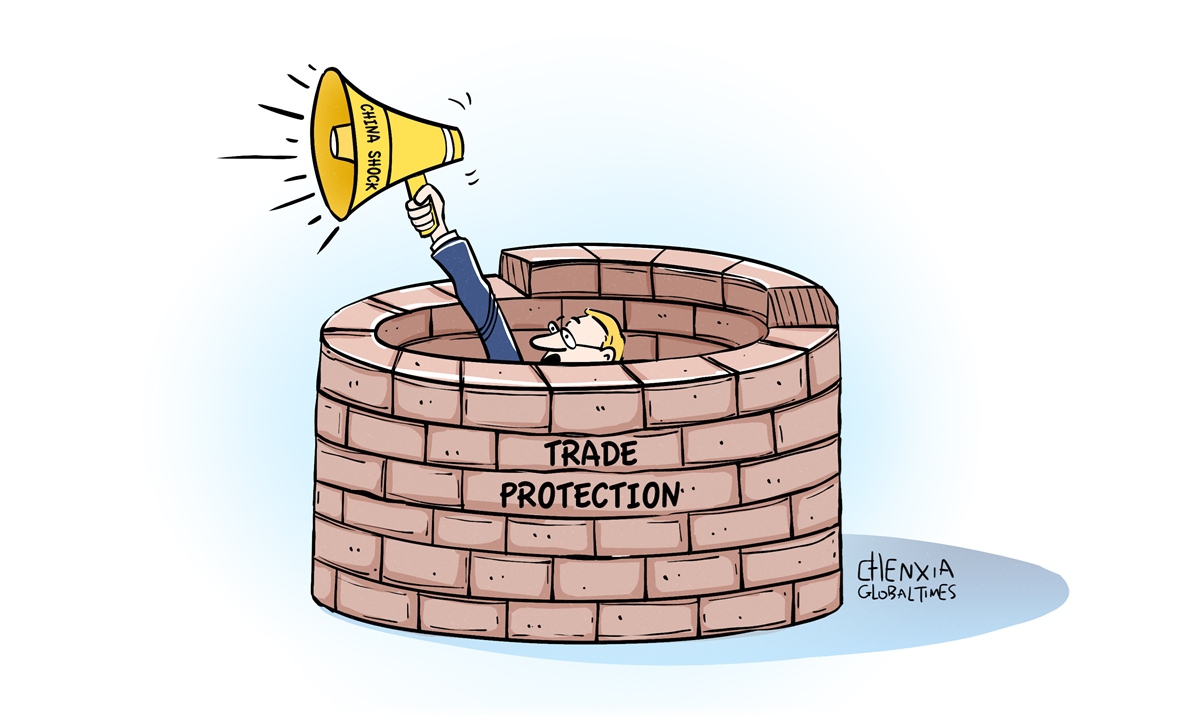
Illustration: Chen Xia/GT
Certain Western media outlets have been repeatedly peddling the so-called China shock narrative, deliberately distorting China's participation in global markets - based on its industrial strengths - into a supposed threat to other economies.Behind this persistent rhetoric lies nothing more than Western anxiety.
For instance, an article in The Guardian published on Tuesday claimed that Europe is facing a fresh "China shock." It hyped Europe's reliance on Chinese components, alleging that it "threatens to cannibalise local factories, leading to job losses and de facto colonization of industry by Beijing."
This one-sided narrative not only misreads the basic logic of the global division of labor but also ignores the positive value of China's supply chains in the global economic cycle. In essence, it serves to pave the road for trade protectionism and stands against the very trend of economic globalization.
The so-called China shock rhetoric is essentially a carefully packaged projection of anxiety. It distorts the advantages that Chinese enterprises have gained through fair competition in the global market into a "threat." What this narrative deliberately overlooks is a basic fact: The deep integration of industrial chains is the result of independent choices made by companies based on cost, quality and efficiency under the tide of globalization, a product of market laws rather than political directives.
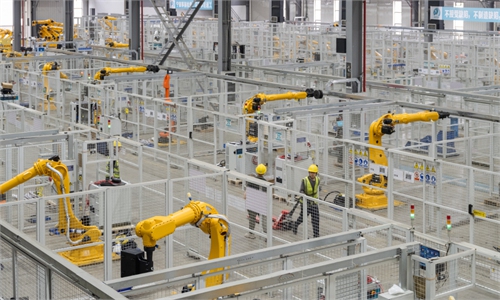
China's competitive edge is the fruit of long-term dedication to the real economy, a complete industrial ecosystem and continuous technological innovation. Chinese companies have won global market recognition through reliable products, cost‑effective supply and steadily upgraded technologies. That recognition meets the real needs of consumers and industrial development worldwide. This is a classic case of complementary advantages and mutual benefit, not "cannibalization" of any industry.
Looking at the broader history of global economic development, market competition has always been dynamic. No country can forever hold an unchallenged advantage. Those who adapt to the times, respect market rules, seize the opportunities of technological and industrial transformation, improve their supply chains and boost innovation will gain the upper hand. Conversely, those who cling to vested interests, fear external competition, and try to contain other countries through trade barriers, smear campaigns or unilateral sanctions will only miss their own chance to transform, while also deepening their industrial difficulties.
The world is undergoing profound changes. Not only China, but many emerging markets and developing countries are accelerating their industrialization and modernization, making the global economic landscape more diverse and balanced. The rise of developing countries, promoting a fairer distribution of development opportunities, is a cornerstone of global stability and prosperity, and serves the common interests of all humanity.
However, some developed countries have reacted with frustration and unease as emerging economies, including China, make breakthroughs in high‑tech fields and rapidly enhance their industrial competitiveness. They pin their own declining competitiveness and lack of growth momentum on the so-called China shock, using it to deflect attention from domestic problems.
China's supply chain contributes more to the global economy than simply shipping goods. It is a crucial stabilizer for global manufacturing and a key driver of cost reduction and the diffusion of innovation.
With its massive scale, mature supporting systems and continuous technological iteration, Chinese manufacturing has effectively lowered global production costs, helping countries, especially developing ones, access products and services that were once out of reach. Over the past several years, the resilience and reliability of China's supply chain have kept countless factories running smoothly around the world.
As the world transitions toward clean energy, the China opportunity narrative is far more widely accepted and welcomed by the international community. For instance, China supplies 70 percent of the world's wind power equipment and 80 percent of photovoltaic panels, and helps to reduce the average cost of global wind power by 60 percent, according to the Xinhua News Agency.
If Western media outlets and politicians could view China as an equal, they would realize that cooperation is the right path. Distorting the win-win cooperation as a zero-sum game will only make them miss the important window of green transition and industrial upgrading.
RELATED ARTICLES