Guangdong sees RCEP trade facilitation, with tariff reductions amounting to 1.4b yuan in past three years: report
By Published: Jun 03, 2026 09:40 PM

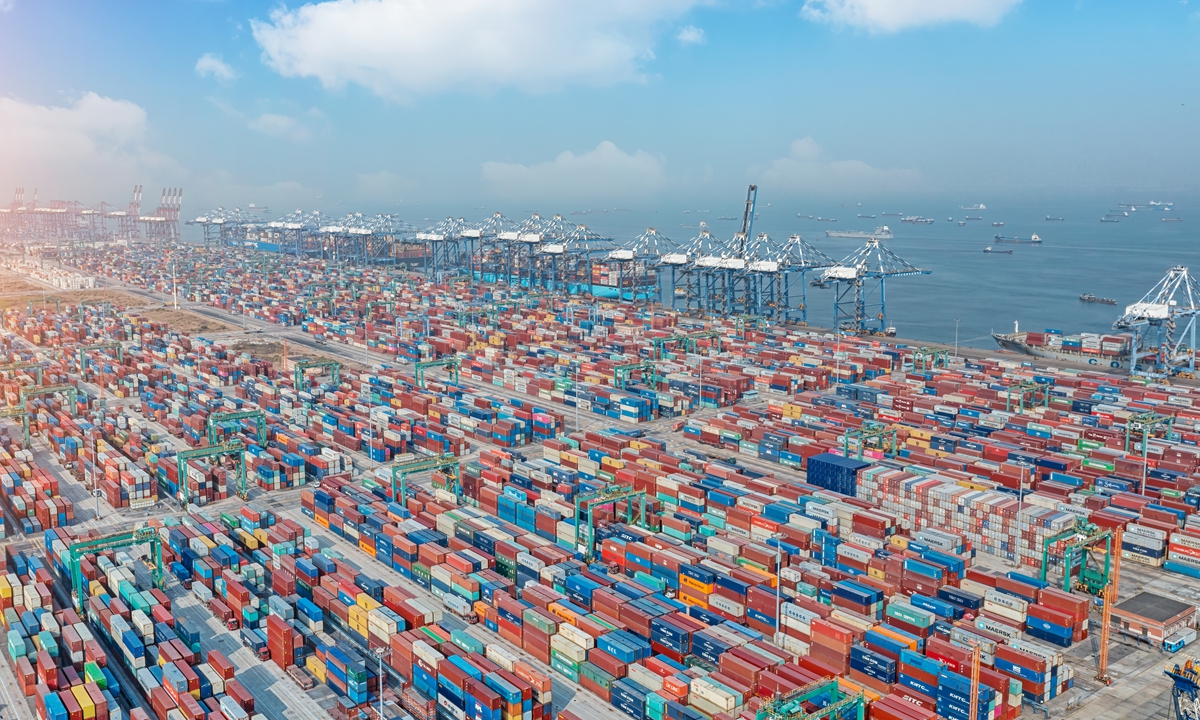
An aerial view of a container terminal in Guangzhou, South China's Guangdong Province Photo: VCG
As June marks the third anniversary of the full entry into force of the Regional Comprehensive Economic Partnership (RCEP), the customs authority in South China's Guangdong Province said that ports in Guangdong have imported a total of 53.8 billion yuan ($7.96 billion) worth of goods enjoying RCEP preferential treatment over the past three years, with tariff reductions amounting to 1.4 billion yuan, CCTV News reported on Wednesday.
The RCEP, the world's largest free trade deal comprising 10 ASEAN countries, as well as China, Japan, the Republic of Korea, Australia and New Zealand, entered into force on January 1, 2022, according to the Xinhua News Agency.
In June 2023, the RCEP agreement took effect for all 15 members after the agreement went into force for the Philippines.
From 2023 to 2025, the tariff savings achieved through the RCEP grew each year, increasing by 8.81 percent year-on-year in 2023, the CCTV News report said. The increase was 32.35 percent in 2024 and 32.12 percent in 2025.
Customs authorities have continuously improved the level of customs clearance facilitation under the RCEP, helping enterprises make good use of RCEP rules of origin based on their own products and industrial characteristics, according to the report. The dividend of tariff reductions continues to be released, the report said, citing customs officials.
Zhao Gancheng, a senior fellow and director of South Asia Studies at the Shanghai Institutes for International Studies, told the Global Times on Wednesday that the fast growth seen in trade facilitation and tax reductions among foreign trade companies in Guangdong, an export powerhouse in China, as well as other localities, showed the continued effects of the RCEP in boosting regional trade and investment flows and regional economic integration.
"As a lot of the RCEP countries are ASEAN countries, the fast growth in the scale of the trade and tax reductions also shows the profound economic complementarity between China and ASEAN countries and the vast potential of the region," Xu Liping, director of the Center for Southeast Asian Studies at the Chinese Academy of Social Sciences, told the Global Times on Wednesday.
An official of the Guangzhou Chamber of Commerce told the Global Times on Wednesday that companies carefully align their business strategies with RCEP rules, such as adjusting sourcing from RCEP countries, and they have enjoyed benefits including tax reductions in recent years.
The tariff reductions are gradual, but they can be accumulated over the years and the effect has become increasingly significant, the official said on condition of anonymity. "For foreign trade professionals, certificates of origin have earned the nickname of 'paper gold'," the official said.
Over the past three years, enterprises have declared imports under the RCEP to Guangzhou customs exceeding 21.6 billion yuan, enjoying tariff reductions of more than 460 million yuan, according to a separate report by the Guangzhou Daily on Tuesday.
The main beneficiary goods include steel products, aviation equipment, and chemical products. During the same period, enterprises applied to Guangzhou customs for more than 66,000 RCEP certificates of origin, and authorized exporters independently issued nearly 5,000 RCEP declarations of origin to facilitate trade, with the value of export goods enjoying preferential treatment reaching 18.6 billion yuan. Major export goods included ceramic products, plastic products, and chemical products, according to the report.
"The RCEP policy has brought tangible benefits to our company. Take our ceramic sitting toilet for example: the import tariff rate for this product in Malaysia is 25 percent. With an RCEP certificate of origin, the tariff rate can be reduced to 22.7 percent, and it will gradually decrease year by year, eventually reaching zero," said Pei Jie, general manager of Roca (China) Co Ltd, an exporter of ceramic products, was quoted as saying in the report.
Pei noted that certificates of origin now benefit from smart auditing, allowing the company to submit applications at any time via a "single window" mechanism designed to facilitate foreign trade and receive certificates without waiting. Pei predicted that the company's full‑year export value to RCEP markets will maintain double‑digit growth.
After years of implementation, the region has developed a well‑synchronized model of cooperation for the RCEP and all parties have already moved beyond shallow cooperation of trade in goods, with industrial and supply chains now deeply intertwined, forming a community that thrives on mutual benefits, Meng Yueming, a researcher at the Liaoning Academy of Social Sciences, told the Global Times on Wednesday.
However, many small and medium‑sized market entities still have a poor grasp of the RCEP trade rules and are not familiar with procedures such as applying for certificates of origin or policies on tariff reductions and exemptions, resulting in a significant waste of policy dividends, Meng said.
Investment growth and trade in services are both expected to show further growth, injecting impetus into RCEP countries, Xu said.
In 2025, Guangdong's trade with ASEAN topped 1.53 trillion yuan, a new record, provincial authorities announced in January.
The RCEP also benefited other localities in the country. East China's Zhejiang Province, for instance, has seen its exports enjoying preferential treatment exceed 80 billion yuan since 2022, according to a Xinhua report in January.
RELATED ARTICLES