Norwegian Children's Literature salon 'From a small country to the big world' staged in Beijing
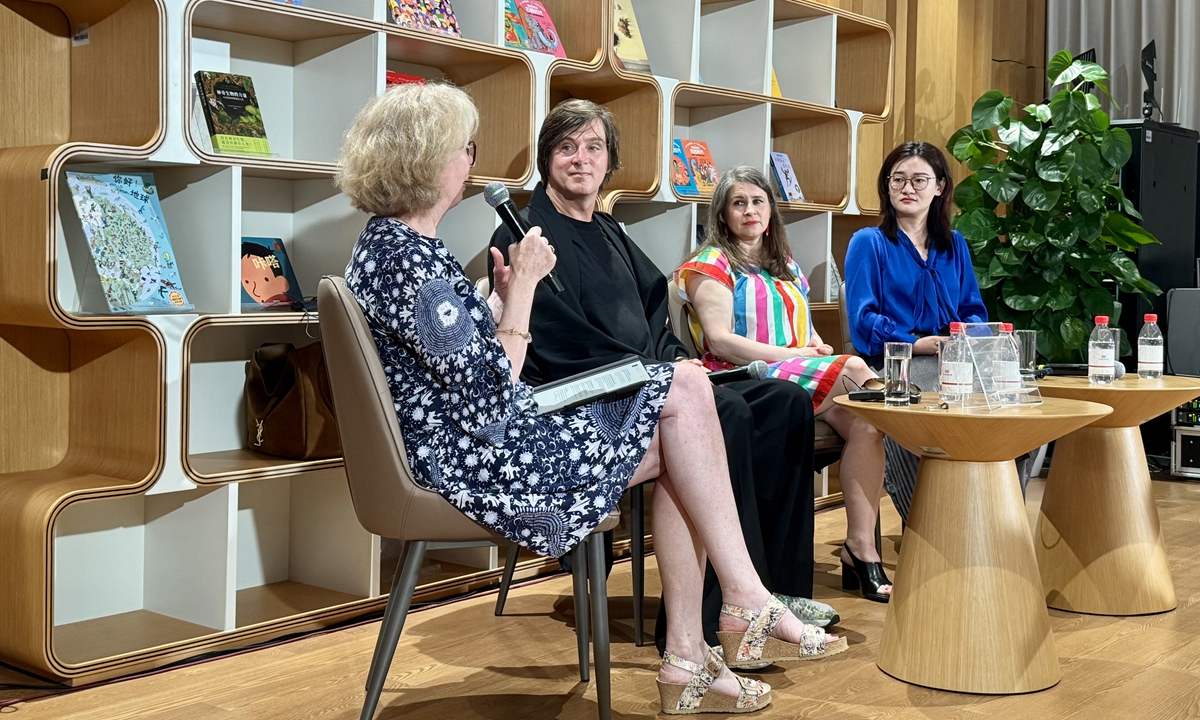
Panel discussion at the literature salon Photo: Dong Feng/GT
The Norwegian Embassy in China hosted a Norwegian children literature promotion session together with the Norwegian Literature Abroad (NORLA), a government-funded, non-commercial foundation for literature promotion, under the theme of "From a small country to the big world - how and why literature travels" at the Beijing Library in Tongzhou district on May 30. Norwegian officials, writers and Chinese scholars and editors participated in the event, sharing their creative journey and insights into what makes the cooperation between Chinese and Norwegian literature sector successful.The library was co-designed by Norwegian architecture firm Snøhetta and China's ECADI.
At the literature event, Norwegian Minister of Culture and Equality Lubna Jaffery said in her opening remarks that it is a special treat to the magnificent library. "Libraries are places of wonder."
This library stands today as a sublime proof of cultural cooperation between China and Norway and an example of sustainable construction, she said.
Norwegian literature, especially children's books, has had a lasting presence in China. The books break boundaries, shun stereotypes and confront conventions, play with form and play with content, Jaffery added.
"Our stories don't tell boys and girls what to think. They invite them to think for themselves. This approach reflects values deeply rooted in Norwegian society," said Jaffery.
Andrine Pollen, Literature Program Manager at NORLA, which is dedicated to promoting Norwegian literature worldwide through translation grants and active profiling, briefed the audience Norway's state-backed support system for literature export, translators and writers. Thanks to major global book fairs, Norway has drastically boosted translation volumes and international exposure of the country's literature books over the past decade.
Pollen kicked off the panel discussion, saying there is minimum taboos in the topics for children's literature in Norway - divorce, war, trauma and mental struggles, as the writers are attempting to show them what the world is like and let them think about it.
Norwegian author Simon Stranger, who is also a children's book author, told the Global Times that he started with writing books for adults. In his own words, he has been working on serious literature. His editor, who noticed he is humorous and likes children, encouraged him to write children's books. Now, Stranger is glad to see his books got localized in China.
His historical-themed writing retains painful lessons learned from wartime to warn future generations. His book Keep Saying Their Names, published in 20 languages, was inspired by his family's WWII experience, and is centered on the theme that no one is born evil.
Sharing his core concept and insights into cross-border literature, Stranger said that with their works translated worldwide, authors dig into universal human emotions and genuine personal feelings.
Reading let people step into other people's lives and feel unfamiliar suffering. Such experience could offer exclusive strength of literature beyond politics and commerce, he said.
Norwegian children's book author and illustrator Kristin Roskifte shared her experience with Chinese readers. She echoed Pollen's opinion and added that the only principle she would add is always be hopeful in the books for children.
For her book Everybody Counts: A counting story from 0 to 7.5 billion, Roskifte said the book was inspired from her parenting reflections and she hand-drew every individual character.
Li Jingjing, a lecturer at the School of European Languages and Cultures at the Beijing Foreign Studies University, said that from a translator's point of view, major translation hurdles lie in implicit cultural context rather than vocabulary.
Sometimes it was hard to spot direct Chinese expression to mirror Norwegian humor and local customs, she elaborated.
Pollen told the Global Times that Chinese publishers and parents prioritize high-quality, award-winning imported children's books and keep opening up to global literary resources. Supported by state funding, Norwegian publishers are confident to develop niche and in-depth books without overreliance on commercial profits.
"Literature builds cross-cultural empathy," she added.
RELATED ARTICLES