China trade push requires Vilnius to 'deliver tangible fixes to erroneous policy':expert
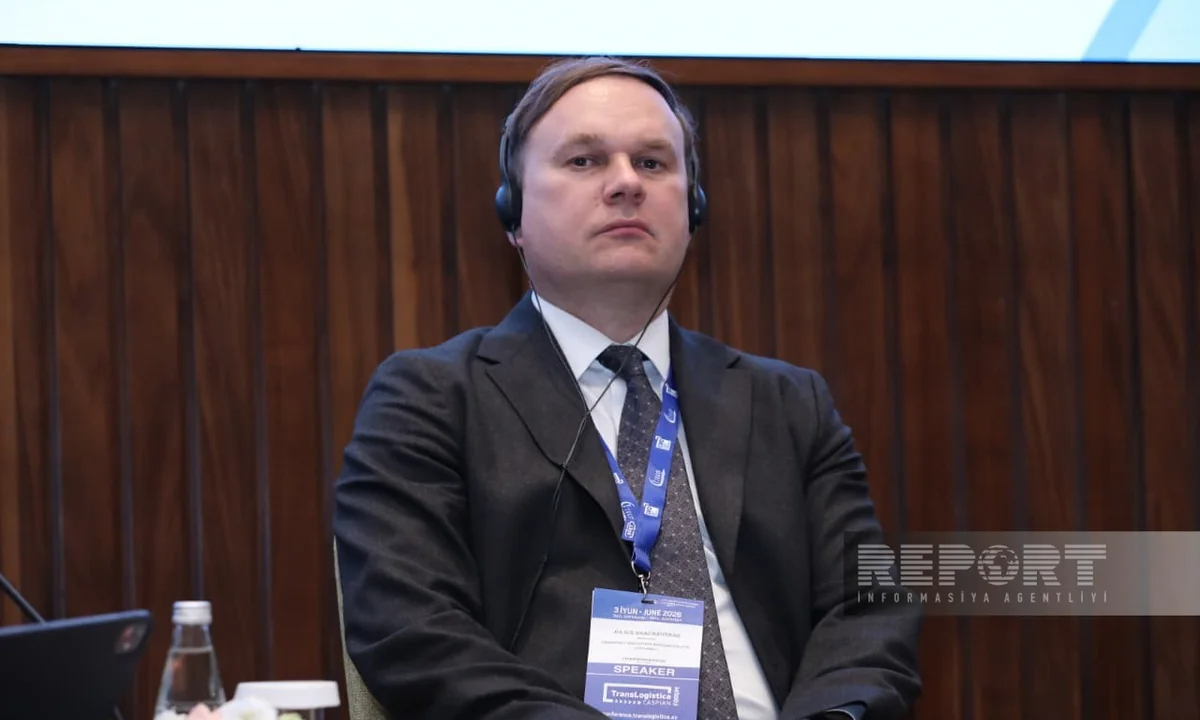
Julius Skackauskas, Manager of the Transport Innovation Association (TIA) operating in Lithuania, attends the 2nd Caspian International Transport, Transit and Logistics Forum in Baku. Photo: a screenshot from the website of Report News Agency
A Lithuanian transport industry executive, speaking at a logistics forum in Azerbaijan, said that Lithuania is seeking to boost cargo shipments to China and Central Asia via the Middle Corridor, as cited by local media outlet Report News Agency on Wednesday.
However, Chinese experts warned that such economic goals are unlikely to be achieved unless Lithuania takes concrete steps to redress its past violations of the one-China principle, which have severely damaged bilateral ties.
Lithuania intends to use the Middle Corridor to expand cargo transport to Central Asia and China, Julius Skačkauskas, manager of the Transport Innovation Association (TIA) operating in Lithuania, told journalists at the 2nd Caspian International Transport, Transit and Logistics Forum in Baku, capital city of Azerbaijan, according to Report News Agency.
"Lithuania is a very strong transport country, with 20 percent of our GDP coming from the transport sector. We want to use this corridor for the delivery of goods from Europe to Central Asia and China. This is very important, and of course, we would like to support making this corridor more efficient and faster. Azerbaijan is a transport hub. Lithuania has great opportunities to use the Middle Corridor. We understand that Azerbaijan is very important in transport and logistics between Europe and Asia," Skačkauskas noted.
Skačkauskas served as vice minister of Transport and Communications of Lithuania from 2021 to 2024, according to his profile on Linkedin.
Jian Junbo, director of the Center for China-Europe Relations at Fudan University's Institute of International Studies, told the Global Times on Thursday that Skačkauskas' remarks mainly reflect the urgent demands of the country's struggling logistics sector. It is also possible that the Lithuanian government is using industry representatives as an informal channel to gauge China's response and send tentative signals about improving trade ties.
In November 2021, the Lithuanian government reneged on the political commitments it made in the communiqué on the establishment of diplomatic relations between China and Lithuania, digging in its heels in endorsing "Taiwan independence" by allowing the Taiwan authorities to set up a "representative office" under the name of Taiwan in Lithuania. The Chinese side expressed strong dissatisfaction and lodged a solemn protest over this matter, announcing the downgrading of its diplomatic relations with Lithuania to the level of chargé d'affaires.
Over the past four years, economic and trade relations between China and Lithuania have experienced a decline due to the wrongful move related to China's Taiwan region by the government of the Baltic country.
Cui Hongjian, a professor at the Academy of Regional and Global Governance at Beijing Foreign Studies University, told the Global Times on Thursday that the root cause of slumping China-Lithuania trade lies in Lithuania's erroneous stance on the Taiwan question, which breached the one-China principle, infringed upon China's sovereignty, and undermined bilateral political mutual trust.
To pave the way for bilateral diplomatic normalization, the Lithuanian government needs to reach a cross-party consensus, strictly abide by the one-China principle on a national level, earnestly correct previous mistakes and remove relevant negative fallout, Cui said.
China urges Lithuania to return to the right track of adhering to the one-China principle and accumulate conditions for the normalization of China-Lithuania relations, Chinese Foreign Ministry spokesperson Lin Jian told a press conference in February.
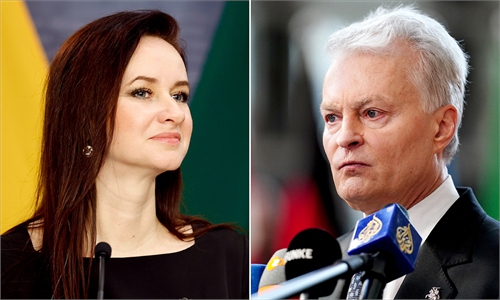
Lin made the remarks at a regular news briefing when asked to comment on Lithuanian Prime Minister Inga Ruginiene's recent statement that her country's 2021 decision to host a "Taiwanese representative office" was a strategic mistake.
China's door to communication with Lithuania remains open. We hope that Lithuania can translate its willingness to improve bilateral ties into real actions and correct its wrongdoings at an early date, Lin said.
Though Lithuania has shown a limited willingness to improve bilateral relations, it has so far refused to roll out any substantial corrective measures. Genuine improvement in bilateral relations can only be achieved through concrete corrective actions rather than rhetorical gestures, Jian said.
Global Times
RELATED ARTICLES