Lithuanian PM and president clash over Taiwan island office name; root cause lies with Lithuania itself to rectify past mistakes: Chinese expert
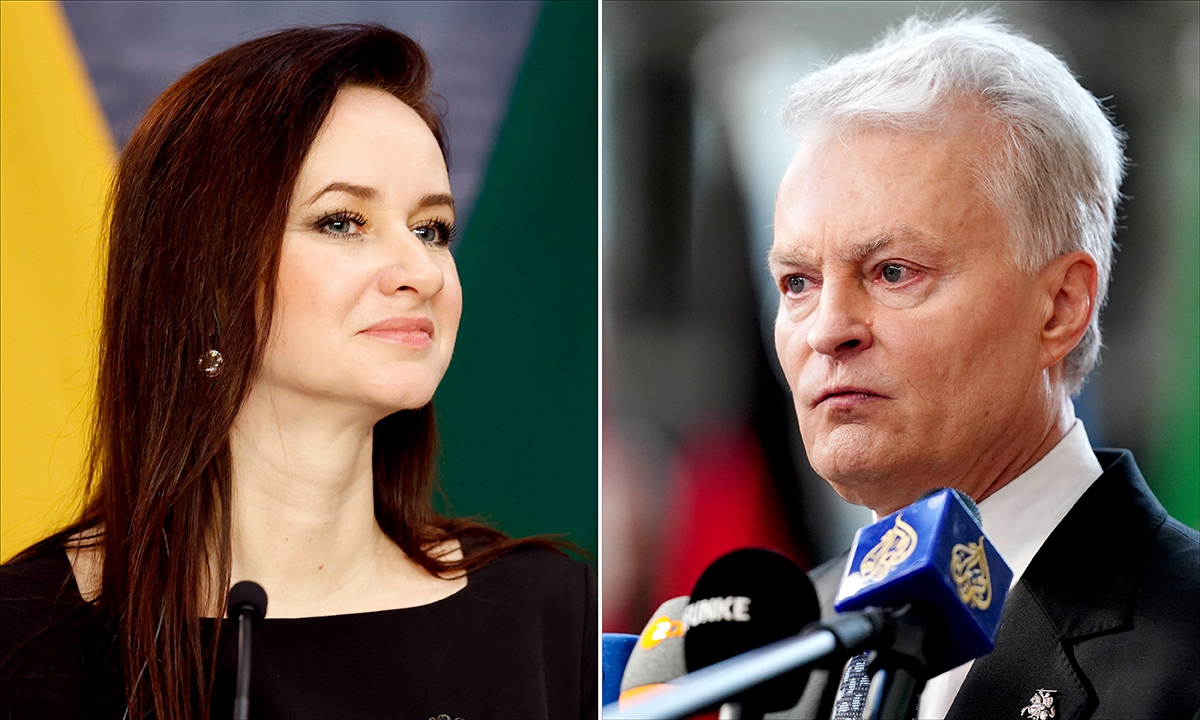
Photos show Lithuanian Prime Minister Inga Ruginiene (L) and President Gitanas Naus?da (R). Photos: VCG
Internal divergence has once again surfaced in Lithuania over the renaming of an office set up by the Taiwan regional authority, which had previously significantly worsened Lithuania's relations with China.The Lithuanian Prime Minister once again reiterated her stance on the so-called "Taiwanese Representative Office" in the country early this week, which she said brought no benefits but hurt ties with China, while the president on Tuesday rejected the prime minister's characterization that he agreed with her position. A Chinese expert said such internal divergence only reflects that the root of the problem has always lain with Lithuania itself, the one eager to rectify its past mistakes.
Nearly one month after Lithuanian Prime Minister Inga Ruginienė said that she would be prepared to consider renaming an office set up by the Taiwan regional authority in her country, she reiterated on Monday that the opening of the so-called "Taiwanese Representative Office" in Lithuania has "brought no benefits" from the region and has damaged relations with China, Lithuanian media outlet LRT English reported.
Ruginienė also said that the president agreed with the positions she expressed during a high-level meeting on foreign and security policy in February. However, one day after she made these remarks, Lithuanian President Gitanas Nausėda rejected that characterization, saying that the prime minister should not comment on statements made during private discussions, according to another report by the media outlet.
Nausėda claimed on Tuesday that the issue of the so-called "Taiwanese Representative Office's" name was settled when it was established and warned that reopening the debate could lead to its closure, according to LRT English. The president also claimed that "Vilnius is not prepared to accept pressure from Beijing."
As of press time, the Office of the Government of the Republic of Lithuania has not yet responded to the Global Times' inquiry regarding the matter.
The Chinese Foreign Ministry did not respond to the matter on Wednesday, but it had made its position clear earlier. In February, responding to a question regarding Lithuania's Prime Minister's previous remarks that Lithuania made a strategic mistake by allowing a so-called "Taiwanese representative office" to open in the capital under the name "Taiwanese," a Foreign Ministry spokesperson stated:" China's door to communication with Lithuania remains open. China hopes Lithuania will translate the willingness to improve ties with China into action."
At the same time, the Taiwan island-based media outlets including CNA and UDN reported on the matter on Wednesday, with the headline only focusing on Lithuanian President's stance. A Chinese expert said such a reaction in the island is hardly surprising, and China's position remains clear-cut. Yet the crux of the current situation is nothing but a self-inflicted disturbance created by Lithuania itself.
The Lithuanian government, in disregard of the Chinese side's strong objection and repeated dissuasion, approved the establishment of the so-called "Taiwanese Representative Office" in Lithuania by Taiwan authorities in August 2021. Since then, China has adopted a slew of legitimate, reasonable and lawful countermeasures including a diplomatic downgrade between China and Lithuania.
China and Lithuania once engaged in very practical cooperation, with the two sides advancing collaboration under the Belt and Road Initiative. However, the president, who has been in office since 2019, is prejudiced against China and has contributed to the deterioration of the bilateral relationship, Zhao Junjie, a senior research fellow at the Institute of European Studies at the Chinese Academy of Social Sciences, told the Global Times.
He added that Prime Minister Ruginiene, who took office only a few months ago in September 2025 and belongs to another political camp, has appeared more pragmatic amid the prolonged deadlock that has severely hit Lithuania's economy and trade.
A new public opinion survey, reported by LRT English, shows that a majority of Lithuanians support renaming the so-called "Taiwanese Representative Office" in Vilnius in an effort to improve relations with China, with 58 percent of adults in Lithuania in favor of changing the name to the "Taipei Representative Office."
The internal divergences only reflect that the root of the problem has lain in Lithuania itself, Zhao said. The choice of whether to make the right decision lies entirely in its own hands, and it should resolve its internal differences and address the issue on its own, as the country itself is the one eager to rectify the mistakes made back then, the expert added.
Against this backdrop, the expert noted that in observing China-Lithuania relations, actions speak louder than words, and consistency between words and deeds is crucial.
RELATED ARTICLES