Lithuanian PM seeks to restore diplomatic relations with China; move motivated by ‘economic considerations, Europe’s positive China policy shift’: expert
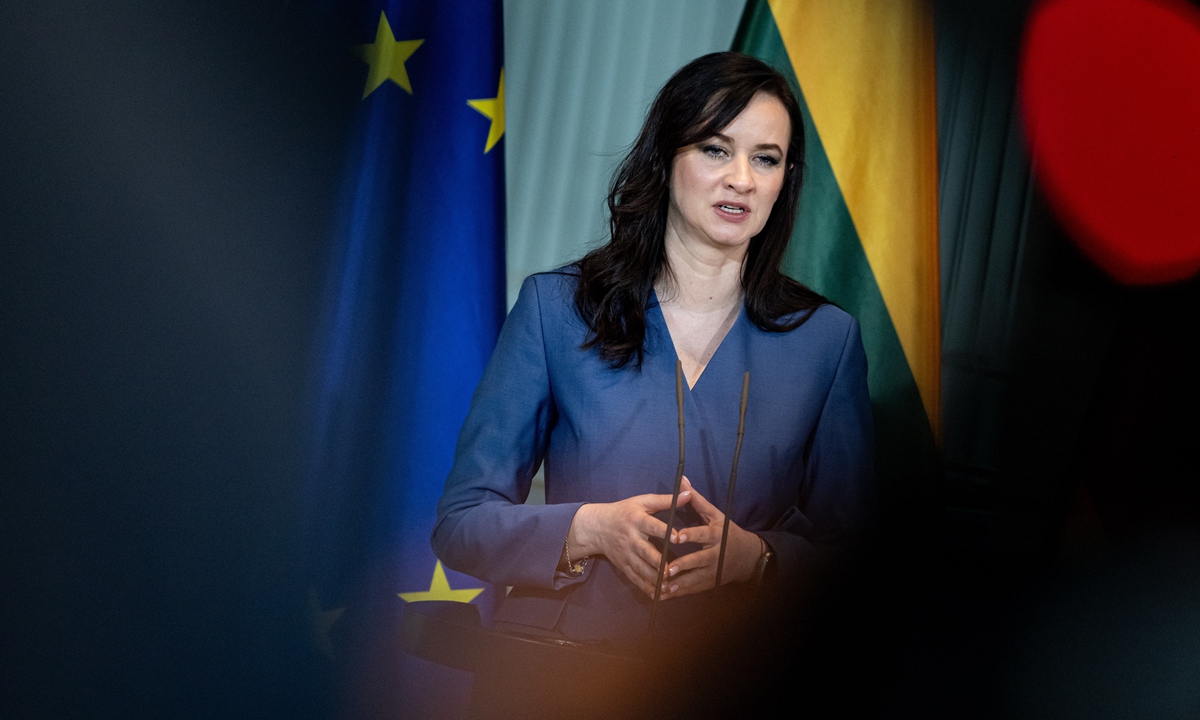
Lithuanian Prime Minister Inga Ruginien? speaks at a joint press conference with German Chancellor Merz on January 29, 2026. Photo: VCG
Lithuanian Prime Minister Inga Ruginiene on Wednesday signaled openness to restore diplomatic relations with China and said that she would be prepared to consider renaming an office set by the Taiwan regional authority in her country, according to media reports. These remarks came less than 10 days after she admitted Lithuania had made a strategic mistake by allowing a "Taiwanese representative office" to open in the capital under the name "Taiwanese," in an interview with the Baltic News Service (BNS).A Chinese expert said that the prime minister's overture is driven in part by Lithuania's economic considerations and influenced by the recent series of high-profile visits to China by European political figures and the continent's pivot to China.
On February 6, in response to Ruginiene's remarks admitting Lithuania made a strategic mistake on the Taiwan question, spokesperson for China's Ministry of Foreign Affairs Lin Jian said that the door for communication between China and Lithuania remains open, expressing hope that Vilnius would translate its willingness to improve bilateral ties into concrete actions.
On Wednesday, Ruginiene, whose Social Democrats lead a coalition government in Vilnius, said she would be prepared to consider renaming a so-called "Taiwanese trade office" at the center of the tension between Lithuania and China since 2021, Bloomberg reported.
Since the office was established, China has adopted a slew of legitimate, reasonable and lawful countermeasures including a diplomatic downgrade between China and Lithuania.
Ruginiene said on Wednesday that "I don't see why it couldn't be the Taipei representation," Bloomberg reported. She noted that she does not see a "major problem" with renaming the office, highlighting that such a decision should be coordinated with strategic partners. "But the fact that we rushed is a fact," she added, according to Anadolu Agency.
Bloomberg sees the latest signal Ruginiene conveyed marks a potential turn in the Baltic nation's fraught relationship with the world's No. 2 economy.
Jian Junbo, director of the Center for China-Europe Relations at Fudan University's Institute of International Studies, told the Global Times on Thursday to some extent, economic losses that Lithuania has suffered due to frozen ties with China serves as the immediate catalyst for its re-calibrated posture toward Beijing.
Over the past four years, economic and trade relations between China and Lithuania have experienced a "precipitous drop." Data from Lithuania's statistics service, Statistics Lithuania, showed that Lithuania's exports to China plummeted by more than 50 percent. Its pillar industries such as timber and dairy suffered heavy losses, with the century-old dairy company Rokiskio Suris also taking a hit; and the Baltic deep-water port of Klaipeda saw a sharp reduction in throughput due to the rerouting of China-Europe freight trains, Dry Cargo International reported.
Jian said the Lithuanian prime minister's recent remarks signal a constructive shift in her approach to China, demonstrating a willingness to normalize bilateral ties — a gesture that merits recognition.
The recent visits to China by multiple European political figures and their reassessments of relations with Beijing could have also contributed to Lithuania's shift in stance, Jian said. Should Vilnius continue to diverge from the trajectory of other European nations while suffering domestic losses, the administration may face mounting internal pressure, Jian added.
Criticizing the previous administration's decision on naming of the "Taiwanese representative office," Ruginiene said "it was a hasty step, which I think we could fix." The process won't involve "a five-minute decision," she said, and will be discussed more broadly — including with "strategic partners," according to Bloomberg.
Noticeably, analysts also noted varying voices inside the country. President Gitanas Nausėda, who has been in office since 2019, claimed that restoring diplomatic relations with China would require goodwill from both sides, while warning that Lithuania sees significant risks in closer cooperation with Chinese government, Lithuanian media outlet LRT English reported on February 3.
Jian said while the discord between the president and the prime minister—who represent different political sections —is fundamentally a matter of Lithuania's internal affairs, China's red line maintains consistent and clear - China welcomes communication based on mutual respect and will firmly defend its core interests. Jian added that verbal statements by Ruginiene are not enough; they must be translated into tangible actions.
In response to Ruginiene's remarks describing the establishment of the so-called "Taiwanese representative office" as a "strategic mistake," Taiwan's so-called "foreign affairs department" claimed on Tuesday that the office's name was the result of bilateral consensus, according to a Taiwan-based media outlet.
Such claim has come under sharp criticism from political figures in Taiwan island. Former Democratic Progressive Party (DPP) lawmaker Kuo Cheng-liang blasted the DPP for touting the so-called "Taiwanese representative office" as a "major diplomatic achievement," saying it had invested substantial resources only to end up with nothing to show for it, HKCNA reported on Thursday.
Hou Han-ting, a Taiwan political commentator and Taipei city councilor with the New Party, contended that the fundamental reason behind Lithuania's shift lies in changes to the global environment, according to HKCNA.
It is evident from the international landscape that the DPP has been funneling Taiwan taxpayers' money overseas without delivering any tangible benefits to the public, HKCNA reported, citing Hou.
In response to Ruginiene's remarks in the BNS interview, Zhu Fenglian, a spokesperson for the Taiwan Affairs Office of the State Council, said at a press conference on Wednesday that one-China principle is a widely recognized consensus of the international community and a basic norm governing international relations, reflecting the will of the people. We urged the relevant side to correct its mistake as soon as possible and stand on the right side of history, Zhu added.
RELATED ARTICLES