BYD climbs to No.2 in Australian auto sales for 2nd straight month; EV innovation and green shift fuel optimism
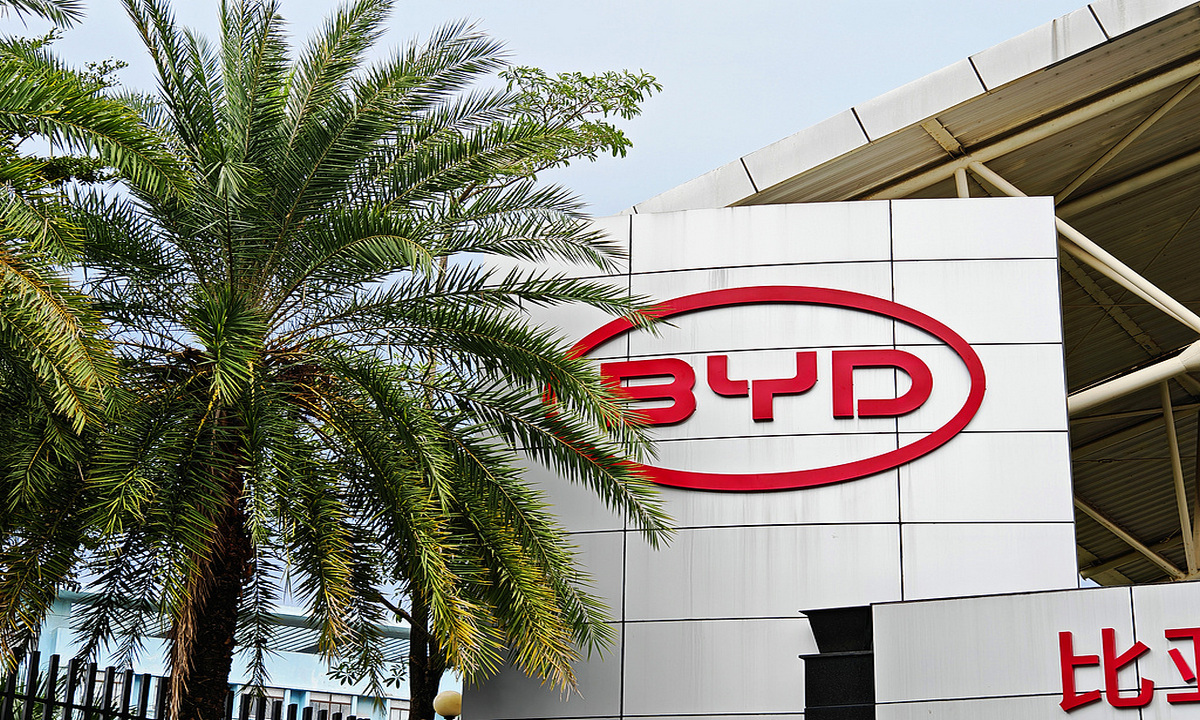
BYD headquarters in Shenzhen, South China's Guangdong Province. Photo: VCG
The sales of Chinese electric vehicle (EV) brand BYD in Australia has been ranking second following Toyota, local industrial data showed, and it is expected to become a local leader with strong market demand.
The progress was driven by rising demand for new EVs in Australia, while BYD's technological edge in electrification and increasingly diversified product portfolio helped it capture changing market preferences, industry observers said, drawing on Australian industry data.
According to a report by Australian vehicle media outlet CarExpert on Wednesday local time, BYD delivered 33,454 units in the first five months of 2026, right after Toyota's 76,017 new vehicles delivery during the same period.
BYD said that Australian consumers will determine when it topples long-time sales leader Toyota, according to the report.
CarExpert said that this carmaker's rapid growth has seen its sales more than double from 15,199 at the same point last year, while Toyota's tally has fallen from 100,753 as the gap between the two brands has continued to narrow.
BYD already demonstrated strong momentum in the April sales figures, signaling its rapid climb up in the Australian market rankings.
In April, Chinese car brands maintained a strong presence, with four of the top 10 sellers for the month again being Chinese marques. BYD was in second place, GWM in seventh, Chery in eighth and MG in ninth, data from the Australian Automotive Dealer Association (AADA) showed. Toyota retained its position as market leader with 15,185 sales, said the AADA.
BYD's rapid rise in Australia was underpinned by its technological capabilities, product innovation and economies of scale, which have helped the company build advantages in batteries, electric power trains and product offerings, said Zhang Xiang, secretary-general of the International Intelligent Vehicle Engineering Association.
The company's ambitions and recent performance have prompted parts of the Australian auto industry to make increasingly bullish projections about BYD's long-term potential for market share.
According to a post on May 27 by Royal Automobile Club of Victoria (RACV), BYD is set to become one of the top three car brands in Australia in 2026, and it eventually plans to be market leader.
This year, the Chinese EV company has also delivered strong performances across overseas markets.
A report by Reuters on June 1 noted that BYD's sales abroad in May rose 80.4 percent year-on-year to 160,644 units, supported by stronger demand for EVs in Europe and emerging markets, driven by higher oil prices.
For Australia, the ongoing shift toward new EVs and a supportive policy environment are emerging as key foundations for the carmaker's sustained market expansion.
Australia's soaring sales of EVs and plug-in hybrids (PHEVs), and to a lesser extent regular hybrids, helped drive up Australia's overall new-vehicle market in April, according to a report by CarExpert on May 5. The report noted that hybrid sales were up 27.1 percent year-on-year, EVs by 157.2 percent, and PHEVs by an even larger 270.2 percent.
On May 5, the AADA stressed that buyers continue to shift toward low-emission vehicles amid ongoing fuel price pressures.
But beyond rising fuel costs, Australia's policy environment has also remained supportive of the transition toward new-energy vehicles.
The increase in supply of EVs since the introduction of the New Vehicle Efficiency Scheme, combined with higher fuel prices and the continued support provided through the Federal Government's Electric Car Discount, is now translating into stronger demand, Federal Chamber of Automotive Industries (FCAI) Chief Executive Tony Weber said, according to a FCAI report on May 5.
According to Weber's April comments, the Australian automotive industry would welcome a sustained shift to EVs, given its substantial investment in bringing more than 100 EV models to the Australian market and the industry's efforts to meet ambitious NEVs targets, according to an FCAR report released on April 7.
Zhang noted that higher fuel costs, partly driven by geopolitical tensions this year, have accelerated Australian consumers' shift toward new-energy vehicles.
Australia's relatively strong consumer purchasing power, mature auto market and faster vehicle replacement cycles have also created favorable conditions for higher EV penetration, Zhang said.
"Against this backdrop, BYD's broader model lineup has further strengthened its competitive position and supported its rapid expansion in the local market."
RELATED ARTICLES