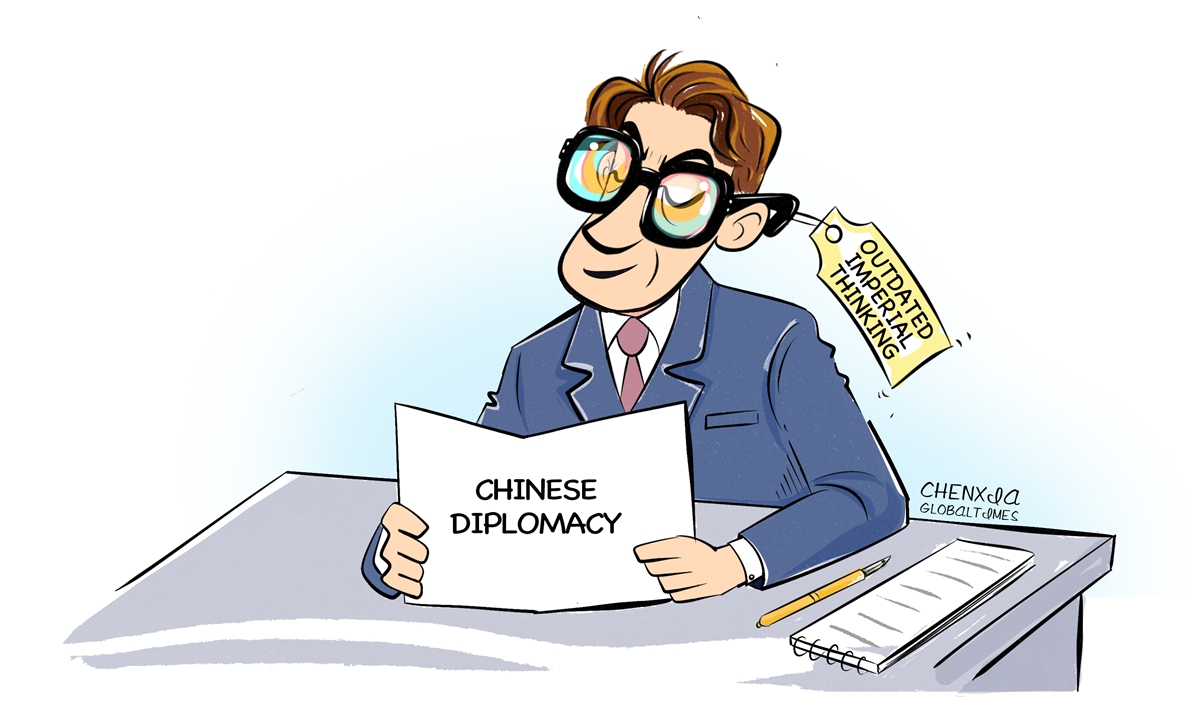
Illustration: Chen Xia/GT
Recent months have seen a steady stream of political heavyweights from various countries visit China, sparking a sustained wave of diplomatic engagement. This boom speaks volumes about China's appeal as a key global economic driver and a source of stability, while reflecting the international community's shared desire for cooperation, opportunities and certainty amid a complex geopolitical landscape.However, China's surging diplomatic momentum has also prompted some voices in the Western public discourse to deliberately cast a negative light on and misinterpret China's diplomacy, with a recent commentary published by The Economist serving as an example. Locked in the outdated diplomatic dogma of a former imperial power, the article brands China's diplomatic successes based on a "partnership without alliance" approach as "broad but shallow."
This article misunderstands the core mission of diplomacy, which is to manage and facilitate relationships between nations, promote peaceful coexistence and cooperation, and contribute to maintaining global order. Diplomacy enhances peace and fosters a cooperative international community. Such inclusive and far-reaching engagement is often difficult for those with an outdated hegemonic bias to acknowledge.
China's diplomacy requires no restrictive terms or unilateral allegiance. Labeling this diplomacy as "shallow" turns a blind eye to the harsh realities many nations have endured under Western diplomatic practices.
Some Western diplomats pitch cooperation under the banner of universal values yet demand economic concessions, political alignment and subservience in return - too often followed by paternalistic lecturing, overseas military bases, crippling debt, regime change and societal fragmentation.
In contrast, China adheres to a model of cooperation based on sovereign equality and does not compel other countries to pledge allegiance to a specific ideology. For many nations in Asia, Africa, Latin America and the Middle East that have long suffered from external interference, this model of cooperation holds unique value in and of itself.
Another logical fallacy lies in the one-sided view that forming exclusive military alliances and providing tied security guarantees are the sole criteria for measuring the depth of diplomacy. Under this yardstick, forming alliances and controlling vassal states are deemed "responsible power" conduct, while China's refusal to form alliances for confrontation is portrayed as a weakness.
Had China followed the Western bloc playbook by roping regional countries into exclusive security structures and coercing them to take sides, Western media publications would immediately begin to tout "China's grave threat to world peace."
For the vast majority of countries in the Global South, sovereignty is the bottom line for autonomous development. China's principle of non-interference aligns with the historical aspirations of nations to break free from external control and determine their own domestic affairs.
Today, the era in which a handful of Western nations monopolized the definition of the "international community" has come to an end. Most countries are unwilling to be coerced into picking sides between major countries. They yearn for development resources and the space for autonomous development. China's partnership diplomacy is widely favored by the Global South and indeed by most sovereign nations precisely because it adapts to this diverse reality.
Under its "partnership without alliance" framework, China leverages economic and trade cooperation, infrastructure support and multilateral dialogue to help developing countries address their development gaps. It also acts as a neutral mediator to defuse regional conflicts and curb conflict-related losses.
With the continued rise of emerging economies, the world's multipolarization has become an irreversible historical trend, and the old rules of bloc confrontation and hegemonic coercion are increasingly outdated.
Built on equality, inclusiveness and mutual benefit, China's diplomacy responds to global countries' pursuit of autonomous development and win-win coexistence, representing a rational choice in keeping with the times.
The broad scope of China's diplomacy stems from the diversity of nations' sizes and development aspirations; its flexible approach to cooperation arises from the differences in global civilizations and development paths; and its prudent and restrained stance is rooted in the profound lessons learned from the disasters caused by historical alliances, confrontations and military interventions.
A diplomacy grounded in partnership, mutual benefit and win-win outcomes, aligned with the trend of multipolarity, is the correct choice that benefits the entire world.
The author is a professor and the executive director at the Centre for National Security Studies, Fudan University. opinion@globaltimes.com.cn
RELATED ARTICLES