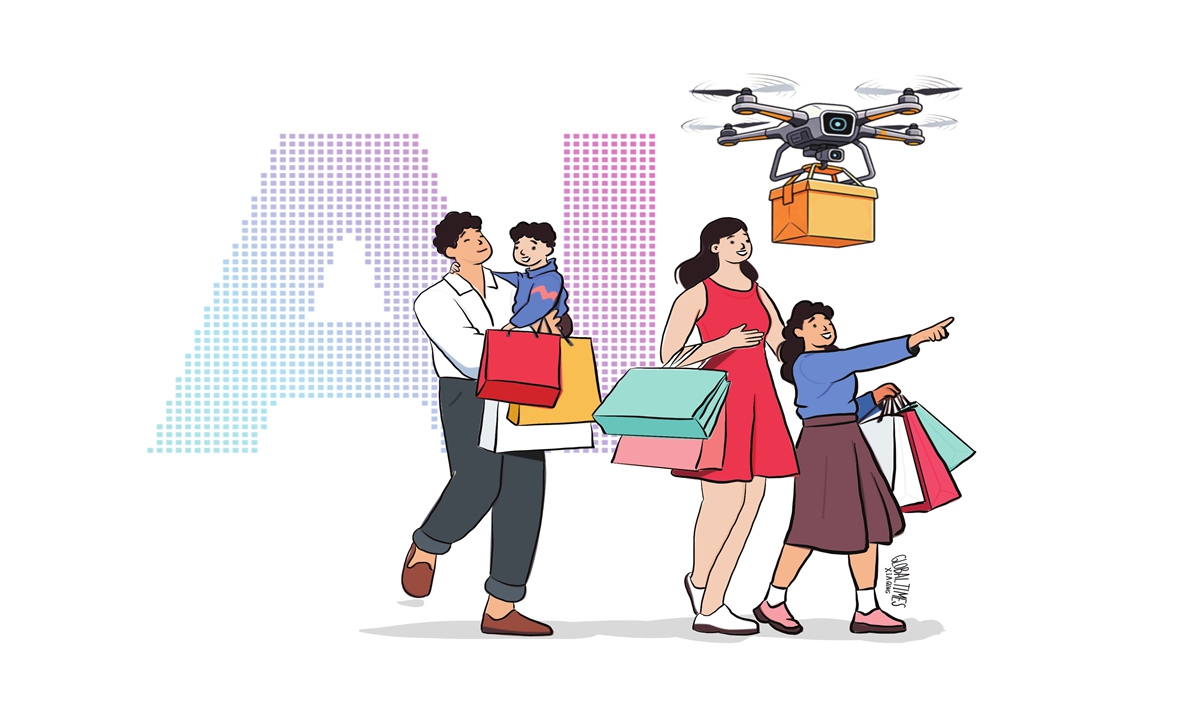
Illustration: Xia Qing/GT
During a recent consumer season in Shenzhen focused on emerging forms of consumption, several of the city's commercial districts introduced hands-on experience zones for products such as artificial intelligence (AI) glasses, companion robots and AI-powered cameras. According to a media report reposted by Shenzhen Fabu on Thursday, foot traffic in major commercial areas increased by more than 10 percent on average during the three-month event.While emerging forms of consumption are often discussed as an abstract concept, the increase in visitor numbers provides a concrete lens through which to observe their development and offers a glimpse into how AI-enabled products are beginning to move beyond technology showcases and into everyday consumer settings.
In Shenzhen's Huaqiangbei, the trend is becoming more visible in day-to-day retail activity. On May 20 - a date some in China treat as an online Valentine's Day - AI-enabled products such as smart watches capable of monitoring emotional states in real time, cameras designed to capture "sweet moments," and companion toys built around emotional interaction - reportedly sold strongly. An article published on the Shenzhen government website, sz.gov.cn, noted that alongside shifting consumption preferences, younger buyers are also changing the logic of gift-giving. AI-enabled devices that combine emotional engagement with everyday functionality appear increasingly aligned with consumption preferences among younger consumers in romantic relationships.
Many similar instances collectively point to a broader trend that may not be immediately visible in macro-level figures, yet is increasingly evident in everyday consumption behavior. Taken together, they provide a clearer sense of the latent potential embedded in China's evolving consumption landscape.
Some foreign media outlets continue to offer a pessimistic view of the Chinese economy, citing what they describe as so-called "weak demand." In practice, however, consumption in China has shown no evidence of decline. Instead, it continues to evolve and upgrade, with new consumption trends and areas of activity emerging.
In recent years, new forms of consumption in China have continued to evolve, with digital, green and health-related spending gaining momentum, alongside the emergence of new business formats, models and scenarios. Technological progress has been an important driver of this process, including the growing presence of AI-enabled products and services in consumer markets. The consumption gains associated with such technological diffusion may still be at an early stage. As technological innovation increasingly intersects with China's large consumer market, growth in consumption appears to depend less on the redistribution of existing demand and more on the creation of new demand.
Data from some sub-sectors offers early signs of this growth potential. According to a CCTV News report in May, data showed that in the first quarter, China produced more than 4.4 million service robots, up 2.6 percent year-on-year. New products such as smart home appliances and 3D printing devices are also steadily entering the market.
Data from the Ministry of Commerce suggests that online retail sales of digital products continues to expand. Smart glasses, for instance, rose by 161.9 percent in the first quarter, while digital cameras grew by 71.5 percent.
At the same time, new business models and retail formats continued to develop in the first quarter, with online sales of goods and services rising 8 percent year-on-year. New retail formats such as unattended stores maintained double-digit growth.
Signals across a range of indicators suggest that new forms of consumption in China are continuing to expand, with considerable scope for further development. One of the underlying drivers of this trend appears to be technological progress.
Some foreign commentary continues to cite so-called "weak demand," but such narratives are at odds with what is actually happening in China's consumer market. Upgrading consumption appears to be a clear trend, and a more pertinent question may be how to identify and respond effectively to these emerging patterns.
The answer may, at least in part, lie in ongoing technological advancement. Far from being characterized by overcapacity and low-price competition, as some external narratives suggest, China's consumption landscape increasingly rewards product innovation, with consumers responding to offerings shaped by the latest technological developments.
Viewed from Shenzhen, this dynamic is apparent in concentrated form. Competition in technology-enabled products is intensifying, product cycles are getting shorter, and services are evolving in parallel. Underlying these changes is the pace of technological development. In this sense, technology offers a useful lens through which to understand the next phase of consumption growth in China.
The author is a reporter with the Global Times. bizopinion@globaltimes.com.cn
RELATED ARTICLES