SPORT / MISCELLANY
Grassroots team’s success shows why diversity in football development matters
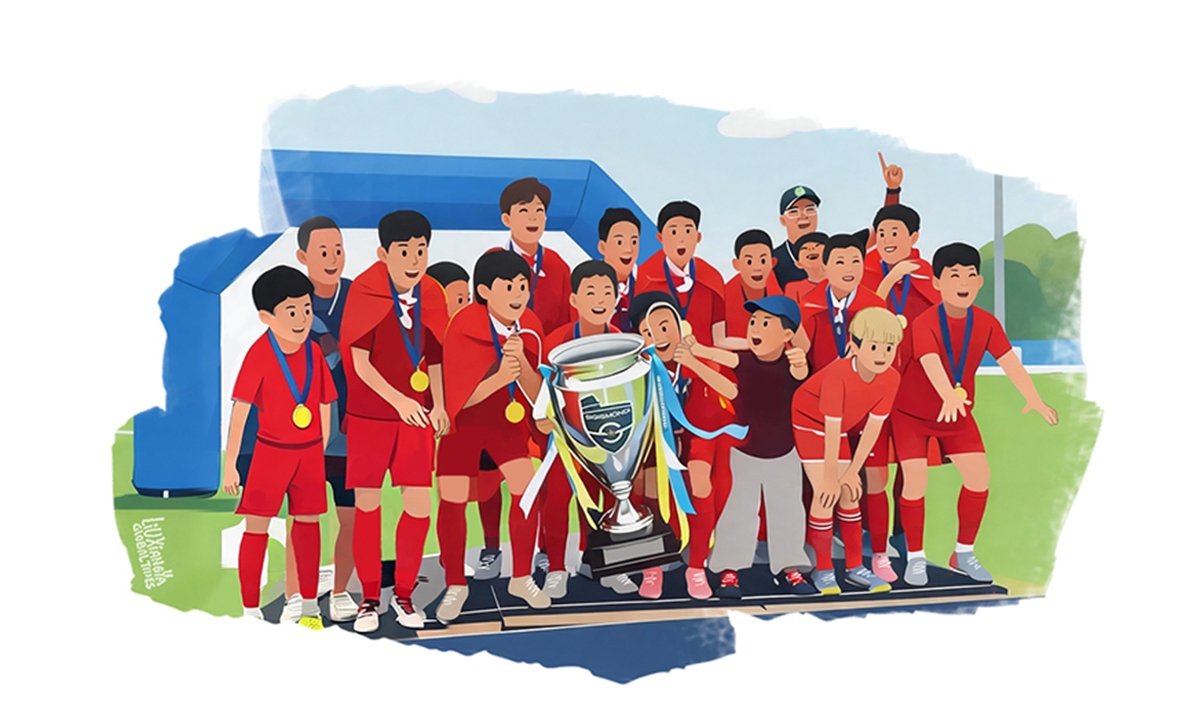
Illustration: Liu Xiangya/GT
The recent triumph of the "Chinese Football Boy" U12 team in Italy's Sigismondi International Youth Tournament has sparked excitement among Chinese football fans.The team became the first Asian side to win the tournament, defeating English top-flight team Everton's academy team in the final match and finishing the competition with a perfect record. The event featured 48 youth teams, including academies from well-known European clubs such as Feyenoord, SS Lazio, Olympique Lyonnais, AS Roma, FC Porto, and Bayer Leverkusen.
Shortly after the U12 team's victory, 14-year-old Li Haoyan secured a place in FC Barcelona's famed La Masia academy system, another milestone that drew widespread attention.
Beyond the celebrations, however, these developments raise a more important question: What lessons can Chinese football learn from the success of a grassroots youth development project operating outside the traditional football establishment?
The answer may be that Chinese football needs more than one pathway to develop talent.
For decades, youth football development in China has largely relied on football or sports schools and professional club academies. These systems have produced many talented players and remain the backbone of Chinese football's development structure. In recent years, the Chinese Football Association (CFA) has also expanded youth leagues, encouraged overseas training opportunities, and promoted long-term reform of the youth development system.
Yet football development is rarely successful when a single pathway dominates talent identification.
Around the world, leading football countries benefit from diverse ecosystems. Professional academies coexist with community clubs, private training organizations, independent football schools, and regional development programs. Competition among different development models often produces innovation and helps identify talented players who might otherwise be overlooked.
This is where the significance of a project like "Chinese Football Boy" lies.
Unlike traditional academy systems that are often tied to specific schools, clubs, or local football associations, the project has built its reputation on nationwide talent scouting and extensive competition exposure. It seeks players from across the country rather than from a single region or institutional network. Such flexibility allows young players with different backgrounds to access higher-level opportunities without necessarily committing to a professional club structure at an early age.
The Chinese Football Boy project's recent success should not be viewed as evidence that grassroots development is superior to the official system. Rather, it demonstrates that multiple development channels can coexist and complement one another.
For years, one of the criticisms of Chinese football has been that the talent pool is not sufficiently broad. Research and industry discussions have repeatedly highlighted the challenge of player retention as children grow older. Many promising youngsters leave football during their teenage years due to academic pressure or limited development opportunities. Some observers have described this phenomenon as the "12-year-old trap," referring to the sharp decline in youth participation as children approach middle-school age.
A diversified youth football ecosystem can help address this problem. When parents and young players see only one route toward football development, many are reluctant to commit. The perceived risks are high. Professional football careers are uncertain, and educational concerns remain important for most families especially in China.
Alternative pathways can reduce that pressure.
Grassroots programs, independent academies, and private development initiatives can offer young players opportunities to continue training and competing while keeping multiple future options open. Some may eventually join professional clubs. Others may pursue football-special scholarships, overseas development opportunities, or university football programs.
Such flexibility is common in mature football ecosystems.
The emergence of private youth development initiatives may also encourage healthy competition. If different organizations compete to provide better coaching, better competition schedules, and better player development environments, the overall quality of youth football is likely to improve.
Importantly, this does not mean reducing the role of football governing bodies. On the contrary, football authorities should focus on creating standards and providing oversight rather than monopolizing talent development.
One possible direction would be establishing certification systems for high-quality private academies and grassroots projects. Programs that meet coaching, safeguarding, educational, and operational standards could be integrated into broader regional development plans. Outstanding players from these programs could gain access to official competitions and talent identification systems without requiring the projects themselves to become part of the traditional football system.
Such an approach would expand the talent pool while maintaining quality control.
The broader lesson extends beyond one tournament victory.
China's football reform efforts in recent years have increasingly emphasized international exposure. The CFA has encouraged young players to train abroad and gain experience in more competitive environments. Following China's strong performances at the youth level, CFA President Song Kai also stressed in an open letter the importance of exposing players to higher-level football cultures and more demanding competitive settings.
That perspective aligns with global football reality.
Europe remains home to many of the world's most advanced youth development systems. Young players who regularly face stronger opponents, experience higher-intensity competition, and adapt to different football cultures often accelerate their development. Exposure alone does not guarantee success, but it creates learning opportunities that are difficult to replicate domestically, where pace is considered slow.
The success of the Chinese Football Boy team in Italy illustrates this principle. But winning a youth tournament does not mean future professional success is guaranteed, as countless youth champions around the world never become elite senior players. Nevertheless, competing against strong European opposition and proving capable of succeeding in that environment provides valuable experience that can contribute to long-term development.
Chinese football has spent years searching for a formula capable of producing more high-level players. The reality is that no single formula exists. Professional academies remain essential. School football remains important. CFA-led development programs remain necessary. But grassroots initiatives have demonstrated that they can also contribute meaningfully to the talent pipeline for a country where people are eager to see the national team return to international stage.
The author is a reporter with the Global Times. life@globaltimes.com.cn
RELATED ARTICLES