ARTS / CULTURE & LEISURE
Pocket parks unveil China’s sustainable urban development wisdom
By Published: Jun 04, 2026 11:22 PM

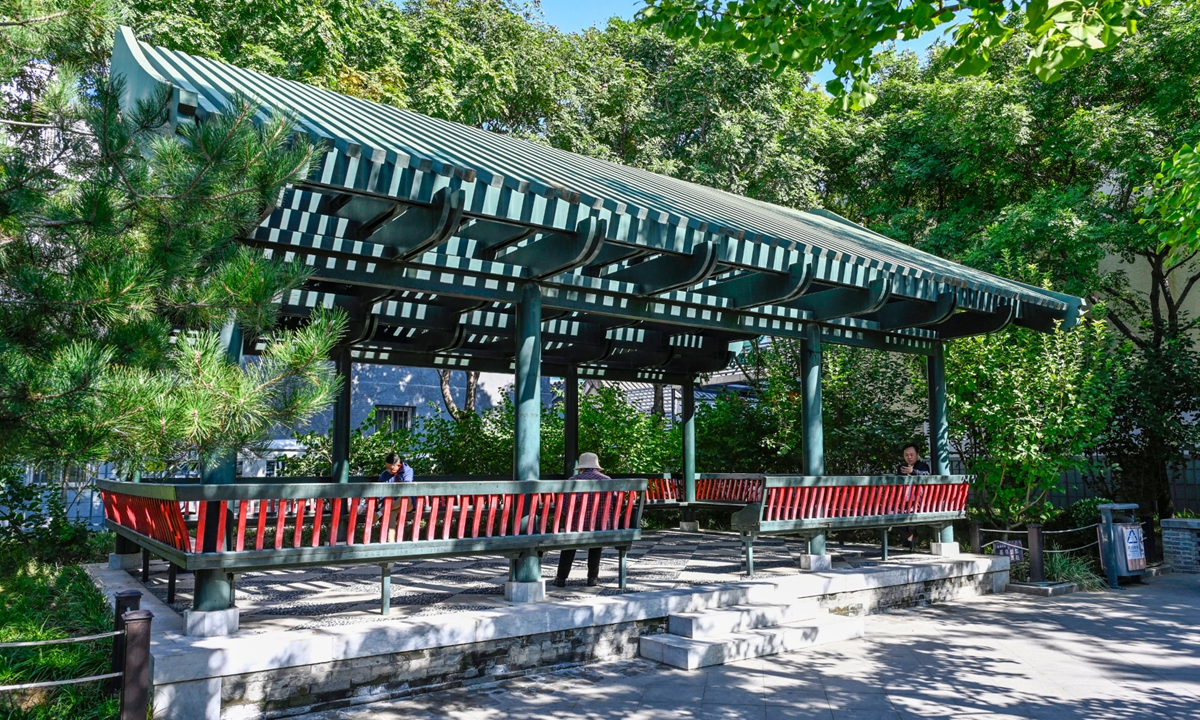
A pocket park in Beijing Photo: VCG
Just steps from the Bell and Drum Towers and tourist crowds of the Shichahai scenic spot in Beijing, a circle of elderly residents gathers around two seniors locked in a game of Chinese chess. Around them, clusters of blooming Chinese roses gently muffle the city's hum. No one would guess that this land was once a jumble of unsightly illegal structures. Today it has been rebuilt as a pocket park, one of thousands that are quietly reshaping China's urban life.Pocket parks, also known as mini parks, typically no larger than a football pitch and often much smaller, have become a signature of China's new urban governance. Built on leftover urban plots, vacant roadside land and former makeshift construction sites, they are equipped with shaded walkways, leisure benches and basic public facilities.
In these compact green spaces, elderly residents practise gentle exercises like tai chi, toddlers chase bubbles, and office workers pause for brief breaks during busy workdays. Scattered across residential blocks and street corridors, these tiny oases have become an indispensable part of urban residents' daily lives.
Data underscores the nationwide momentum of this urban upgrade. During China's 14th Five-Year Plan period (2021-25), more than 18,000 pocket parks were completed across the country, the People's Daily reported.
Yu Jinlong, a Beijing-based cultural scholar, told the Global Times on Thursday that the popularity of pocket parks signals a decisive shift in China's urban renewal from top-down megaprojects to a more nuanced, people-centered approach.
In urban renovation, "we have moved beyond the era of demolishing old neighborhoods and building from scratch. The new logic is community co-governance, with the everyday person at the center," said Yu.
This shift stems from the practical realities of China's urbanization. As central city land resources become increasingly occupied, large-scale construction of sprawling urban parks has become economically and spatially unfeasible. Pocket parks, by contrast, can materialize on former rubbish-strewn vacant lots, underused bridge undercrofts, or land reclaimed from illegal structures. Rather than selling such land to developers, municipal governments are increasingly turning it into public greenery. The cost-benefit ratio is compelling - a low-expenditure intervention that raises livability.
Liu Guowei, an urban planning expert, told the Global Times that pocket parks also resolve long-standing urban governance pain points. This low-cost, high-efficiency renovation model maximizes the value of idle urban resources while upgrading overall urban management.
Beyond ecological improvement, Liu added that pocket parks serve as carriers of urban cultural heritage.
For example, Fuzhou's Songshan Cultural Park in East China's Fujian Province, built on a cleared illegal-construction site in the Jin'an district, features a long wall inspired by the region's traditional "horse-saddle" rooflines. Intangible heritage, from noodle-making techniques to Shoushan stone carving, is etched into panels and sculpture. These mini cultural landscapes function as accessible community exhibition halls, preserving urban memories for elder residents and helping younger generations trace the city's historical evolution.
This marks a deeper conceptual leap: A park is no longer a destination you visit on a public holiday, but an extension of your doorstep.
Liu noted that urban China is gradually pivoting from the 20th-century model of "building parks inside cities" to the 21st-century ambition of "building cities inside parks." Green spaces are no longer merely scenic spots for holiday visits but rigid, high-frequency living spaces deeply integrated into residents' daily routines.
From abandoned marginal land to vibrant life hubs, and from isolated green plots to cultural and ecological engines, pocket parks embody the core of China's refined urban governance. Both experts noted that these tiny green corners reflect the country's sustainable urban development wisdom, centered on people's well-being.
The author is a reporter with the Global Times. life@globaltimes.com.cn
RELATED ARTICLES