China makes comprehensive progress in human rights protection: report
Approach to protect human rights by focusing on fundamental needs breaks away from the Western model: experts
By Published: Jun 05, 2026 04:58 PM

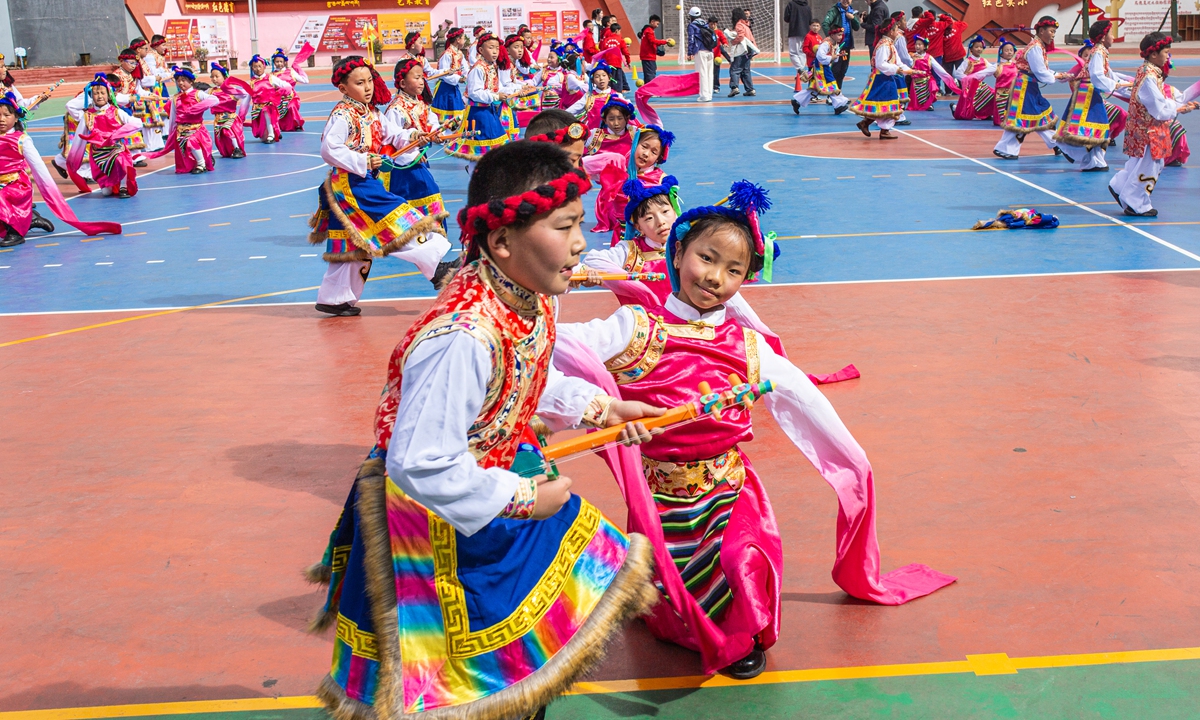
Students from Qamdo Experimental Primary School take part in various activities on campus in Qamdo, Southwest China's Xizang Autonomous Region, on May 13, 2026. Photo: Shan Jie/GT
China has comprehensively bolstered its human rights protection capability, according to an evaluation report jointly released on Friday by the China Society for Human Rights Studies and 20 national human rights education and training bases in the country, the Xinhua News Agency reported on Friday.
The report assesses the implementation of the National Human Rights Action Plan of China (2021-2025), which was issued in September 2021, Xinhua reported.
China has fully implemented the five-year action plan, accomplishing all 181 tasks outlined in it, the report says, per Xinhua.
It notes that China has advanced human rights through development, with the country completing the building of a moderately prosperous society in all respects and eliminating absolute poverty.
These achievements demonstrated through this implementation fully validate the scientific soundness and practical effectiveness of China's path of human rights development, experts said.
China has consistently upheld the principle that the rights to subsistence and development are the primary human rights, focusing on the fundamental needs of the people and continuously improving rights protection systems in areas such as social security, healthcare, education, and environmental protection. In doing so, it has strengthened the foundation of human rights protection for all citizens and broken away from the Western model of a singular and overly formalistic human rights narrative, Zhu Ying, a professor at the Baize Institute at the Southwest University of Political Science and Law, told the Global Times on Friday.
According to the report, China has strengthened protection of the rights and interests of all groups, ensuring that people from various sectors participate in economic and social development, exercise their democratic rights, and benefit from the outcomes of modernization on an equal basis. In addition, the rights of women, children, the elderly and people with disabilities have been better safeguarded, Xinhua said.
China has actively promoted human rights education and awareness, fostering greater public understanding of and commitment to respecting and protecting human rights, the report noted.
This action plan features several notable highlights, which not only provides targeted and comprehensive protection for the rights and interests of vulnerable groups, including women, children, and the elderly, but also proactively responds to the needs of the digital age, Zhu said.
Through specialized legislation, it strengthens the protection of digital rights, addressing emerging gaps in the human rights protection framework and enhancing safeguards for new forms of human rights challenges, the expert noted.
There is always room for progress in human rights protection, the report says, adding that China still faces imbalanced and insufficient development, while sci-tech development and industrial transformation are also giving rise to new demands for rights.
The report expresses the expectation that China will respond to these challenges and further advance human rights during the 15th Five-Year Plan period (2026-2030).
The action plan spanning the period 2021-2025 was the fourth national human rights plan released and implemented by the Chinese government, Xinhua said.
Very few countries in the world - especially major countries - have continuously formulated and implemented four consecutive national human rights action plans. In line with the principles advocated in the Vienna Declaration and Programme of Action, China has successfully completed four phases of its National Human Rights Action Plan, and preparations are currently underway for the formulation of the fifth phase, Zhao Shukun, professor at the Institute of Human Rights of Southwest University of Political Science and Law, told the Global Times on Friday.
This represents a concrete example of China's commitment to respecting and protecting human rights, its determination to advance the development of its human rights cause, and its ongoing efforts to enhance the level of human rights protection, said Zhao, who also involves in conducting the report. "It demonstrates China's sustained pursuit of human rights progress through long-term planning, policy implementation, and institutional development."
China follows the principles of equality, mutual trust, inclusiveness, mutual learning, win-win cooperation and common development, and it fulfills its international human rights obligations with a strong sense of responsibility, the report states.
Through the implementation of four consecutive National Human Rights Action Plans, it is evident that China has pursued a planning-based approach to human rights protection, characterized by cooperation and coordination among multiple stakeholders, including the government, enterprises, social organizations , and the public, Zhao noted.
"This approach differs from the adversarial framework often advocated or portrayed in Western human rights discourse, which tends to emphasize a confrontational relationship between the state and its citizens," she said, adding that China's experience demonstrates a model in which various sectors of society work together to advance human rights protection and development, with an emphasis on coordination, shared responsibility, and practical outcomes.
RELATED ARTICLES