GT on the Spot: Waste-to-energy facility in Suzhou offers a glimpse into environmental efforts, achievements
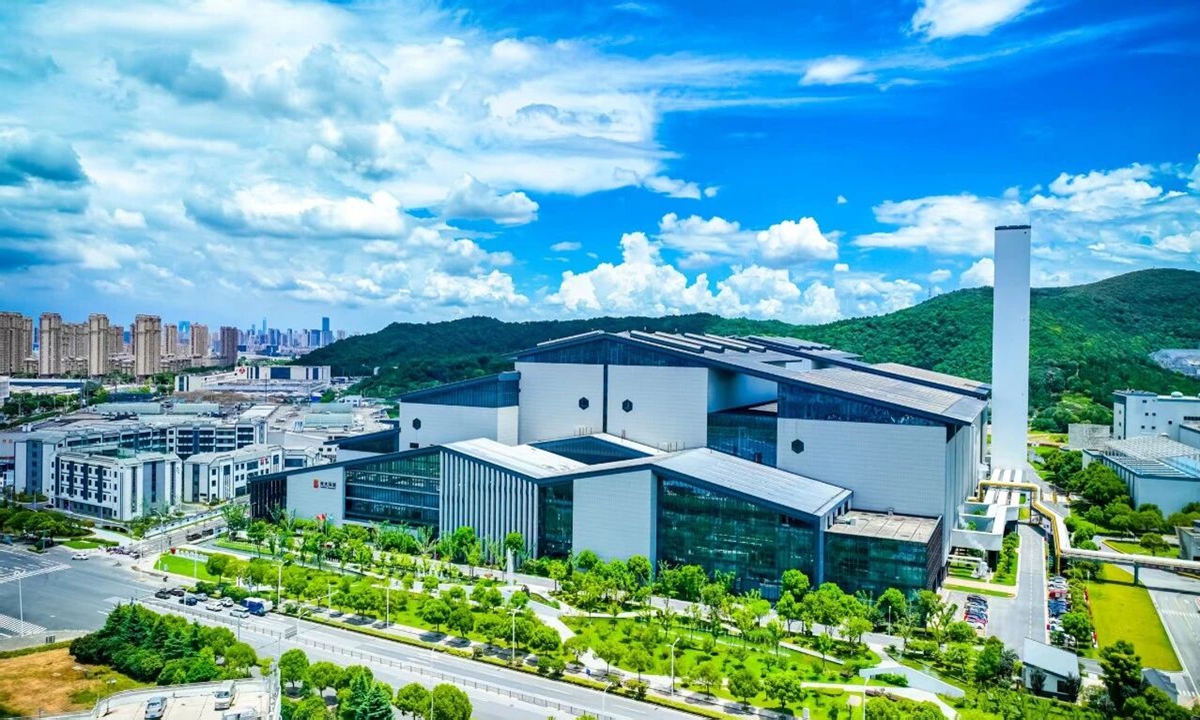
Everbright Environment's waste incineration facility in Suzhou, East China's Jiangsu Province Photo: Courtesy of Everbright Environment
Observing through the massive glass window, a giant mechanical claw lifts garbage that has been fermenting for several days from a waste pit dozens of meters deep and steadily feeds it into the inlet - yet the area remains entirely odor-free.The scene unfolds at a waste-to-energy facility in Suzhou, a city in East China's Jiangsu Province, which was named to the inaugural "20 Cities Towards Zero Waste" initiative under the United Nations Secretary-General's Advisory Board on Zero Waste in March.
Suzhou maintains a comprehensive utilization rate of over 98 percent for bulk industrial solid waste. The coverage rate of domestic waste sorting facilities exceeds 99 percent, and all sewage sludge from water treatment is fully disposed of and recycled. These figures paint a full picture of Suzhou's progress in building a Zero-Waste city, the Xinhua News Agency reported.
With these figures in mind, the Global Times reporter visited the waste-to-energy facility operated by Everbright Environment in Suzhou, where most of Suzhou's urban municipal solid waste is processed, ahead of the World Environment Day which falls on June 5.
Shift in industry
At the waste-to-energy facility, real-time emission data is displayed on the large screen in the central control room. All readings covering carbon monoxide, hydrogen chloride, sulfur dioxide, nitrogen oxides and particulate matter are synchronized with the national environmental protection platform, with indicators significantly outperforming EU standards.
Through independent technological innovation, the project adopted medium-temperature, ultra-high-pressure reheat technology, enabling power generation per tons of waste incinerated to exceed 700 kWh, the Global Times learned from the company.
The progress in Suzhou epitomizes the wider evolution of the sector in China. A local government official in Suzhou recalled past two decades of operation, noting that when Phase I of the project began operation in 2006, municipal waste in the city was still mainly disposed of through landfill.
With rapid growth in both population and GDP in Suzhou, the project underwent successive capacity expansions and by 2021 had enabled the city to achieve full incineration and zero landfill of raw municipal solid waste, effectively resolving the long-standing "waste siege" issue.
Fueled by an intensifying environmental consciousness, China has transformed its waste management paradigm over the past two decades by promoting cleaner and more efficient waste incineration technology, according to Xinhua.
China's national emission standards for waste-to-energy plants align with the latest EU benchmarks, positioning them among the world's most stringent. Some regions, including Beijing, Tianjin, Shanghai, Jiangsu and Zhejiang, have implemented even stricter local regulations that surpass EU thresholds, per Xinhua.
Ma Jun, director of the Beijing-based Institute of Public and Environmental Affairs, told the Global Times that China's waste incineration industry has achieved rapid growth over the past decade, with the number of relevant enterprises having risen sharply, effectively alleviating the garbage siege issue.
Although the industry once faced strong resistance from residents of selected sites, environmental authorities mandated disclosure of operational data, Ma said. Under public supervision, enterprises improved pollution control, facility conditions and technical capacity, driving the industry's rapid development, the expert added.
With the advancement of dual-carbon goals and zero-waste city development, waste incineration serves as an indispensable field in the building of a Beautiful China, Ma said.
However, Ma emphasized that waste incineration is only one essential link in the waste management system and must work with recycling and classification to take full effect.
China's Ministry of Housing and Urban-Rural Development said on May 25 that China aims to raise its urban household waste recycling utilization rate to above 76 percent by the end of 2030.
Latest data from the ministry also shows that by the end of 2025, China had 1,137 waste incineration facilities with a daily processing capacity of 1.18 million tons. Fifteen provinces and municipalities including Beijing, Zhejiang and Shandong have achieved zero landfilling of raw domestic garbage, with its control of major pollutant emissions ranking among the world's advanced levels.
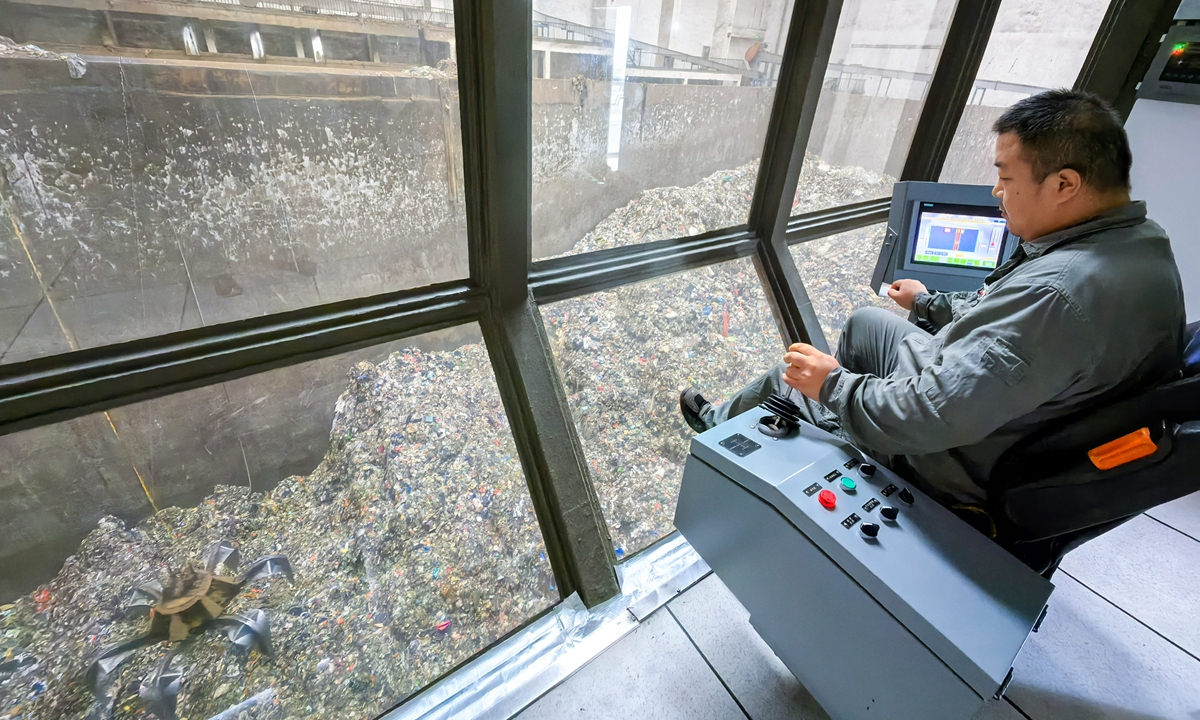
A worker operates a garbage crane to sort household waste into different fermentation zones at a waste treatment facility in Jinan, East China's Shandong Province, on Septmber 19, 2024. Photo: VCG
'Not enough waste to burn'Amid the rapid growth of the industry, the situation has transformed from "wastes sieging cities" to a "shortage of garbage for incineration." A staff member from Everbright Environment told the Global Times that this perspective has also triggered widespread discussion across the industry.
"Rather than signaling a crisis, this phenomenon can be understood as a structural turning point in the industry's upgrading process," the staff member said. At present, waste collection is insufficient compared with incineration capacity, with an estimated industry gap of about 20 percent. Regional development is also uneven, with many enterprises concentrated in major cities and developed areas.
By the end of 2025, China's installed daily waste-to-energy incineration capacity had reached 1.1 million tons, equivalent to 360 million tons annually, CCTV News reported in April, citing experts. Meanwhile, China's actual annual domestic waste output stands at 320 million tons, leaving many plants running under capacity.
According to CCTV News, experts said waste disposal capacity varies unevenly across China, with disparities within provinces and cities due to differences in economic growth, population density, waste output and collection systems.
"China has advanced household waste sorting nationwide over the past few years, and the increased recycle rate also means less will be incinerated, leading to intensified capacity surplus," Ma added.
The Everbright Environment staff member told the Global Times that "there is not enough waste to burn" reflects a shift in China's waste management from ensuring basic treatment capacity to pursuing higher efficiency and sustainability.
Moderate capacity redundancy is a natural result of forward-looking planning, which once helped ease the "waste siege" and now requires more refined and efficient operations, the staff member added.
Therefore, operational hurdles due to "insufficient wastes" may seem challenging for some waste incineration enterprises for a moment, yet they reflect China's resolve, capacity and achievements in addressing an environmental problem arising alongside the urbanization, which will continue to sustain the building of a Beautiful China, according to analysts.
RELATED ARTICLES