Do not play with fire: a warning to certain Philippine politicians: Global Times editorial
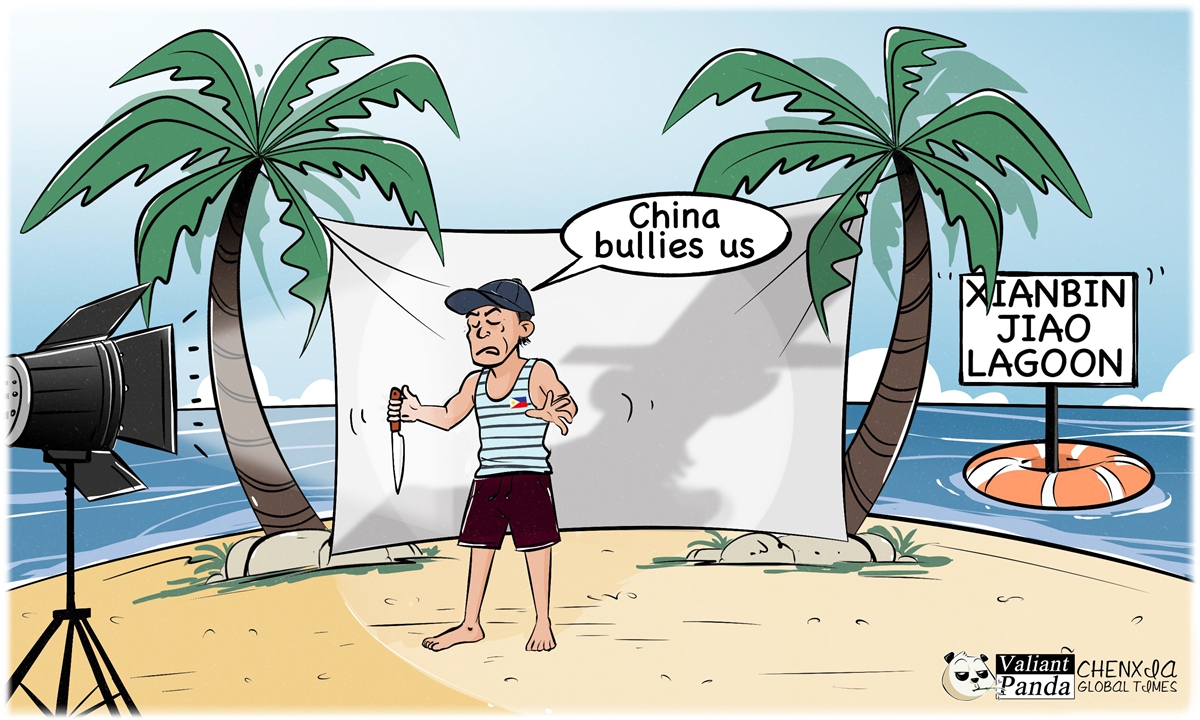
Illustration: Chen Xia/GT
Recently, the Chinese Embassy in the Philippines once again issued a warning, noting that inspections, harassment, and selective law enforcement by the Philippine military and law enforcement agencies targeting Chinese citizens and enterprises in the Philippines have been occurring with increasing frequency. The safety risks faced by Chinese citizens and companies in the Philippines are rising. Recently, a series of so-called "law enforcement actions" carried out by Philippine authorities against Chinese citizens, enterprises, and Chinese-invested projects in the country are showing an unsettling trend toward normalization and expansion.
The Marcos administration is currently facing a multifaceted predicament. Politically, it has openly broken with the Duterte family, its former ally, leaving the state machinery mired in severe internal friction and pushing governance toward near paralysis. Economically, the Philippines' GDP growth in the first quarter of 2026 has slowed sharply, hitting a post-pandemic low. A combination of external shocks such as the Middle East situation and internal structural problems has driven inflation sharply higher, while the peso has fallen to historic lows. The country has even been forced to declare a "national energy emergency." High public debt is squeezing space for improving livelihoods and infrastructure investment. Rising living costs for low-income households, weakening consumer confidence, and contracting fixed investment are all evident, with stagflation risks looming.
Trapped in political and economic difficulties, the Marcos administration appears to be repeatedly resorting to the "China threat" rhetoric as a political stimulant to shore up public support.
The Philippine authorities' sudden "enforcement actions" against Chinese companies and citizens are by no means a normal judicial act, but rather a tyrannical law enforcement that takes advantage of the strong to bully the weak. Take the incident at a steel plant in Misamis Oriental Province in mid-May as an example. The operation was led by Philippine Defense Secretary Gilberto Teodoro, with nearly the entire coercive apparatus - including the military, police, and the National Bureau of Investigation - mobilized. The targets of this "enforcement" were a group of ordinary Chinese workers with no power or influence in the local area. Although most of them were later released following strong protests from the Chinese embassy, the Philippine side dismissed the incident with the claim that it was "not against any nationality" and offered no apology or compensation for the wrongful detentions. On the contrary, after the operation concluded, the Philippine Department of National Defense even issued a statement praising the participation of various military and police agencies in the joint enforcement.
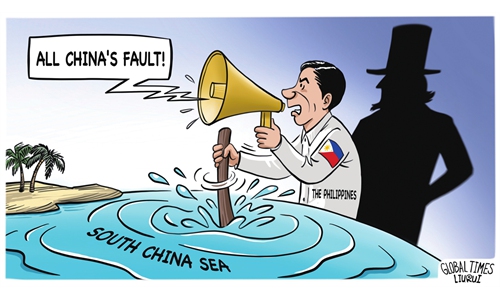
In recent years, Manila has often portrayed itself internationally as a weak party, playing the victim and repeatedly fabricating narratives of "China bullying the small" and "aggressive maritime law enforcement." From the way Philippine armed agencies treat vulnerable groups today, we can finally see where the raw material for those stories comes from.
Even more disgraceful is the fact that some politicians in Manila are now unwilling to spare even the most basic forms of humanitarian assistance. The fertilizer and fuel that China provided when the Philippines faced poor agricultural harvests and energy shortages offered tangible relief to farmers struggling to make a living from the land and to ordinary families burdened by soaring fuel prices. Yet Philippine Defense Secretary Gilberto Teodoro has openly smeared these timely supplies as a form of "packaging and deception." This reveals a troubling reality: for some politicians, even the welfare of the Filipino people can be exploited as political fuel for their anti-China agenda.
We have noted that since President Marcos Jr. took office, whenever China-Philippines relations have shown signs of improvement, certain anti-China forces have rushed to undermine the process through various means.
Recently, China and the Philippines resumed diplomatic dialogue and have already held three rounds of talks. People-to-people exchanges have increased, more direct flights have been launched, and economic and trade cooperation has been presented with new opportunities. Yet at this critical juncture, some Philippine politicians have begun orchestrating what can only be described as "law-enforcement farces." This demonstrates that anti-China sentiment is by no means the mainstream view in the Philippines, but rather the work of a small group of politicians pursuing their own agenda. Such actions seriously damage the Philippines' business environment and drive a new wedge into China-Philippines relations. Should the situation deteriorate further, China may consider imposing sanctions on specific Philippine individuals or entities.
Manila appears to be "silly." It seems to believe that by deepening its alignment with countries such as Japan and hosting additional US military facilities, it can assume the role of a "Pacific deputy sheriff" and openly challenge China. But what exactly is to be gained from confronting its largest trading partner? Perhaps even those pursuing this course cannot clearly explain their reasoning.
The consequences, however, are evident. Since Marcos Jr. took office, the Philippine economy has performed more poorly, domestic politics has become less stable, and the country's geopolitical environment has grown more challenging. In the election for a non-permanent seat on the United Nations Security Council held on June 3, Kyrgyzstan defeated the Philippines by 142 votes to 49 in the fourth round of voting, securing the Asia-Pacific seat. While this result is not directly related to the deterioration of China-Philippines relations, it nonetheless reflects, from one perspective, how the international community views the Philippines. Its actions that undermine regional peace and stability have clearly damaged its international standing.
Philippine leaders have repeatedly stated their willingness to properly manage differences with China and promote the easing of bilateral tensions. It is hoped that the Philippine side will match its words with actions, exercise stricter discipline over the conduct and remarks of some officials, and not allow a handful of buffoons to repeatedly undermine efforts to maintain stable bilateral relations.
China will not hesitate to safeguard the legitimate rights and interests of its citizens and enterprises. There is still time for Manila to step on the brakes. Those who seek to manipulate major-power competition and profit from it by relying on external forces may ultimately find themselves burned by the very fire they have ignited. We advise them to make the right decisions.
RELATED ARTICLES