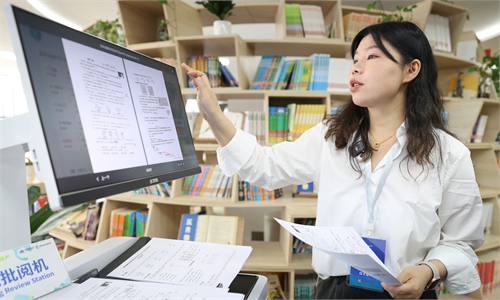
12.9 million Chinese sit 2026 college entrance exam as gaokao shows a social ethos that values knowledge, fairness
From traffic control to AI-powered anti-cheating systems, nation ensures a fair and smooth process
By , in Beijing and Chen Xia in Shanghai Published: Jun 07, 2026 10:22 AM

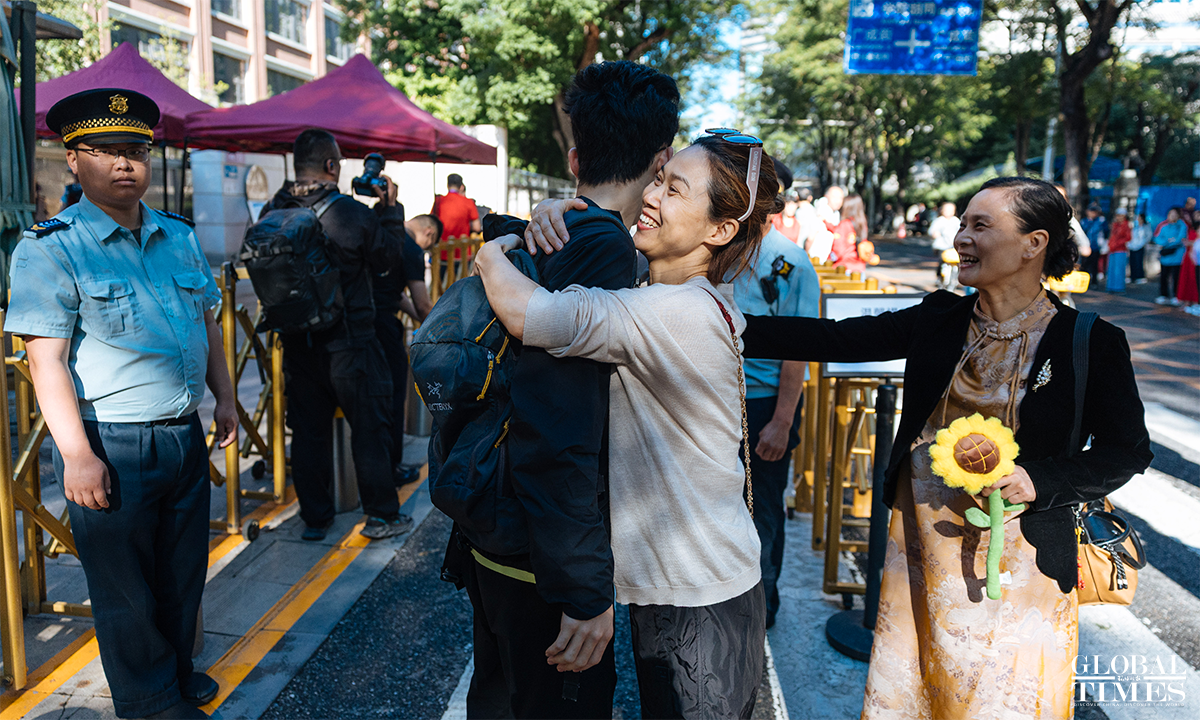
Students arrive at the exam sites of Beijing No. 8 High School, accompanied by their teachers and parents, for the 2026 national college entrance exam, also known as the gaokao, on the morning of June 7, 2026. Photo: Li Hao/GT
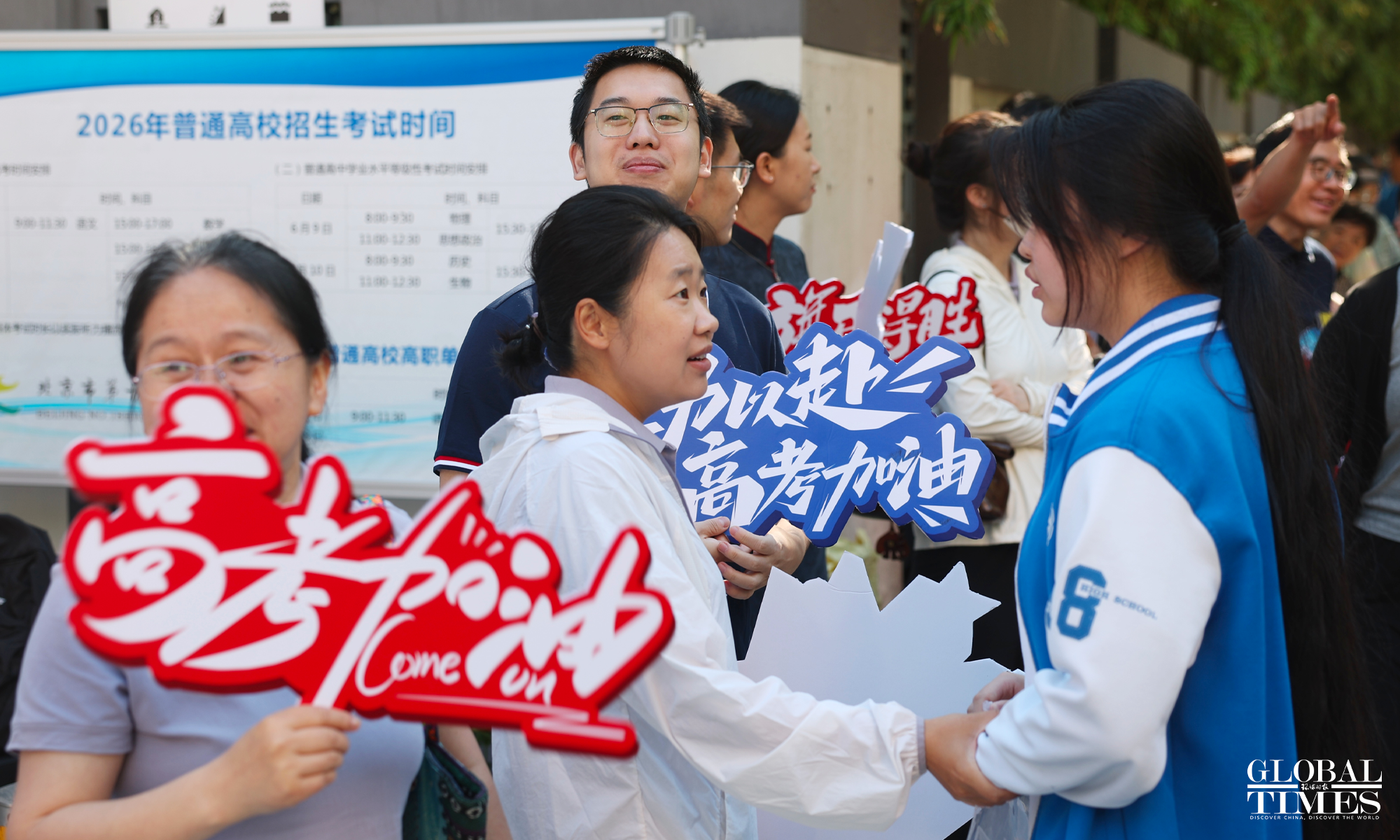
Students arrive at the exam sites of Beijing No. 18 High School, accompanied by their teachers and parents, for the 2026 national college entrance exam, also known as the gaokao, on the morning of June 7, 2026. Photo: Cui Meng/GT
It is the time of the year once again when one examination commands the concern of the nation. As China's national college entrance exam, or gaokao, began on Sunday, scenes at test sites captured the moment: parents offering hugs and encouragement as students stepped into exam halls for one of the most pivotal tests of their lives. Some mothers wore qipao, a traditional dress symbolizing qikaidesheng, or success at the outset.
A total of 12.9 million students have registered for this year's gaokao, with 7,981 testing centers and about 348,000 examination rooms set up across the country. Chinese language and mathematics are the subjects tested on the first day of the exam, media reported.
Authorities have mobilized a wide range of resources, from traffic control and noise-reduction measures to AI-powered anti-cheating systems and emergency medical services to ensure a smooth and fair examination process. This year's essay topics, which repeatedly touched on technology and societal change, illustrate how the gaokao reflects China's evolving social values and supports the country's strategic priorities.
Since the gaokao's restoration in 1977, the college entrance examination is not only a selection process, but also an important engine of national development and social mobility. The gaokao has continuously provided China's higher education institutions with high-quality students, cultivated a large number of professionals for national strategy, economic development and technological innovation, and fostered a social ethos that values knowledge and upholds fairness, analysts said.
Ensuring a convenient and fair environment
At Beijing No. 8 Middle School, students and parents began gathering outside the testing center hours before the first exam. Parents were seen holding signs to encourage their children, one of which read, "May success bear your name, and may our paths cross at the summit."
Police officers and community volunteers offered assistance and distributed messages of encouragement, while a temporary service station helped students resolve last-minute identification issues.
Across China, local governments have mobilized resources to support the students taking this year's gaokao. In Yuncheng, North China's Shanxi Province, testing centers are equipped with cooling facilities, backup audio systems and round-the-clock medical support. Outside exam venues, authorities have stepped up traffic management, noise control and food-safety inspections in an effort to ensure that students can focus on one of the most important exams of their lives.
During the gaokao, market supervision authorities across Guangzhou launched targeted inspections to safeguard students, covering food safety, stationery quality, special equipment and even anti-cheating measures. In several districts, officials checked canteens, nearby restaurants, catering services and student accommodations to ensure safe meals, according to a notice published by the authorities.
In a notice issued on June 6, the Ministry of Education (MOE) reminded candidates to observe exam discipline and refrain from bringing mobile phones, smartwatches, smart glasses or other wireless communication devices into testing centers, requiring any such items to be stored at designated locations before entering examination rooms.
To curb cheating during the gaokao, testing centers across China have deployed technologies including AI-powered monitoring systems and smart security screening gates.
In Beijing, candidates are barred from bringing smart glasses into testing venues, while in Guangzhou, Guangdong Province, security gates have been upgraded to better detect concealed wearable devices. AI monitoring systems used in many examination rooms can automatically flag unusual behavior by test takers and generate video clips for further review, according to China Central Television.
Keeping pace with the times
China's 2026 gaokao essay questions featured five sets of papers, each with its own writing task. Education officials told the Xinhua News Agency that the essay questions were designed to reflect contemporary themes, promote critical thinking and values education, and encourage students to apply what they have learned to real-world issues.
Compared with last year, technology featured more prominently in this year's essay questions. In Beijing, one prompt asked students to draft a promotional message for a volunteer event themed "Artificial Intelligence and a Happy Retirement," to encourage the participation of seniors ahead of the Chongyang Festival.
In Shanghai, the essay topic also focused on technology, asking candidates to reflect on how it reshapes the world and transforms the way we imagine it.
One of the essay prompts in National Paper I asked students to reflect on a word whose meaning had evolved for them as they grew up, and to discuss how that change reflects their personal development and understanding of a rapidly changing world.
The recent changes to gaokao essay topics and university programs reflect broader efforts to align education with evolving social and economic needs, Zhang Yiwu, a professor in the Department of Chinese Language and Literature at Peking University and director of its cultural and arts committee, told the Global Times.
Zhang said the prominence of argumentative writing underscores a growing focus on critical thinking, analytical skills and clear expression, while universities are increasingly channeling resources toward emerging fields such as artificial intelligence and other strategically important disciplines. The shift, Zhang said, reflects a move beyond merely adjusting existing programs toward cultivating new areas of growth.
In January, the Ministry of Education issued a notice on the gaokao, outlining plans to improve the quality and broaden the reach of higher education, with an emphasis on expanding enrollment in top-tier undergraduate programs.
Universities are restructuring their academic offerings to prioritize foundational disciplines, emerging fields, interdisciplinary studies, and areas of high demand, in line with national priorities for scientific innovation and industrial development. At the same time, existing programs are being updated and refined, supporting China's pursuit of advanced scientific and technological self-reliance, reads the notice.
Moreover, this year, multiple Chinese universities have rolled out new undergraduate programs such as embodied intelligence, low-altitude economy and management, as well as marine intelligence and unmanned technologies, aiming to meet the country's emerging strategic and industrial needs, according to an updated catalog recently issued by the MOE.
The college entrance examination has long remained a focal point of concern for Chinese society, not only because it shapes the personal development of candidates and their families, but also because it reflects the nation's enduring emphasis on education and knowledge. The exam carries the public's expectations for fairness and social mobility, Zhang noted, adding that trends in the gaokao provide a window for observing broader societal changes and evolving values.
RELATED ARTICLES