China takes series of responsive law enforcement operations against Japan-Philippines so-called maritime ‘delimitation talks’; moves demonstrate China’s capability, resolve: Chinese expert
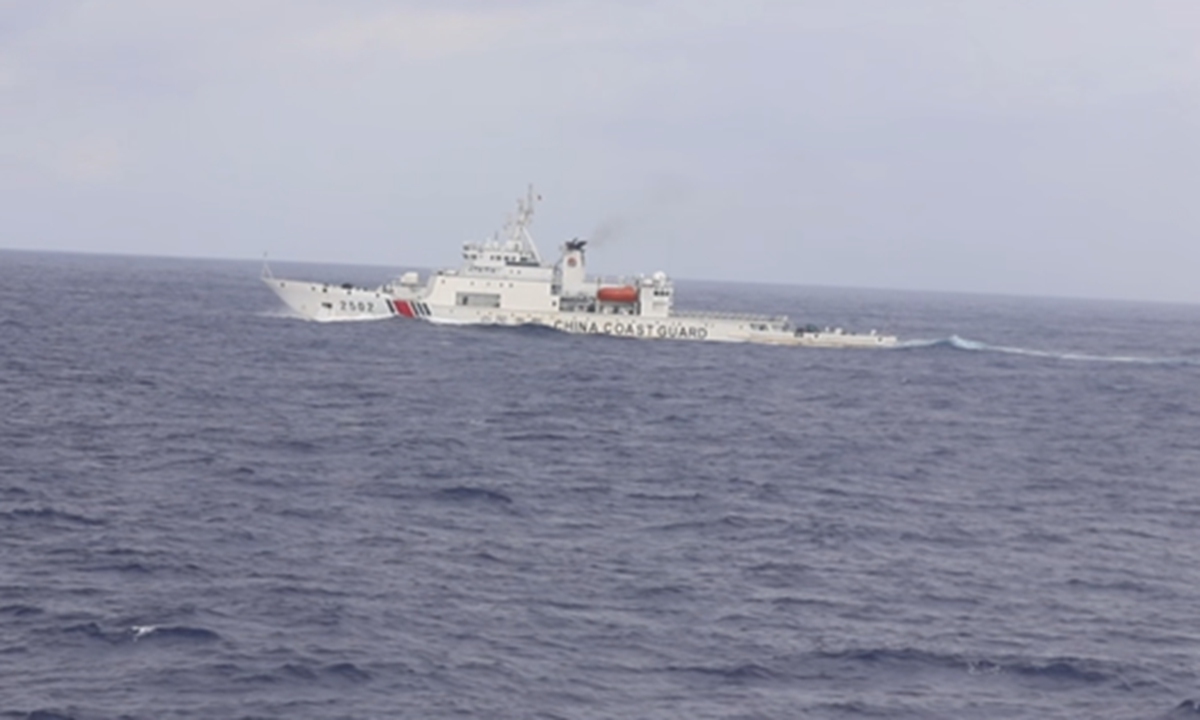
A screenshot of a video clip shows the China Coast Guard (CCG) task group, led by the CCGS Daishan, conducting routine law-enforcement patrols in accordance with the law in waters east of China's Taiwan island on June 1, 2026.
China has recently taken a series of responsive actions, including a special maritime law enforcement operation on Saturday in waters east of Taiwan island, after Japan and the Philippines announced plans to start talks on maritime delimitation in the waters east of China's Taiwan island. A Chinese expert said the coordinated moves demonstrate China's sovereignty and jurisdiction, as well as its capability and resolve to safeguard its maritime rights and interests.
China launched a special maritime law enforcement operation, led by China's Ministry of Transport and jointly undertaken by the Fujian Maritime Safety Administration, the Guangdong Maritime Safety Administration, the Eastern Navigation Service Center of the National Maritime Safety Administration, and the East China Sea rescue bureau, in the waters east of Taiwan island on Saturday. It is a necessary move in response to Japan and the Philippines' unilateral announcement of the "maritime delimitation talks" on the east of China's Taiwan island, which constitutes a serious violation of China's territorial sovereignty and maritime rights and interests, the Xinhua News Agency reported.
The move came after Japan and the Philippines claimed last month that they would begin so-called formal talks on delimiting the maritime boundary of the so-called exclusive economic zone and the continental shelf between the two countries "in accordance with international law," according to a Reuters report.
Previously, a necessary responsive operation was carried out on June 1, as the China Coast Guard (CCG) task group conducted routine law-enforcement patrols in accordance with the law in the waters east of China's Taiwan island, CCG's spokesperson Jiang Lue said.
"We urge Japan and the Philippines to immediately cease all illegal acts that undermine China's sovereign rights and interests. The CCG will continue to strengthen control and management over relevant waters and take real actions to resolutely safeguard national sovereignty and maritime rights and interests," Jiang said, according to CCG.
No matter it is law enforcement operations of CCG or maritime safety administration, these operations affirm China's sovereignty and jurisdiction over waters east of the Taiwan island, showing the country's resolve, capability and maritime management strength to safeguard maritime rights and interests, Zhang Junshe, a Chinese military affairs expert, told the Global Times on Sunday.
Given the complex maritime conditions in the waters east of Taiwan island, which present a test for vessel performance and law enforcement operations, these operations demonstrate that CCG and maritime authorities are fully capable of conducting regular law enforcement patrols and maritime control in the area, Zhang said.
It further shows that China has set up a sound framework for protecting sovereignty, maritime rights and interests and managing waters around Taiwan island, according to Zhang.
The so-called unilateral delimitation talks between Japan and the Philippines are tantamount to attempting to "carve up" these waters, which seriously infringes upon China's maritime sovereignty and rights and interests, Zhang added.
According to China's domestic law and international law including the UN Convention on the Law of the Sea (UNCLOS), China has exclusive economic zone and continental shelf in this area. Japan and the Philippines' so-called maritime delimitation talks constitute a severe violation of China's maritime rights and interests, UNCLOS and other international law and basic norms governing international relations, Chinese Foreign Ministry spokesperson Mao Ning stressed during a previous press conference on May 29 after the claim by Tokyo and Manila.
"The so-called delimitation talks are completely illegal, null and void, and will have no effect on China's claims to rights in the area east of the Taiwan island or exercise of China's lawful rights," Mao said, adding that China urges Japan and the Philippines to immediately stop any violation of China's maritime rights and interests and take concrete actions to uphold regional peace and stability.
In violation of the international law, Zhang said that Japan and the Philippines aim to jointly contain China and restrict its maritime operations as part of their coordination with the so-called Indo-Pacific strategy with the plan.
The expert added that Japan also seeks to provoke China alongside the Philippines in adjacent waters, hoping to ease the pressure from China's countermeasures over its actions concerning the Diaoyu Islands.
In response to the Democratic Progressive Party (DPP) authorities' echoing of the move by Japan and Philippines, Zhu Fenglian, a spokesperson for the State Council Taiwan Affairs Office said on June 3 that compatriots on both sides of the Taiwan Straits belong to the Chinese nation, according to CCTV News.
"We should stand firm on our national stance, uphold national righteousness, and jointly safeguard national sovereignty and territorial integrity as well as the overall interests of the Chinese nation. If the DPP authorities dare to collude with external forces and betray national interests, they will surely be spurned by compatriots on both sides of the Taiwan Straits and punished by history," Zhu added.
Faced with public opinion pressure, the DPP authorities still haven't voiced strong protests. Such a compromising stance essentially amounts to acts that harm national and ethnic interests, Zhang said. "Chinese people on both sides of the Taiwan Straits should work together to safeguard our country's sovereignty, maritime rights and interests as well as national interests," he added.
Regardless of how external forces behave, the steps taken by China's relevant departments make clear China's position, the expert said, and is a testament to China's resolve and capacity to secure national sovereignty and maritime rights and interests.
RELATED ARTICLES