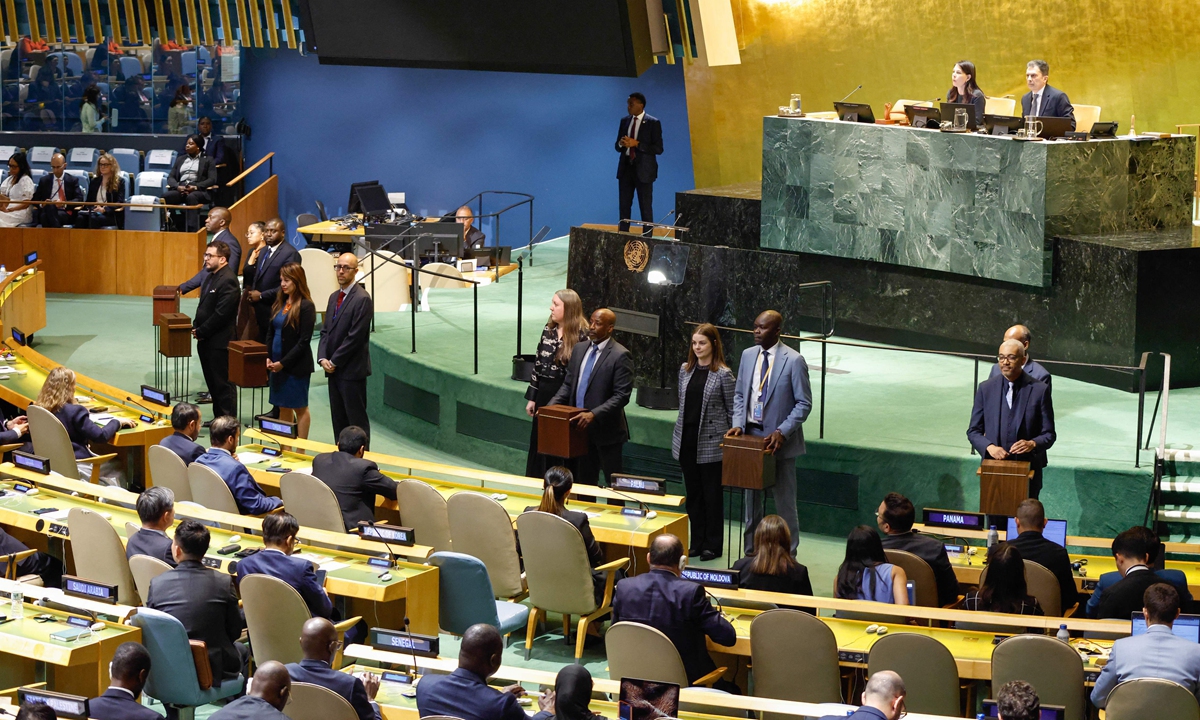
Ushers hold ballot boxes during a UN General Assembly meeting for the election of the non-permanent members of the UN Security Council at the UN headquarters in New York, US, on June 3, 2026. Photo: VCG
Kyrgyzstan's election as a non-permanent member of the UN Security Council for the first time in its history is not only a landmark achievement for the country's diplomacy, but also a significant moment for Central Asia and the broader Global South.
Kyrgyzstan positions itself as a voice of the Global South. Its victory over the Philippines (with 142 votes in favor) was made possible largely by the support of countries in Africa, Latin America and Asia. The case for Kyrgyzstan as a voice of the Global South at the UN Security Council was a central pillar of its candidacy. Bishkek, the country's capital, has strategically positioned itself as a representative for small, developing, landlocked and mountain states, leveraging its own vulnerabilities and diplomatic record to argue for a more inclusive and equitable international order.
Kyrgyzstan highly appreciates and supports the global initiatives proposed by China. Together, Kyrgyzstan and China can build a better world by amplifying the voice of the Global South, promoting regional stability and advancing common security concepts.
First, China and Kyrgyzstan can jointly strengthen the representation and influence of the Global South in global governance. By aligning their positions on key issues - such as preventing unilateral sanctions, opposing interference in internal affairs and promoting peaceful conflict resolution - China and Kyrgyzstan can ensure that the UN Security Council's agenda reflects the legitimate concerns of the Global South. With Kyrgyzstan now at the Council table, the two countries can coordinate closely to propose resolutions and initiatives that prioritize development, poverty alleviation and non-interference, while challenging narratives that disproportionately benefit Western geopolitical interests.
Second, China and Kyrgyzstan can work together to strengthen regional security and counter common threats. Central Asia faces a range of transnational challenges, including terrorism, extremism, separatism, drug trafficking and cybercrime. As a non-permanent member of the Security Council, Kyrgyzstan can help put these issues on the global agenda, drawing the international community's attention to the specific vulnerabilities of landlocked developing countries.
Third, the two countries can deepen their Belt and Road Initiative (BRI) cooperation and use the Security Council platform to highlight the importance of development as the foundation for lasting peace. Kyrgyzstan is a key node in the BRI, with infrastructure projects such as the China-Kyrgyzstan-Uzbekistan railway promising to transform the country into a regional transit hub.
Economic development, when inclusive and sustainable, reduces the root causes of conflict - poverty, inequality and lack of opportunity. At the Security Council, Kyrgyzstan can champion resolutions that link post-conflict reconstruction to large-scale infrastructure and trade connectivity, while China can provide expertise and resources.
Moreover, China and Kyrgyzstan can jointly address the challenges of climate change and water security, which are increasingly recognized as threats to international peace. Central Asia's water resources, particularly the Syr Darya and Amu Darya rivers, are a source of both livelihood and potential tension.
Kyrgyzstan's upstream position gives it a critical role in water management. China's experience in green development and large-scale ecological restoration can support Kyrgyzstan in balancing energy needs - such as hydropower - with downstream agricultural demands.
Finally, China and Kyrgyzstan can serve as role models for South-South cooperation and mutual trust. Unlike traditional great power politics, which often exploits small states as proxies, China's foreign policy emphasizes equality, non-conditionality and respect for national development paths. Together, the two countries can advocate for a new type of international relations based on dialogue over confrontation and partnership over alliance. At a time when geopolitical rivalries are intensifying, the China-Kyrgyzstan partnership sends a powerful message: Countries of different sizes, histories, economics and social systems can collaborate for the common good.
In conclusion, Kyrgyzstan's debut in the UN Security Council is more than a diplomatic honor - it is an opportunity to reshape global governance from within. By leveraging their strategic partnership, China and Kyrgyzstan can amplify the Global South's voice, advance regional security, prioritize development-led peacebuilding, address emerging threats like water and climate change, and model a fairer form of international cooperation.
The author is director of the Institute of World Policy of Kyrgyzstan. opinion@globaltimes.com.cn
RELATED ARTICLES