China’s first general-purpose humanoid robot undergoes real-home trials; room remains for robots to understand various needs, raise effiiciency: expert
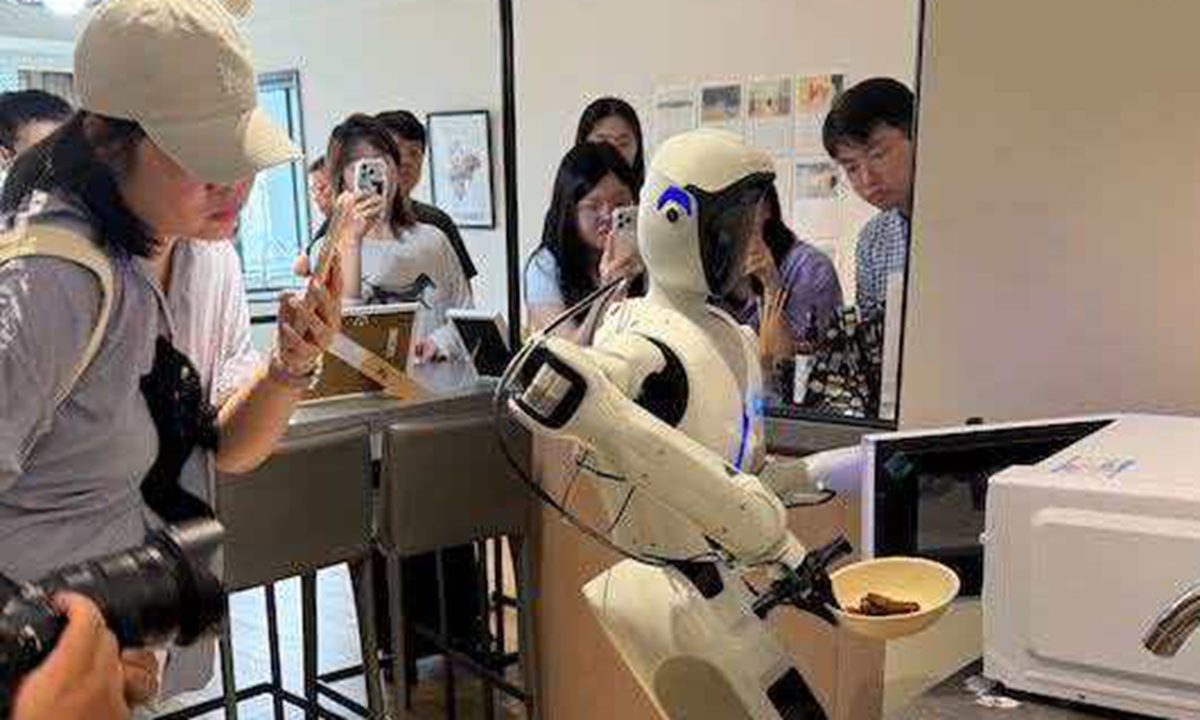
The humanoid household robot SeeLight S1 moves to a counter, picks up and heats fried chicken in a microwave in Wuhan, Central China's Hubei Province. Photo: Courtesy of Zhu Zheng
"Xiaoguang, please prepare breakfast." Responding to the command, a humanoid household robot rolled to a counter, picked up bread, heated fried chicken in a microwave and served the meal in under 8 minutes at a model apartment in Wuhan, Central China's Hubei Province, showcasing the latest advances in home-service robotics. This is China's first general-purpose humanoid robot which has entered real household scenarios on a trial basis, chinanews.com reported on Sunday.
Named Xiaoguang, the robot is the SeeLight S1, a general-purpose humanoid robot for home use developed by GigaAI, according to the report. Unveiled on May 20, the first batch of 100 robots have entered household testing.
Inside the roughly 150-square-meter model apartment, two SeeLight S1 robots worked simultaneously. One handled breakfast-related tasks, including fetching food, heating chicken wings, clearing the table and loading dishes into a dishwasher, while the other removed clothes from a dryer, folded them and placed them in a wardrobe. The robots learned to perform these household chores in less than a month of on-site training, according to the report, per the report.
Unlike conventional robots programmed to execute fixed sequences of actions, the SeeLight S1 is powered by GigaAI's self-developed embodied foundation model, Zhu Zheng, co-founder, chief scientist and CEO of the SeeLight brand, told the Global Times on Sunday.
"It is not completing pre-written scripts. The robot forms a complete loop from perception, to understanding, and to action. A user can give it a natural-language command, and it can interpret the request, plan the necessary steps, control its body to carry them out, and continue learning through real-world use."
To explain the challenge, Zhu compared household robots with humanoid robots designed for stage performances.
"Tasks such as dancing or performing flips mainly rely on what we can call the robot's 'cerebellum'. Many of these capabilities can be trained through reinforcement learning in virtual environments, and the technology path is relatively mature," he said. "Household robots, however, depend on the 'brain.' They must understand their surroundings, plan tasks, execute operations and continuously learn in highly variable household environments. That requires far stronger generalization across scenarios and tasks."
According to Zhu, this is why a robot performing a choreographed dance on stage and a robot that can understand a spoken instruction and autonomously complete a sequence of household tasks represent two fundamentally different categories of capability.
The decision to deploy still-developing robots in real homes reflects a broader challenge in embodied AI. While laboratories offer controlled testing environments, real households are messy, unpredictable and constantly changing, according to Zhu.
Li Yonglu, an associate professor at Shanghai Jiao Tong University, said that the challenge reflects the well-known Moravec's paradox in AI. For them, playing Go or solving mathematical problems can be easier than performing everyday tasks humans are accustomed to, such as grasping objects or folding clothes, according to the Vista, a Chinese magazine.
The emergence of still-developing household robots has also prompted people to reassess the value of domestic labor, Li said. Many chores that appear simple are, in fact, among the hardest tasks for robots to replace.
Beyond movement and manipulation, robots still struggle with higher-level abilities such as judgment, understanding and reasoning, Li noted.
Meanwhile, some media reports have also noted that users who tried robots' housekeeping services encountered several limitations: simply tidying up four books can take more than five minutes; folding a single piece of clothing often requires over ten minutes, and the robot sometimes spills water when trying to grasp a mug. Its movements are so sluggish that it almost seems like it's deliberately dawdling over its work.
Looking ahead, GigaAI plans to launch an upgraded household robot, the SeeLight S2, in the third quarter of this year. The new model is expected to feature a smaller chassis, longer battery life, a wider operating range for its robotic arms and improved algorithms, enabling it to better adapt to compact kitchens and bathrooms, and meet diverse household needs such as retrieve objects from high places, Zhu noted.
"Trial programs will be opened to real households in the third quarter, including homes with elderly residents, children and varying domestic needs, enabling the robot to be tested and refined in real-world scenarios," Zhu added.
RELATED ARTICLES