Illustration: Liu Rui/GT
The weight of China's new-energy vehicles (NEVs) has been rising steadily. Figures cited by multiple media outlets show that the average curb weight of new-energy passenger cars reached 1,939 kilograms in the first four months of 2026, up 27.5 percent from 2020. Why are NEVs becoming larger and heavier?
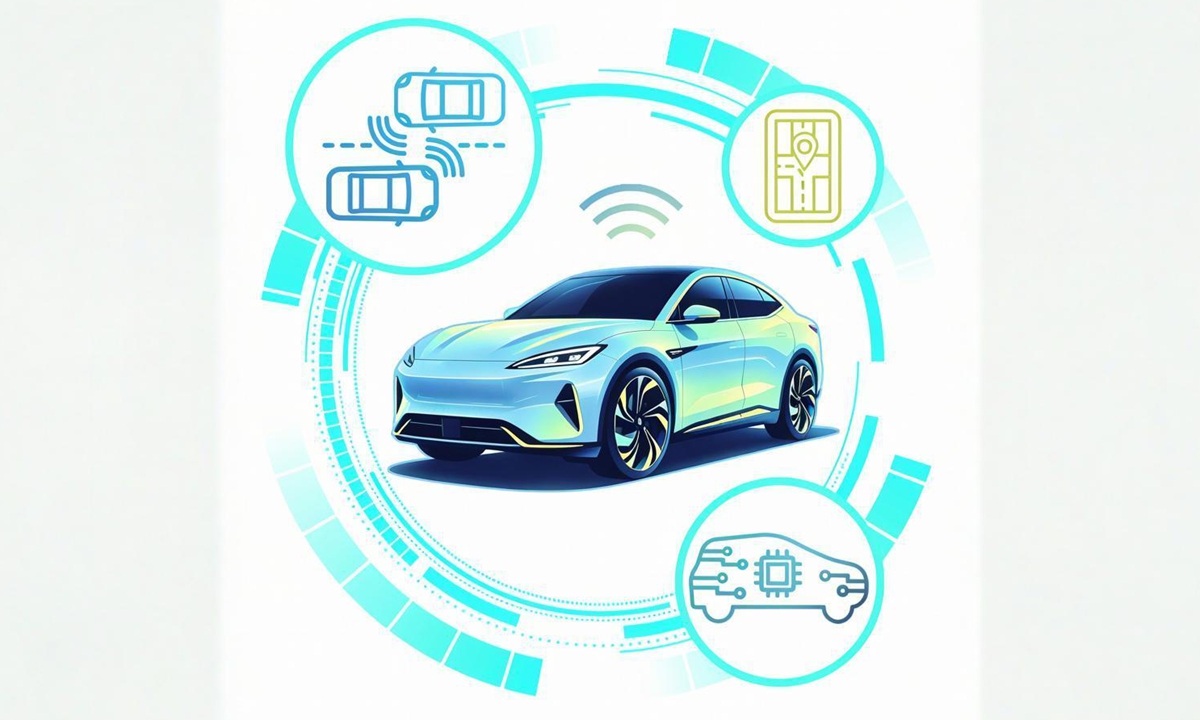
The trend reflects a combination of factors. Some industry experts interviewed by the media point to two main drivers. First, growing demand for longer driving ranges has prompted many manufacturers to equip vehicles with larger battery packs. Second, the broader adoption of intelligent technologies, including advanced driver-assistance systems (ADAS) and smart cockpit features, adds additional weight.
The rise in vehicle weight reflects a broader change in consumer expectations. Increasingly, Chinese buyers are looking for NEVs that go beyond basic transportation. Many now place greater emphasis on longer driving ranges, more sophisticated intelligent systems, and enhanced in-cabin experiences. Demand in China's NEV market is becoming more varied and nuanced.
This evolution points to several underlying trends. On one hand, it reflects the broader adoption of NEVs and the way consumer demand is evolving in tandem. The Ministry of Transport estimated that during the recent May Day holidays, traffic on the country's highways averaged about 64 million vehicles daily, of which roughly 15.4 million were NEVs - up 33 percent from the same period last year. As more NEVs are used for longer-distance travel, expectations for driving range are rising accordingly. As NEVs become more embedded in everyday life, demand for enhanced features and capabilities continues to build.
On the other hand, as Chinese consumers grow more accustomed to fully electric vehicles (EVs), some who previously favored higher-end conventional fuel cars are now adopting EVs. This has increased demand for higher-quality features, including ADAS and other intelligent technologies.
Taken together, the rising weight of NEVs reflects evolving consumer preferences, with buyers seeking vehicles that are better equipped, safer, and more capable. The trend also indicates that China's NEV market remains active even as it matures, with continuing growth in demand. Expectations for longer driving ranges and higher-end features are likely to support further development and expansion of the country's EV sector in the years ahead.
The rise in vehicle weight also suggests that NEV manufacturers are responding, at least in part, to shifts in demand and evolving consumer preferences. In terms of driving range, Cui Dongshu, secretary-general of the China Passenger Car Association, said in an April article that the average range of newly listed battery electric passenger vehicles reached 579 kilometers in April 2026, up from 523 kilometers in 2025, while the number of models with a range of more than 700 kilometers continued to rise, pointing to steady technological progress in this segment.
Beyond driving range, a variety of design elements and equipment features are being steadily enhanced. Hidden door handles, display screens, and panoramic sunroofs are being adopted in different NEV models. At the same time, advances in artificial intelligence (AI) are enabling the introduction of new in-vehicle applications and functions, with manufacturers gradually expanding the range of intelligent features available to consumers.
The increase in NEV weight reflects ongoing hardware upgrades by manufacturers. While this trend is likely to persist, it does not necessarily imply that vehicles will continue to become heavier indefinitely. Some observers have pointed out that rising vehicle weight can bring potential issues, which merit attention. However, as the industry continues to evolve and technologies advance, manufacturers are expected to keep adjusting their offerings, adjusting design and equipment choices to meet the needs of a maturing NEV market.
NEV weight, in this respect, offers a valuable lens through which to observe the rapid changes taking place in the industry. Market development is unlikely to follow a linear path, which is entirely normal in a rapidly evolving industry, but both manufacturers and consumer demand continue to evolve swiftly.
Some foreign commentary has tended to view the EV sector through a relatively static lens, portraying it as experiencing stagnant demand and a replication of production capacity, which could lead to so-called "overcapacity." This interpretation, however, is incorrect. In practice, both demand and production in China's EV market continue to develop at a steady pace.
Consumer expectations are shifting, and manufacturers are actively responding with products that better align with these evolving requirements. This ongoing adjustment between demand and supply suggests that China's NEV sector still has substantial room for further development in the years ahead.
The author is a reporter with the Global Times. bizopinion@globaltimes.com.cn
RELATED ARTICLES