Photo: Screenshot from CCTV
Chinese scientists have taken a major step toward building a “space power bank” – a solar power station that can store energy and transmit to space and ground devices – by completing the ground verification for a wireless power transmission system capable of beaming kilowatt-level energy to multiple moving targets simultaneously, China Central Television (CCTV) reported on Sunday.
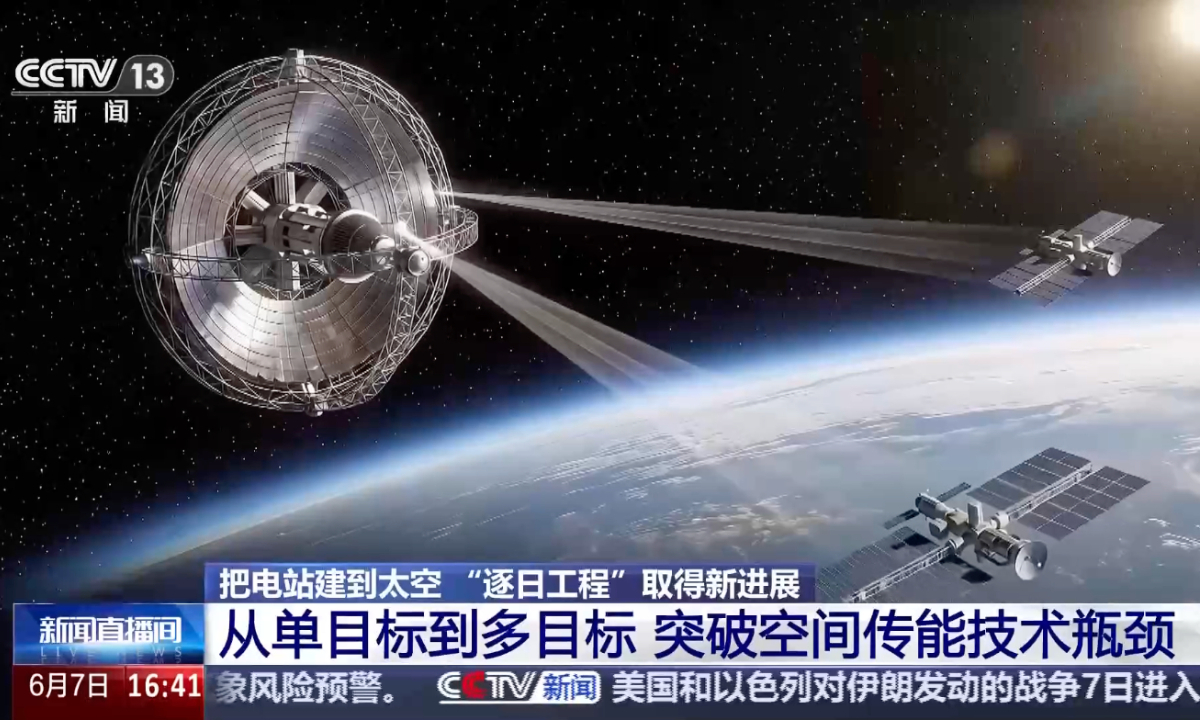
The project focused on harnessing space energy resources is expected to transmit electricity generated in the space “wirelessly” through the air to ground-based equipment, drones, satellites, and even future deep-space spacecraft.
A space solar power station would place large photovoltaic panels in space, where there is no atmospheric interference and no day-night cycle, to continuously harvest sunlight and transmit energy wirelessly to other equipment.
A research team led by Duan Baoyan, professor from Xidian University and an academician of the Chinese Academy of Engineering, has made significant progress on the “Zhuri” project, which literally means “sun chasing” in Chinese.
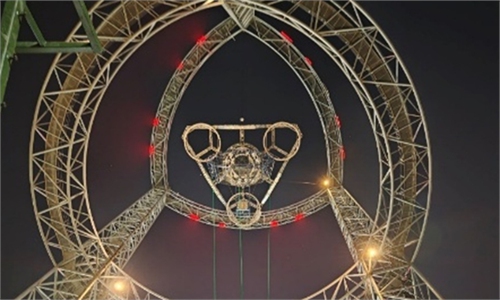
They developed a ground-based test system for wireless power transmission that can charge multiple moving targets at the same time, and successfully tested the ability of the 75-meter-high facility built on the university campus which was designed to test the whole energy transmission process on Earth before any orbital deployment.
In early 2022, the research team completed the world’s first full-link, full-system ground verification system for a space solar power station. They successfully demonstrated the entire process – from solar energy collection, photovoltaic conversion, and microwave transmission to wireless power transfer through space and final reception, rectification, and power output.
After nearly four years of development, the Zhuri Project has upgraded from previous fixed point-to-point wireless power transmission to beam power to multiple moving targets simultaneously, CCTV reported.
In reality, spacecraft and ground devices are constantly moving, fixed-point wireless power transmission is impractical. The latest breakthrough enables a single system to accurately deliver power to multiple fast-moving targets at the same time – akin to hitting several distant moving targets in complete darkness, according to CCTV.
The research team encountered numerous challenges in the early stages of development, with targets frequently being lost and transmission beams often deviating from their intended paths. To overcome these problems, the team carried out research to improve the control system, CCTV reported.
In recent tests, the system achieved a wireless power transmission efficiency of 20.8 percent from direct current to direct current over a distance of 100 meters, and delivered 1,180 watts of power, per CCTV.
According to Fan Guanheng, associate professor from the School of Mechano-Electronic Engineering, Xidian University, the construction of space-based solar power stations could potentially enable abundant and readily available electricity. By collecting solar energy continuously in space, 24 hours a day, solar power stations could provide a constant and uninterrupted power supply.
“In addition, such systems could reduce our reliance on fossil fuels and help lower carbon emissions and protect the environment. They could also support the development of ‘charging stations’ in space, transforming how spacecraft are powered,” Fan said.
Global Times
RELATED ARTICLES