Chinese companies play major role in 2026 World Cup with innovation
International sports arena likely to see more Chinese technology: analyst
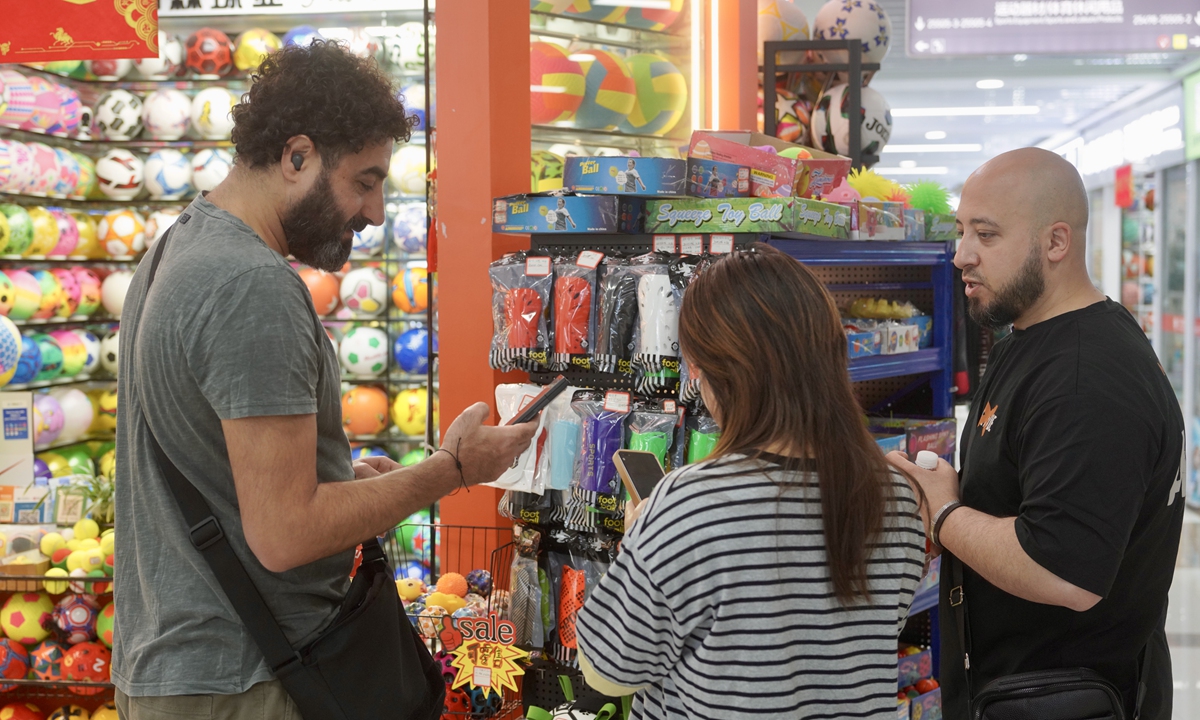
Foreign buyers inquire about football shin guards in a shop in Yiwu, East China's Zhejiang Province on April 21, 2026. With the 2026 FIFA World Cup set to kick off on June 11 and run through July 19, football fever has driven a steady increase in orders for related products in Yiwu. Photo: VCG
Set to be held in the US, Canada and Mexico from June 11 to July 19, this year's World Cup tournament will see 48 teams contesting for the first time in the tournament's history. Although the Chinese men's national soccer team did not qualify for the World Cup, the country's presence will be palpable.
With less than a week before kickoff, this year's World Cup has yet to generate strong buzz in China, possibly due to time zone differences and other factors. But there is no such lag for Chinese companies, which are already engaging with the event at a higher and more advanced level.
China's footprint at this year's World Cup highlights a shift from low-cost manufacturing to stylish, original designs, alongside the contribution of Chinese referees and officiating technologies. This evolving role is driven by innovation and advanced technology. Guy-Laurent Epstein, UEFA events marketing director, told the People's Daily that Chinese companies are no longer mere commercial sponsors buying ad space, but are instead bringing cutting-edge technological innovations directly into UEFA's tournament systems.
Upgraded innovation
In Yiwu, the world's supermarket in East China's Zhejiang Province, brightly colored commemorative soccer balls stand out vividly. Chen Shaomei, manager of Minsa Sports in the Yiwu International Trade Market showed the Global Times their popular overseas bestseller - a commemorative soccer ball designed with the signature colors of the three host countries: the US, Canada, and Mexico.
"This is our self-designed, self-manufactured, and self-branded commemorative ball," Chen told the Global Times on Sunday.
This is the sixth World Cup that Chen has participated in as a merchant. Chen's company has been deeply engaged in the ball industry for many years, with 90 percent of its products exported overseas.
Chen said Chinese manufacturing, including that of Yiwu, has moved beyond competing primarily on price and now stands out through creative design and higher-quality advantages. "Our greatest strength lies in our unique designs," he noted.
Beijing-based sports and e-commerce retail company All Star Partner secured official World Cup licensing rights for multiple popular national teams. Jin Ye, chief operating officer of the company, told the Global Times on Sunday that truly vibrant and enduring products must integrate team culture, fans' emotions, and real-life usage scenarios.
"Fans cannot express their passion only inside the stadium - they showcase their identity while shopping, traveling, going to school, commuting, attending parties, and sharing on social platforms. Therefore, we are developing more lifestyle-oriented products such as casual T-shirts, hats, bags, plush pendants, cups, neck pillows, canvas shoes, and more, allowing national team IPs to truly become part of everyday life," Jin said.
In the past, when people thought of Chinese companies participating in international sports events, they mainly associated them with manufacturing and supply chain capabilities. However, soon Chinese enterprises will not only be capable of producing products, but also of participating in design, brand expression, and user engagement - thereby influencing the commercialization strategies of international IPs in the Chinese and broader Asian markets in return, Jin noted.
The export sports enterprise Kelme, leveraging its strong technological innovation advantages, will be the official jersey sponsor for the national teams of Jordan and Bosnia and Herzegovina, according to Fujian Daily.
"We use new functional sports fabrics that give the jerseys multiple advantages, including moisture absorption, quick drying, and excellent breathability. The entire jersey weighs less than 140 grams, making it lightweight, form-fitting, and skin-friendly. Professional players have praised it as 'breathing armor,'" said Yang Yuanchang, deputy director of the international marketing department of the company, Fujian Daily reported.
Hu Qimu, a professor at the Maritime Silk Road Institute of Huaqiao University, told the Global Times on Sunday that these creative products not only enrich the supply of the World Cup, but also serve as a vivid reflection of the country's industrial transformation and upgrading.
"From relying primarily on price competition in the past to now shifting toward creative design and independent branding, Chinese enterprises have enhanced their competitiveness through continuous innovation," Hu said.
High-tech support
Beyond this presence, some Chinese technology companies are building a solid "technological foundation" for the tournament.
As FIFA's Official Technology Partner, Lenovo is providing AI equipment, services, and solutions for this World Cup. According to a statement sent to the Global Times on Sunday, the company said that during the event, its 3D Digital Human Visualization Solution will be officially applied to the refereeing system and event broadcasting.
The system uses 3D modeling and next-generation generative AI technology to create 3D virtual avatars for the players of this tournament. Particularly in offside replay segments, they offer both on-site and online audiences more intuitive visual interpretations, while accurately replicating each player's body dimensions and features, greatly enhancing the credibility and transparency of refereeing decisions, said the company.
As the "media heart" of this World Cup, the 2026 FIFA World Cup International Broadcast Centre, located in Dallas, the US, has selected Hisense as its dedicated display equipment provider.
The company told the Global Times that Hisense's technology accurately reproduces every detail of the on-field action, which will assist Video Assistant Referees in making precise decisions and supporting high-quality event broadcasting.
Hu noted that the participation model of Chinese companies in major sporting events has evolved from an early focus on seeking exposure to applying their technologies in real overseas scenarios.
International media outlets including Reuters have also observed that Chinese companies are undergoing a major transformation in their role at top-tier international sporting events, evolving from peripheral merchandise suppliers into key providers of core technological infrastructure, the People's Daily reported.
Hu noted that Chinese enterprises are not only achieving brand promotion and business expansion through sports marketing, but are also leveraging their capabilities to provide high-quality products and drive improvements in event organization.
As Chinese companies participate more deeply in top-tier international events, the future international sports arena is likely to see more "Chinese technology" and "Chinese solutions," the expert added.
RELATED ARTICLES