China, EU to discuss establishing trade and investment consultation mechanism: source
Trade official’s visit to EU highlights China’s willingness to solve problems through dialogue and consultation: analyst
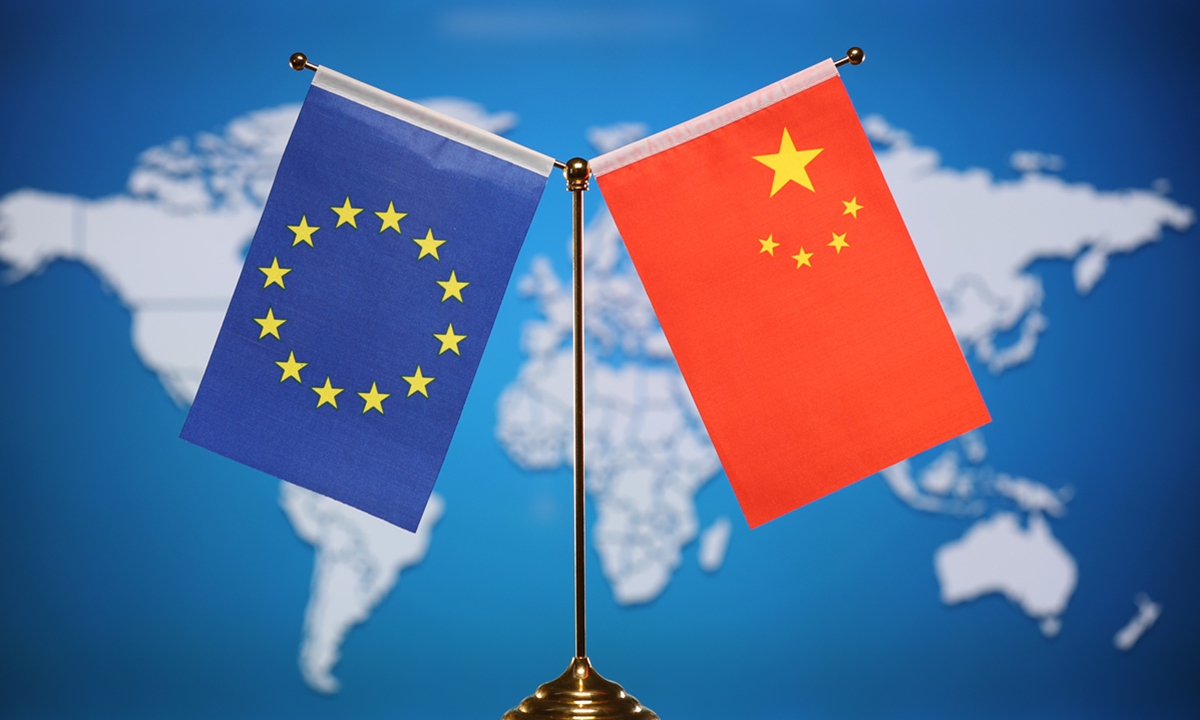
China EU Photo:VCG
Amid concerns over escalating China-EU trade and economic tensions, fresh progress is set to be made between the two sides in resolving issues through dialogue with the establishment of a consultation mechanism.
Chinese Vice Minister of Commerce Ling Ji is visiting the EU headquarters from June 9 to 14 to discuss with European officials the relevant arrangements for establishing the China-EU Trade and Investment Consultation Mechanism (TIC), the Global Times learned from a source who is familiar with the situation.
Earlier on May 30, in response to a question regarding the European Commission's recent discussion on relations with China, a Ministry of Commerce (MOFCOM) spokesperson said that the communication channels between China and the EU remain open, and both sides are exploring the establishment of a trade and investment consultation mechanism and will hold relevant dialogue.
Recently, some observers have expressed the belief that the risk of a "trade war" is on the rise between China and the EU amid growing trade frictions. Against this backdrop, it is necessary to establish the China-EU Trade and Investment Consultation Mechanism to maintain the stability and certainty of bilateral economic and trade relations, analysts said.
During his visit to the EU, Ling will hold talks with Ditte Juul Jorgensen, Director-General of the Directorate-General for Trade and Economic Security at the European Commission and other EU officials.
This move demonstrates China's willingness in implementing the consensus of China-EU leaders and properly handling differences and frictions through dialogue and consultation, according to the insider, who declined to be named.
China and the EU have maintained communication on bilateral economic and trade issues. On Thursday, Li Chenggang, China international trade representative with the Ministry of Commerce and vice minister of commerce, met with Sefcovic in Paris. The two sides had in-depth exchanges on WTO reform and China-EU economic and trade relations, according to China's Ministry of Commerce (MOFCOM).
Chinese Minister of Commerce Wang Wentao is also expected to visit the EU headquarters at the end of June for talks with Sefcovic, per a report by the South China Morning Post.
The Global Times has learned that Ling's trip to Europe will prepare for Minister Wang's meeting with Sefcovic in the EU.
Not ruling out dialogue
While the European side has repeatedly said it will introduce new trade instruments, it has not ruled out communication and dialogue with China, according to media reports.
On May 29, after a college orientation debate on relations with China, the EC issued a statement saying its overarching approach remains de-risking, not decoupling. The commission also stressed that China is a crucial partner for the EU, and engagement and dialogue will continue.
In handling China-EU economic and trade relations, China has consistently advocated to properly resolving trade differences through dialogue and consultation.
On Friday, Chinese Foreign Ministry spokesperson Mao Ning said that China has repeatedly stated its position recently and is willing to engage in dialogue and communication with the EU. Mao also expressed hopes that the EU would abide by the basic principles of the market economy such as free trade, fair competition, and open cooperation, avoid protectionist measures, and insist on addressing differences and resolving concerns through dialogue and consultation.
Dong Yifan, an associate researcher at the Institute of Country and Regional Studies at Beijing Language and Culture University, told the Global Times that as two major global economies, it is normal for China and the EU to have some degree of economic and trade differences and frictions but "the key lies in properly handling differences and finding the right way to resolve problems."
"I understand that during the 14th WTO Ministerial Conference (MC14) at the end of March this year, the European side proactively proposed to China the establishment of a trade and investment consultation mechanism, and the two sides have since maintained communication on this matter," Dong said.
Dong believes that the EU's agreement to establish a consultation mechanism with China also proves the EU's willingness to maintain dialogue with China. In particular, the statement after the EC's meeting on May 29 confirms that the EU attaches great importance to its economic and trade relations with China and is inclined to solve problems through dialogue.
"Next, the two sides will discuss how to define and implement this mechanism, thereby effectively managing and resolving differences," the expert said.
Dong further noted that the root cause of the industrial problems currently facing the EU does not lie with China, and adopting trade protectionist measures and artificially disrupting the industrial and supply chain cooperation between China and the EU will only make the problems worse.
The industrial structures of China and the EU are highly complementary. Working together to create an open, stable, and predictable environment for cooperation will not only help enterprises on the both sides enhance their global competitiveness but also promote higher-level mutual benefit and win-win outcomes, Dong noted.
The expert hopes that the EU will work with China in the same direction to promote the stable and healthy development of China-EU economic and trade relations.
RELATED ARTICLES